
There are a lot of people walking around with a badge, a carry permit, or both, who have never actually been taught to shoot. They’ve been taught to qualify. Those are not the same thing.
Paul Costa has spent nearly two decades in law enforcement watching that gap up close. As an assistant range master responsible for firearms training for over 700 officers, he had a front-row seat to what institutional training produces: people who can pass a course of fire on a known range, under no stress, with no time pressure that matters, and who haven’t meaningfully developed as shooters in years.
He decided somebody needed to close that gap.
The Institutional Training Problem Nobody Wants to Talk About
Paul Costa isn’t speaking from the outside looking in. After seven years managing ranges and training patrol officers, responsible for firearms qualifications for over 700 officers, he moved into special operations, where he’s spent the last twelve years as a full-time special operations canine handler. High-risk warrant service, hostage rescue, barricaded subject incidents, and fugitive apprehension with federal and local SWAT teams across the Tri-State area. He’s a deputized U.S. Marshal Task Force Officer. He’s worked alongside DEA and FBI regional teams.
He’s also watched officers go through qualification after qualification without meaningfully improving as shooters — and that bothers him.
“They need it,” he says of law enforcement training. “It requires guys with this knowledge to start putting it out there so we can change the overall capabilities of our protectors.”
The competitive shooting world has spent decades conducting rigorous, data-driven research into how humans can be trained to shoot faster and more accurately.
Most police departments haven’t kept pace. The result is officers who can pass a qual course and not much else.
What Competition Actually Teaches You
A few years ago, Costa started competing in USPSA. Within a year, he climbed from unclassified to Master Class in Carry Optics, the 85th to 94th percentile of competitive shooters nationwide. He currently shoots at least one match per month across USPSA, PCSL, and Hit Factor formats.
That’s not a humble brag. It’s a data point.
Costa didn’t pursue competitive shooting to collect trophies. He pursued it because he understood something that a lot of people in the defensive firearms world miss: competition is a pressure-tested laboratory for developing real skill, and the lessons it generates are directly applicable to anyone who carries a gun for serious purposes.
“Speed and accuracy are not competing concepts,” he says. “People view them as one or the other. We show them how both can be accomplished at the same time. Just because you’re shooting fast doesn’t mean you can’t be accurate — and that’s exactly what’s required when you’re using these guns in a defensive capacity.”
This is the kind of thing that sounds obvious until you realize how many programs are still teaching people to choose between fast and accurate, as though marksmanship is a binary dial rather than a skill with a ceiling worth pursuing.
Costa’s approach is to apply competitive training methodology, the stuff that actually works, to the people who actually need it: cops, SWAT operators, military personnel, and armed civilians who take their responsibility seriously.
Process Over Outcome
One thing Paul emphasizes that’s worth sitting with: the goal isn’t a rank or a classification. The goal is a process.
“Master Class is essentially top ten percentile across all of competitive shooting. Grand Master would be great, but it’s not necessary. I got the ranking I wanted to establish, and now I try to stay process-oriented and let the chips fall where they fall.”
That mindset, drilling down on fundamentals, trusting the process, letting performance metrics emerge from good practice rather than chasing them directly, is the same framework he brings to instruction. He’s not teaching people to game a qual course. He’s teaching them to actually shoot.
He also teaches students to understand their own shooting. To develop awareness. To identify what they’re paying attention to and why. The goal is for students to be able to diagnose their own errors and train themselves effectively when no instructor is around, because the instructor won’t be there when it counts.
Why This Matters
The Second Amendment community talks a lot about being prepared. About taking responsibility for your own safety. About not being a soft target.
Most of that talk doesn’t get followed up with the work.
Firearms training, real training, not just putting holes in paper at 7 yards, is where it’s at. Understanding the mechanics of your trigger press, building a draw that’s consistent under stress, learning to move and shoot without compromising accuracy: these are skills. They’re learnable. They require instruction from people who actually know what they’re doing.
Paul Costa is one of those people. He’s still on the job full-time, still competing monthly, and still instructing for Achilles Heel Tactical on top of all of it, logging thousands of miles to put quality training in front of the people who need it most. He is adamant on one point above all others: if a law enforcement officer ever finds themselves in the middle of a violent encounter, they deserve every possible advantage. Better training doesn’t just produce better shooters. It keeps cops alive.
The capability gap in how we train armed Americans, law enforcement, and civilians is a real problem. Instructors like Paul are among the people trying to close it.
If you carry a gun, you owe it to yourself to train with someone who’s actually developed a methodology worth following.
Not someone who took a class once and started teaching. Someone who has tested their approach operationally, refined it competitively, and built a track record of producing capable shooters.
More Training Resources on TTAG:
- Why Achilles Heel Tactical Built an Annual Training Pass—and Why It Isn’t for Everyone
- Achilles Heel Tactical One-Day Firearms Training Course Designed to Deliver Immediate Performance Gains
- Public Safety Isn’t About Laws — It’s About Time to Effective Resistance
- Indoor Range Drills – The RSO Can’t Say No



Shooting quail is fun and tasty but if you really want to get good blue winged teal hunting is better.
Those morning doves are the shits. I swear sometimes you’d think they can fly between the pellets.
Oh, I’m sorry this article is about practicing to kill people, I saw qual and thought quail.
Duh on me.
Killing people is a whole lot easier then killing coyotes.
“Oh, I’m sorry this article is about practicing to kill people”
No, it isn’t. Its about being prepared and proficiently stopping the threat – that’s not the same as just setting out to kill people. In fact, overall the threat rarely dies when stopped by defenders, a lot more rare than the number of lives the bad guys take from defenseless people.
“Killing people is a whole lot easier then killing coyotes.”
Subjectively, no it isn’t.
I’ve nailed some coyotes in the past. I’ve also on several occasions had to defend against bad guys. Its easier to shoot a coyote, they tend to stop and stand still for a bit at times if you get them at the right time so you can wait for that – bad guys you usually don’t have the advantage of waiting for the right time ’cause they decide when to strike and its usually with an element of surprise and they can get really active when you are defending against them. But, its subjective depending on the situation.
Saving your wife in a gun fight must have been traumatic.
You Sir have my acknowledgement.
I was just fooling around.
God bless you Booger.
Isn’t this the same argument against standardized testing? Police are essentially teaching to pass the required test and nothing more.
Incentives could take care of it. Time off to attend classes, ammo stipend, little pieces of ego boosting flair to encourage locker room competition, etc…
But you’ll get a shitload of pushback from bureaucrats, politicians with badges and probably even union reps because their members are already just sooooo tired and overworked.
If only those were the only factors that we had to deal with. I had two chiefs (municipal of small to mid size) disband their swat teams because they couldn’t be bothered to work out let alone shoot or train for scenarios. Nothing but respect for those two making the hard but right choices but it wrecked their grant process for a couple years.
The problem with standardized testing isn’t the standardization, it’s the chosen standardization not reflecting real-world competence. Usually this is by design.
Also known as the “tyranny of metrics”, it’s the habit of measuring something because it is easy to measure rather than because it tells you something useful and then pretending you know something useful because you have this measurement in hand.
Or, the entire thing is designed to produce an outcome via the illusion of “testing”.
Notice that in most cases where the job is the metal meeting the meat at a high level, such a problem doesn’t tend to exist. Funny, that. “Oh, you mean measuring the wrong thing might get me killed? Yeah, let’s measure the right thing and do it with accuracy and precision!” tends to be the prevailing attitude.
Where you do find the odd case of such an issue existing, it’s nearly always because someone with zero knowledge of the undertaking in question stuck their nose in and started mucking around because “fairness” or some other shit that has exactly nothing to do with said undertaking.
Combat training is designed to produce a predictable response to identified scenarios. NONE OF IT IS CONDUCTED WITH OPPOSING FIRE POWER. Same for competitive events.
No one ever knows how they will respond (regardless of type and amount of training) with bullets inbound to their location. Run, hide, cover, stand, shoot back, attack, which can you guarantee will be your personal response? Which skill will fail you: stance, grip, sight alignment, reload, acquire backup gun, knowing what is behind the obvious target,identification of all threats, identification of everyone and everything that is not a threat?
Note: Like actual military combat training, competitive events must be frequent; proper shooting is a perishable skill.
Yes, train, train, train again (as you can afford), never expect your training will fully effective when pew pew becomes PEW PEW.
S.I.A.
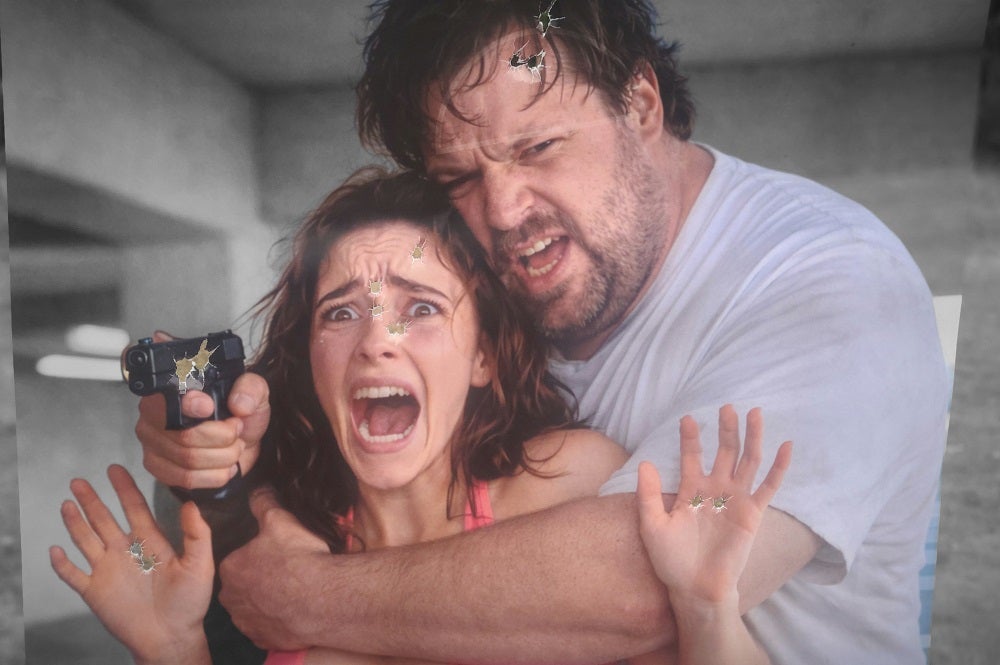
For added pucker factor, occasionally throw a hostage or two into your mix.
Good article.
“For added pucker factor, occasionally throw a hostage or two into your mix.”
Excellent recommendation; thanx.
…which can you guarantee will be your personal response?
Guarantee? Dude, this ain’t an IRS form. There’s no guarantees.
What there is, however, is statistical probability derived from experience with many repetitions. Which is to say that we can say with high confidence that certain behaviors in training will have a strong tendency to appear IRL when things are pear shaped.
Is it guaranteed that a Delta operator on his first mission won’t freeze and get shot dead? No. Is it a statistical likelihood worth discussing? Also, no. Homie was trained, trained and then trained some more in a situation where mistakes are not tolerated and everyone’s using live ammo. Two mistakes, or one major mistake, and he’s not in Delta anymore.
There’s a reason for this: It produces a statistically reliable product at the end of the pipeline. Guaranteed? No, because no QC is perfect. Very highly reliable to the point that it’s not worth discussing? Yup.
However, as we learned in Mogadishu, there’s also one hell of a lot of luck involved in two way ranges. Seasoned Delta operators take a 7.62×39 to the face from a 13 year old kid just like everyone else does if the kid happens to launch the round on the right trajectory.
My point, precisely. It’s all about objective expectation management. Being a former operator, or experienced competition shooter does not assuredly advantage the veterans of both. Nor the average shooter who takes only single “high speed, low drag” combat training class.
One wonders: how many defensive shootings involved former operators? How many defensive shootings involve average persons who is experienced in competitive shooting? How many defensive shootings involve persons who have neither experience? What was the success rate of each segment? What are the numbers of those segments that declared they would have been unsuccessful without combat operator, or competitive experience?
At the end of my comment, I wrote, “Train, train, train”, and thoroughly understand what you getting, what you can depend on.
Personally, I suspect rather strongly that “training” past the ultra-basics is overrated unless your job is carrying a gun and chasing bad guys.
There are plenty of police reports where an old lady with nearly zero firearms experienced DRT’ed a bad guy breaking into her house with her dead husband’s pistol/revolver that she hadn’t seen in a decade but knew the location of. Generally, she doesn’t magdump, or even cylinderdump the guy either.
Those Somali kids didn’t need much training to kill Delta guys. Though, to be fair, the kids probably had a fuckton of khat onboard.
Gun people have a hobby. We tend to talk it up and act like it’s way, way, way more difficult than it really is.
Which is not to say that training = bad but let’s be real here: A lot of training is shooting and what do we like to do? Oh yeah, shooting. Funny, that.
We don’t realize how that comes across to noobs, novices or normies or how much of it is just marketing, again, because we like it.
You wrote it better than I.
What I’d like to see is much along the lines of what the author discusses, but with national standards that all law enforcement officers must meet. Height and weight standards similar to the military, education standards to be met for advancement, real world training in conflict deescalation, and of course, how to really act in threat circumstances. I am not talking about nationalizing the police, just making it as professional as we can so that every one of us can trust them to do the right thing all of the time. Incidents like DUI arrests for those who test 0 on breath and blood tests, traffic stops that turn into much more without probable cause, wrong address no-knock warrants, corruption, failure to support other legal agencies, etc., all contribute to a public that has lost faith in what should be our most honorable and trusted institutions.
Same is true of field vs. range shooting…I have killed over 3,000 bounties including everything that bothers millions of chickens…crows and little furry things not included but still whacked. Shooting coyotes was routine after all that practice. The same is not true of range practice…no realistic moving targets. If they had thumbs, coyotes would certainly shoot back and they’d probably rub most of the Keystone cops out.
Humans also have few protective instincts, so the coyotes had an advantage but still took .308s and in the Hefty for fifty they went. That’s how US snipers get such huge kill counts from a single soldier, they are shooting “dumb people” not highly instinctive animals. By the way: The best bait for coyotes in the desert is Marie Calendar pie pans of water…no canine will pass up a drink when it’s 100+ degrees. And if bounties or something is worth shooting, it’s worth shooting with a 308…and if it’s worth shooting with a .308, then it’s worth two rounds to make sure. So I shot every bounty twice even if down before driving out to pick up the carcasses as an “investment”.
The last thing a human predator should do is mess with a predator hunter.