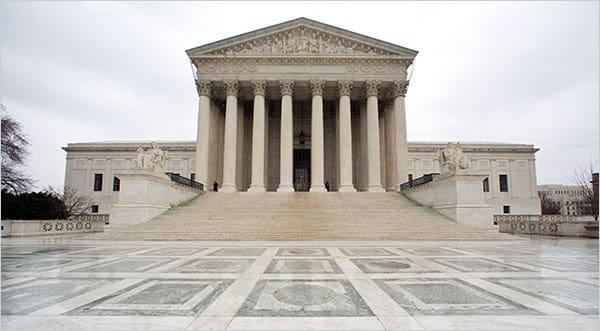
A new Marquette Law School survey has yielded interesting information on bans on so-called “assault weapons,” which will be considered by the U.S. Supreme Court next session, along with important data on how Americans view the Supreme Court.
This fall, the Supreme Court will hear the consolidated cases Viramontes v. Cook County and Grant v. Higgins, challenging bans on common semi-automatic rifles in Cook County, Illinois, and the state of Connecticut. And according to the new Marquette poll, thoughts on how the court should rule on the topic are pretty evenly split.
The question presented, unlike in many such polls, was written in an unbiased way: “The U.S. Supreme Court will hear a case asking whether the 2nd Amendment guarantees the right to possess AR-15 and similar semi-automatic rifles. Do you think the Supreme Court should rule there is a constitutional right to possess AR-15 and similar rifles or that there is not a right to these kinds of rifles?
The answers were closely divided, with 52% saying the court should rule that there is not a constitutional right to these rifles, and 48% saying it should rule that there is. Digging deeper into the Demographics, however, showed where the divide widens.
Among Republicans, 72% responded that the court should rule there is a right to own such rifles, with 28% answering no. But among Democrats, 74% believe there is not a right to own AR-15s and other common semi-autos, and only 26% believed there was. Among Independents, the responses were even closer than the general population, with a 49%-to-51% split, with the edge going to no constitutional right to own such firearms.
It’s important to note that on such an important Constitutional question, it really doesn’t matter what public opinion polls show. The only thing that matters is what the nine Supreme Court justices decide.
While support for the bans might be split among the people polled by Marquette University, the U.S. Department of Justice has come down squarely on the side of SCOTUS, which ruled the bans unconstitutional. On September 4, the DOJ filed an amicus brief in support of the plaintiffs in the challenge.
“The right to keep and bear arms guaranteed by the Second Amendment is among the ‘fundamental rights necessary to our system of ordered liberty,’” the DOJ explained in the brief. “Millions of Americans exercise that right by owning an AR-15 rifle, which is ‘the most popular rifle in the country.’ Yet the State of Connecticut and Cook County, Illinois, have made the possession of AR-15s a crime.”
While the assault weapons responses were interesting, responses about whether Americans trust the Supreme Court showed support for the court continues to fall. Concerning the question, “In general, what most often motivates Supreme Court justices’ decisions?” 57% of respondents answered “politics,” while only 42% answered “mainly the law.” And the number of respondents who believe rulings are based on politics has increased by 4% over the past year and a half.
Broken down among party lines, more Republicans believe justices are mainly motivated by the law, 59%, with 41% saying politics. Among independents, 54% say politics motivates the justices, as do 74% of Democrats.
The national survey was conducted September 2-9. Interviews were conducted using the SSRS Opinion Panel, a national probability sample with interviews conducted online.