

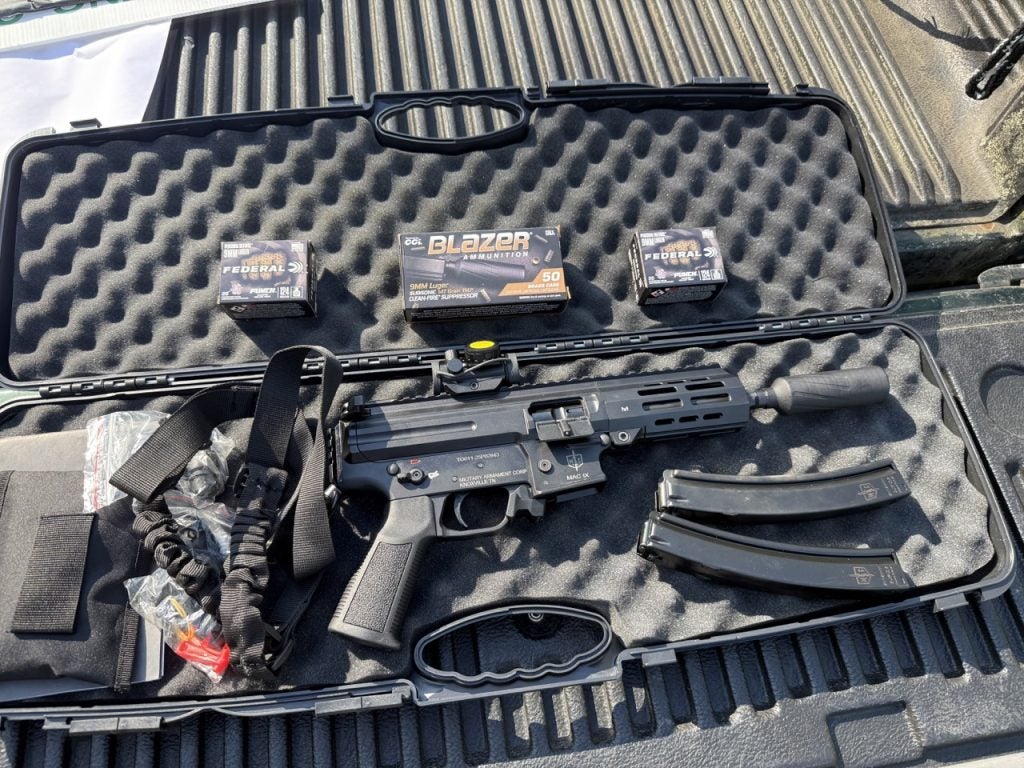
When the MAC IX showed up at my door, the first thing I noticed was the hard case it came in. Not a bag, not a soft sleeve with a zipper that will fail in two years. A real, lockable hard case. Inside, along with the pistol itself, you get two MP5-pattern magazines, a sling, a cleaning kit, a flash hider, and an owner’s manual.
For a firearm sitting at $797 MSRP, that’s a solid unboxing experience. Military Armament Corporation, an SDS Arms brand designed and built out of Knoxville, Tennessee, clearly put thought into packaging this thing for shooters who want to get to the range without a pit stop at the gun store first.
Pick up the MAC IX, and the first thing you notice is how compact and light it is. At just 5.10 pounds and 15.97 inches in overall length, it has the footprint of a serious PDW without the paperwork headaches that come with going the SBR route. It feels dense and purposeful in the hand, not cheap or hollow.
Pistol, PCC, or Both?
Before going further, it’s worth clarifying what the MAC IX actually is, because the terminology gets a little slippery with a gun like this. The MAC IX is legally classified as a pistol. It ships without a stock, and a rear 1913 Picatinny rail accommodates a pistol brace if you want to add one. MAC markets it as a PCC, and the firearms community broadly uses that term to describe this category of large-format pistols built around a pistol caliber. Both descriptions are accurate in their own context. Think of it this way: it’s a pistol by legal classification and a PCC by purpose and platform design.
That distinction matters for a couple of reasons. First, you take it home without any additional NFA paperwork. Second, if you eventually want to add a stock and go the SBR route, that rear rail is already there waiting for you. It’s a platform that gives you options, and that’s part of the MAC IX’s appeal.

Build Quality and Materials
The MAC IX features a 7075-T6 aluminum receiver finished in black anodize, which is not a material choice you typically see at this price point. That alloy is the same spec used on quality AR-platform uppers, and it’s a meaningful upgrade over cast or lower-grade aluminum. The lower is hard-coat anodized 6061, and the bolt runs a nitrided finish with steel reinforcements throughout, which tells you MAC built this to handle round counts beyond casual range days.
The M-LOK handguard is functional and clean, giving you real estate for lights, lasers, or a forward grip without adding unnecessary bulk. Running above it is a full-length Picatinny rail that provides uninterrupted mounting space from the front sight all the way back to the receiver. Everything on this platform has a purpose, and nothing feels tacked on.
Operating System and Controls
The MAC IX runs a direct blowback design, which is about as mechanically simple as it gets in the semi-auto world. Fewer parts mean fewer things that can go wrong, and in a 9mm platform, this operating system has a long track record of eating round after round without complaint. Recoil is soft and manageable. Follow-up shots come naturally.
The controls are a genuine highlight. You get an ambidextrous charging handle, ambidextrous safety levers, and a flared magwell for faster reloads. The magazine release is dual-function, offering both an HK-style paddle release and an AR-style button. That combination alone is worth calling out specifically, because it means you can run the gun the way you prefer without any modification.
The MP5 Magazine Advantage
One of the smartest decisions MAC made with the IX was building it around MP5-pattern magazines. This matters more than it might seem at first glance. MP5 magazines are widely available from multiple manufacturers, reasonably priced, and backed by decades of proven reliability. You are not locked into a proprietary magazine ecosystem where you pay a premium for a single-source product. The two magazines that ship with the gun are curved 30-round metal units, and MAC also offers a bolt-hold-open version of that magazine for a few dollars more, which is a worthwhile upgrade for extended range work.
Suppressor Ready From the Factory
The barrel is threaded 1/2×28 and comes with a machined tri-lug adapter installed, so you can run a direct-thread suppressor or a tri-lug-mounted can right out of the box with zero additional hardware. That is not a minor detail. Many budget-friendly pistols in this category treat suppressor compatibility as an afterthought. The MAC IX treats it as a core feature, and the platform is genuinely set up to excel in that role. Subsonic 9mm through a good suppressor on a direct blowback platform is one of the more enjoyable shooting experiences available, and the MAC IX is positioned to deliver that with minimal additional investment.
Running the Bushnell Trophy TRS-25 on the MAC IX
Factory-adjustable front and rear sights are included in the kit and come ready for installation. Most shooters will eventually put a red dot on that rail, but the iron sights are there if needed. I had a little trouble installing the front sight and chose to just run the red dot from the start.
I mounted a Bushnell Trophy TRS-25 red dot for my testing, and it’s a great budget optic pairing for a gun in this price range. The TRS-25 runs around $80 street price, and while some reviewers turn their nose up at it, I’ve had good experiences with this little sight and I wanted to see how it played with the MAC IX’s full-length Picatinny rail. Short answer: it plays very well.

The TRS-25 dropped right onto the rail with no fitment issues, sitting low enough to provide a natural cheek weld without any riser. The 3 MOA dot is crisp and clear at typical engagement distances, and for shooting inside 50 yards, which is exactly where this platform lives, it gives you everything you need to shoot fast and accurately. I ran a mix of drills at 10, 15, and 25 yards, and the combination of the MAC IX’s soft recoil and the TRS-25’s forgiving eye box made staying on target between shots genuinely easy. The gun barely moves, and the dot just sits there waiting for you when you come back on target.
Zero held consistently throughout my range session, which matters more than people give it credit for on a blowback-operated gun. Direct blowback actions generate a sharper, snappier recoil impulse than a delayed system, and some budget optics will walk their zero under sustained fire. The TRS-25 didn’t budge. I ran through both included magazines multiple times and went back to my zero target at the end of the session to confirm. Impacts stayed exactly where I had dialed them.

One thing worth noting is that the TRS-25 is not a large optic, and on the MAC IX’s extended rail, it looks almost comically small, which I found oddly charming. It’s the kind of setup that makes other shooters at the range ask questions. If you want to dress this gun up with something bigger and more capable, the rail will absolutely accommodate it. But for a pure functionality-per-dollar argument, the TRS-25 on the MAC IX is a hard combination to argue against. You’re all-in under $900 with a capable, suppressor-ready 9mm pistol and a reliable red dot that will not let you down.
Accuracy and Range Performance
At the distances where a 9mm pistol-caliber platform lives, the MAC IX performs exactly as expected. The 6.5-inch barrel contributes to higher velocity than a handgun, and the longer sight radius makes precise shot placement more accessible to a wider range of shooters. Drills run smoothly. The trigger is better than you expect at this price, with a pull that is consistent and predictable rather than gritty or stacked. I tested three different types of ammo and ran over 300 rounds through the platform with no issues.
First, I tested the practical accuracy on steel targets from a standing position. The results were consistent and better than expected for a direct blowback pistol without a pistol brace. The included strap helped me hold the pistol steady on the target more than I thought it would.

Next, I ran three loads through the MAC IX for group testing, shooting five-shot groups at 25 yards from a supported position.
Blazer’s 147-grain TMJ Subsonic, a natural choice for suppressed use given its below-sonic velocity, turned in an average group size of 1.89 inches. Federal’s 124-grain Punch, one of the better purpose-built personal defense loads on the market, came in just a touch tighter at 1.76 inches. The best performance of the day went to Federal’s 147-grain HST, a load that has earned its reputation as one of the gold standards in 9mm defensive ammunition, which grouped at 1.72 inches.
All three loads fed and ejected without a single hiccup. The MAC IX did not play favorites with any of them, and the spread between best and worst group was less than two-tenths of an inch. For a pistol in this price range, that kind of consistency across multiple load types is impressive and speaks well to the quality of that cold-hammer-forged barrel.
Who Should Buy the MAC IX?
This is the right gun for a specific kind of buyer. If you want an MP5 experience without spending MP5 money, the MAC IX gets you very close to that feeling with a more modern ergonomic package and a lower parts-and-ammo cost of ownership. It is a natural fit as a suppressor host, a home defense option, or a competition shooter getting started in the pistol-caliber carbine world. The modular platform means you can add a brace, mount a light and red dot, and have a highly capable setup without spending far beyond the base gun’s price. And if you decide down the road that you want a proper stock and are willing to go through the Form 1 process, the rear rail makes that path straightforward.
The Bottom Line
At a price that comes in well below most name-brand PCCs or MP5 clones, you have budget left over for optics, lights, or ammo. The MAC IX is not a compromised budget gun that makes you wince when you think about the parts. It is a thoughtfully designed, well-built 9mm pistol that happens to be priced at a level working shooters can actually afford. The suppressor-ready setup, quality materials, MP5 magazine compatibility, and solid ergonomics make it a platform that earns its place in the safe on merit, not just on price. If you are in the market for a modular 9mm pistol built for PCC-style use and the MAC IX is on your radar, it deserves serious consideration.
Specifications:
- Caliber: 9mm Luger
- Action: Direct Blowback, Semi-Automatic
- Barrel Length: 6.5 inches
- Thread Pattern: 1/2×28 with Tri-Lug
- Overall Length: 15.97 inches
- Weight: 5.10 lbs
- Magazine Capacity: 30 rounds
- Magazine Compatibility: MP5/MAC-5 pattern
- Receiver: 7075-T6 aluminum upper, 6061 lower
- Finish: Black anodized
- Handguard: M-LOK
- Rail: Full-length Picatinny
- MSRP: $797
- Website: milarmamentcorp.com
Performance
| Ammunition | Average Group Size (5 shots, 25 yards) |
| Blazer 147 grain TMJ Subsonic | 1.89″ |
| Federal 124 grain Punch | 1.76″ |
| Federal 147 grain HST | 1.72″ |

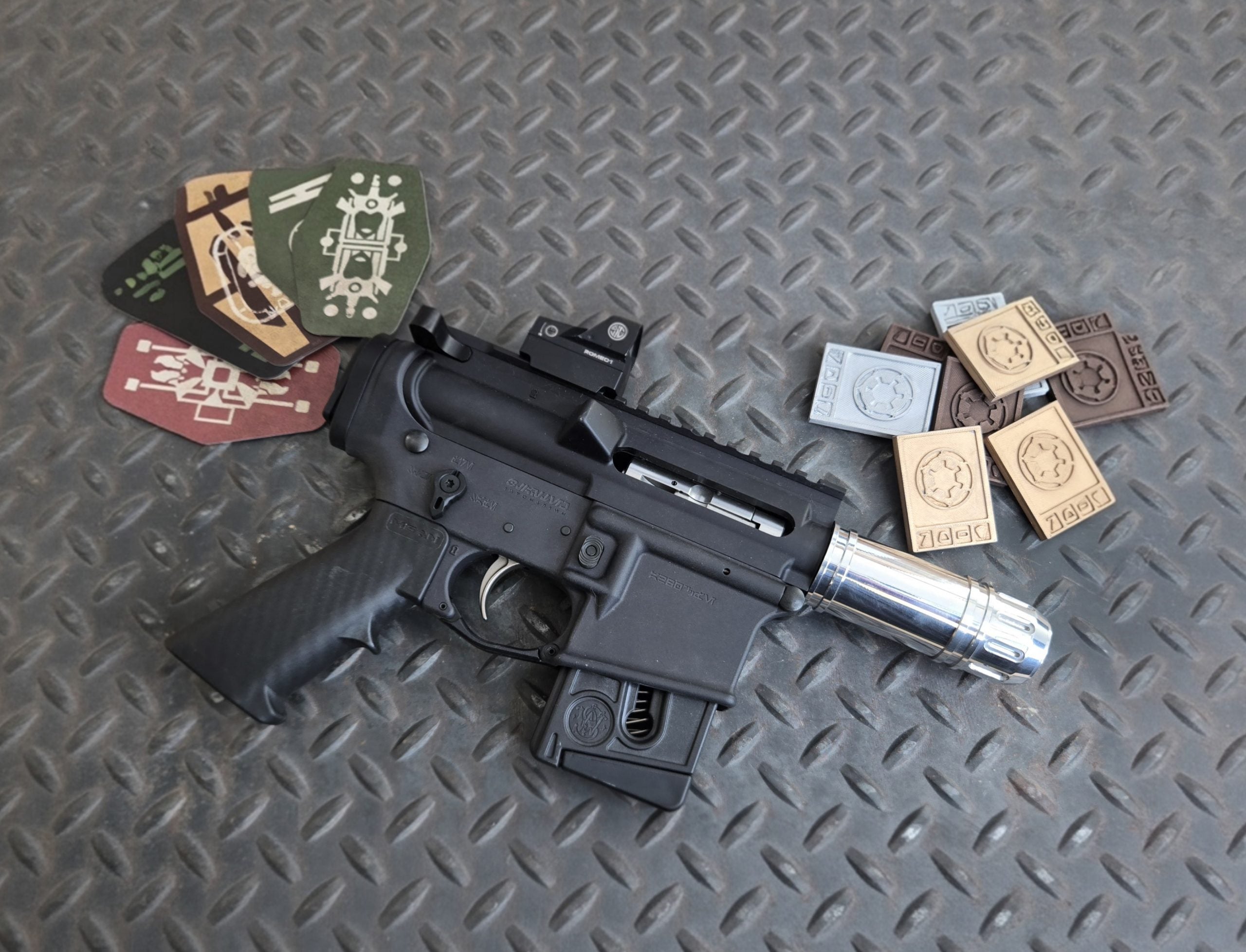






“…if you eventually want to add a stock and go the SBR route…”
or…. get the (to borrow a phrase from an ignorant anti-gun democrat politician) ‘thing that goes up’ and skip the NFA SBR route now that you don’t go to prison for 10 years for the heinous crime of a pistol brace touching your shoulder.
[note: As of 2025, it is legal to shoulder a pistol brace without it being classified as a short-barreled rifle under federal law. However, be aware that some state laws may still impose restrictions.]
I would have put a Holosun HS 510 C-GR on it. Mostly because I happen to have a few of them sitting unused and I like them on my AR’s too – but I think it would go very well with the MAC IX.
I figured we would see an expansion of this style of firearms once sbr became less of an issue. Now to see if they work on something in 30sc to take advantage of the inherent magazine capacity advantage and see what a longer barrel length can produce with that extra pressure. Would love something in 357 sig as well but that tends to have different challenges.
I’m curious why.
.30SC offers a minor (14%) capacity / size advantage, which could be significant in a micro (maybe even a “real” SMG) but I don’t remember a single instance of any PCC reviewer ever having a problem with either the size or capacity of any of the major 9×19 mags (MP5, CZ, Glock, Uzi / Colt).
It theoretically offers opportunities for light-fast loads, but nobody makes any. Have you tried any handloads along those lines?
With the lack of available barrels in the 4.5 let alone longer for just about anything sold (sadly the hipoint carbine is unavailable here in that caliber) I haven’t been able to experiment in anything of that caliber unless you count 32h&r which did show promise with the 75g xdef with accurate #7 (just about matched load data for 1300fps). But why not turn a 30 rounder to the better part of 40 with a forced reset trigger?
That’s a shame. I’d really like to see what you could do!
To answer your question: because math dictates that converting from the most ubiquitous, versatile, affordable, and available centerfire cartridge to one of the least gets an insignificant boost to 34 rounds, not 40.
Unless I am grossly optimistic about spring tension and internal volume that doesn’t seem right when a 10 round shield magazine for 9mm is 13 in 30sc (other reason we don’t see much of it outside some really oddball models) in regards to a 30 round mp5 type magazine. That aside could always build a bolt action if I get more time than tasks.
You are grossly optimistic😉but it isn’t really your fault.
9×19 rim diameter is 13.9% greater than .30SC rim diameter; therefore .30SC capacity can only ever be 13.9% greater than 9×19 capacity in the same volume. That is the absolute, inescapable truth if you’re a shooter or manufacturer.
If, OTOH, you’re a marketing scvmbag, you use e.g. a different baseplate and say “Look! We increased capacity a [mathematically impossible] amount just by switching to this amazing new cartridge!”
Gotcha so some room for expansion but it would only go so far (like with the shield likely having such a baseplate). Well can always buy a box and try stuffing a friends mp5 magazine next time I visit and see where we end up. Ah well still allows the possibility of a lighter firearm build but getting well past diminishing returns territory for what that would cost with current demand.
No room for expansion (that isn’t equally applicable to 9×19).
E.g. ignoring the spring, follower, and floorplate (which are constant for both) a 30rd 9×19 mag has two columns of 15 cartridges, each 5.88″ tall. 5.88 / .344 = 17.09. That’s not even close to 18, much less 20. You might get more to fill the empty mag tube, but not to feed (there’s no such thing as a 2.28-stack magazine, only 1, 2, or 4).
Also, how would it get lighter when .30SC has a higher boltface thrust than 9×19?
The math agrees for the volume but assuming the magazines in s&w are roughly the same size something else seems to be at play https://www.smith-wesson.com/product/s-w-magazine-shield-plus-30-sc-16-round (16 vs 13) as to less weight bolt force or no overall recoil is less and I would assume roller delayed can be tuned to handle it to shave a ounce or three before any other add ons get involved especially with materials from the last 30 years. Quad stack on a mp5 varient would be fun in general but I doubt that would eveexist outside of custom one offs.
Whatever the case I am sure there is room for improvement somewhere and if not 5.7 it is.
Overall recoil is not less. .30SC loads exist for the specific purpose of duplicating 9×19 ballistics, and every load with the same MV forward cannot help but have the exact same MV back.
The smaller bullet diameter offers a [theoretical] possibility for lighter/faster loads, but in the current market 9×19’s much broader range includes far more, and lighter, light-bullet / low-recoil loads. I’d love to see you come up with something yourself, but I don’t even see components right now.
5.7 has undeniable advantages in both capacity and recoil, at the cost of overall power. FYI, after building a successful 5.7 cheek pistol I recently tried it in 9×19; I made it work, but didn’t really like it because I needed to focus too much on bracing against recoil.
Knowing next to nothing about FRTs, I have to ask whether there is a model of FRT which is compatible with this firearm, or are the current FRTs on the market pretty well universally compatible with most any mag fed firearm larger than a full size pistol?
MP5 has a couple options, given this making enough sales to be relevant this could probably have one in a year or two based off of how quickly a few companies are cranking out new designs.
Looking at the low-res pictures, it looks like a standard AR15 lower that was milled for H&K’s magazines. If that is an AR fire-control group, any FRT would work.
Maybe ask Mr. Spicer to pop the rear takedown pin and flip it up to show the rest of the class?
7.6gr of the Accurate #7 haven’t tried the next .1gr up yet.
Uzi used to be the big thing.