
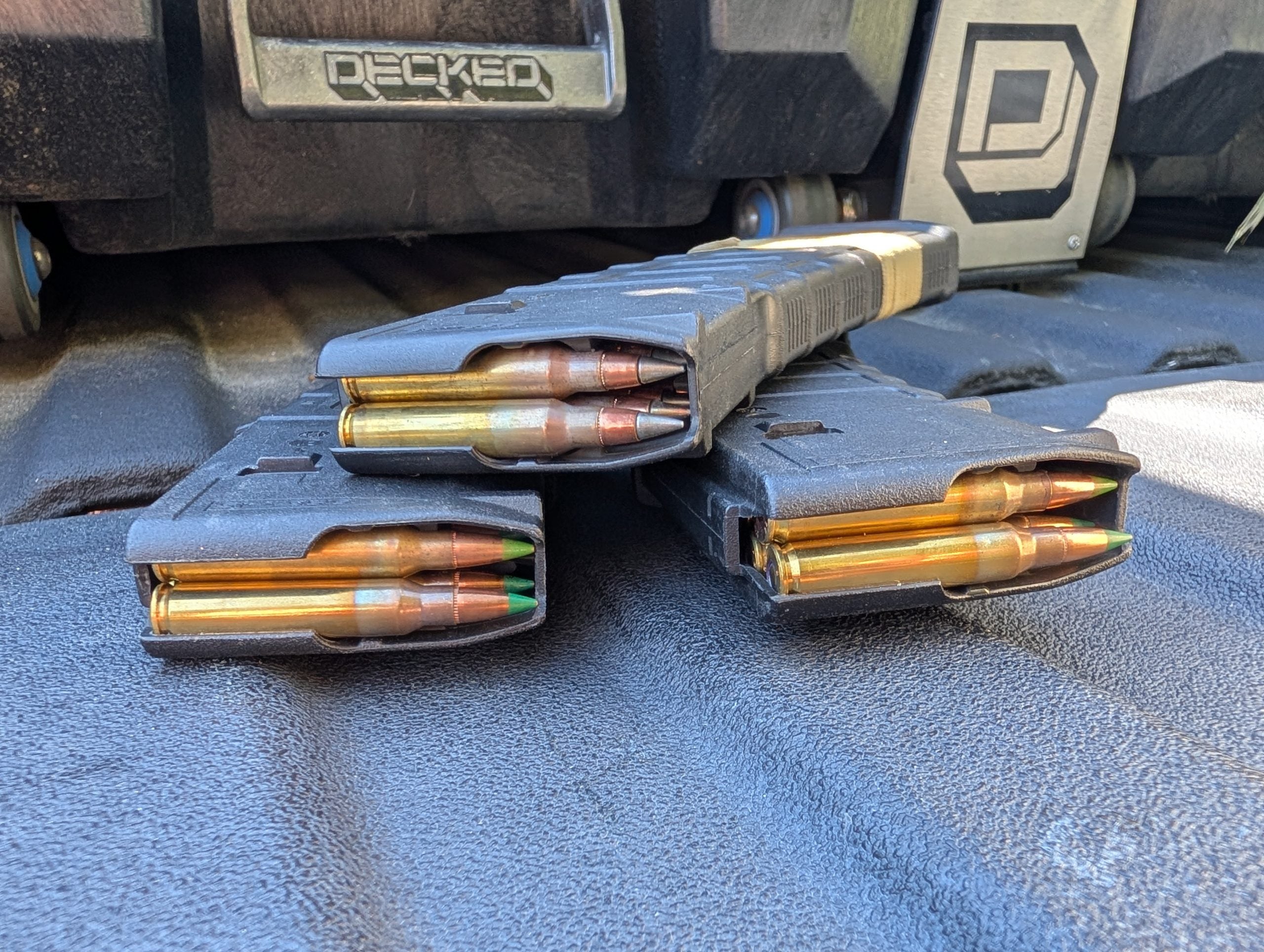
When the U.S. military introduced the M855A1 Enhanced Performance Round (EPR), it featured a substantially different projectile design from the M855 green-tip ammunition it replaced.
Legacy M855 uses a lead core, a copper jacket, and a steel penetrator contained within the projectile. M855A1 does things differently. Its hardened steel penetrator — nearly twice as heavy as the M855’s and hardened to 58 HRC — is exposed at the nose of the bullet, sitting atop a copper slug within a reverse-drawn copper jacket. The Army fielded it in 2010, and it’s been the standard 5.56mm service round ever since.
That change improved the performance the military was looking for, but it also created a mechanical problem in the M4/M16 platform. The exposed steel tip could strike the aluminum portion of the rifle’s feed ramp during chambering, causing accelerated wear.
The ammunition wasn’t necessarily the problem. How the magazine presented it to the rifle was.
The Problem Is M855A1’s Steel Tip
Traditional aluminum USGI magazines and some older polymer magazine designs present the top cartridge at a relatively shallow angle.
With conventional FMJ ammunition, that generally isn’t an issue. The cartridge moves forward under bolt pressure, contacts the feed path, and is directed into the chamber.
M855A1 changes that equation.
Its exposed steel penetrator is considerably harder than the aluminum receiver. If the cartridge is presented too low, the penetrator can strike the aluminum feed ramps below the barrel extension as the bolt drives the round forward. And M855A1 runs at higher chamber pressures than M855, around 61,000 PSI versus roughly 51,500 PSI, which contributes to chamber wear.

Repeated impacts can gouge and wear the aluminum. Once enough material is displaced, the damaged area can cause additional feeding malfunctions with other ammo.
The obvious solution is to keep the bullet from hitting that area in the first place.
Why the Gen M3 Feeds M855A1 Better
Rather than modifying the rifle, magazine manufacturers can change the angle at which the cartridge leaves the magazine.
That’s where newer magazine designs, such as the Magpul PMAG Gen M3, come into play.


The Gen M3’s feed-lip and internal geometry provide a higher cartridge presentation angle than older magazine designs. Instead of sending the projectile forward on a relatively flat path, the magazine points the nose upward toward the barrel extension.
That seemingly small change matters with M855A1.
By presenting the cartridge higher, the magazine reduces the likelihood that the exposed steel penetrator will strike the aluminum receiver below the feed ramps. The round instead follows a more direct path toward the barrel extension and chamber.
The Gen M3’s four-way anti-tilt follower also helps maintain consistent cartridge presentation as rounds are stripped from the magazine.
It’s a relatively simple mechanical solution: change where the bullet is pointed before the bolt starts pushing it forward.
Why The Marine Corps Moved To The Gen M3
This wasn’t merely a commercial-magazine improvement.
The Marine Corps authorized the Magpul PMAG Gen M3 for use with the M4, M4A1, and M27 in January 2017, after extensive testing with M855A1 ammunition. That decision was a notable reversal; the Corps had banned PMAGs from service use just a couple of years earlier, and the Gen M3’s improved geometry was a significant factor in prompting a change of mind. Magazine reliability had become particularly important with the M27, which was being fielded broadly across Marine infantry units.
The military also developed improved aluminum magazines to address the issue. The Enhanced Performance Magazine, or EPM, was developed by ARDEC starting in 2013 and completed in mid-2016.


It changed the follower and feed geometry to provide a steeper cartridge presentation angle, from 37 to 44.5 degrees, compared with the shallower angle of older USGI magazines — and the Army reported it delivered a 300 percent improvement in mean rounds between stoppages compared to prior USGI designs.
The objective was essentially the same: get the nose of M855A1 higher before it moves forward. Republican senators later pushed the Army to follow the Marines’ lead on the Gen M3, arguing that duplicating years of Marine testing wasted resources when a proven polymer solution was already fielded.
Not All AR Mags Feed the Same
For most AR-15 owners shooting conventional .223 Remington or 5.56 NATO ammunition, the differences in cartridge presentation between quality magazines may never become particularly noticeable. Practical civilian testing has raised some skepticism about how severe feed-ramp wear becomes in real-world use — a 2018 Defense Review evaluation of multiple magazine types found that, in most cases, the actual damage was limited, though the EPM and Gen M3 consistently offered the highest clearance for the M855A1 penetrator.
M855A1 still makes those differences much easier to see, especially over sustained high-round-count use.
An exposed steel penetrator changes what happens when a cartridge hits the rifle’s feed path. Magazine geometry determines where that projectile is headed when the bolt strips it from the magazine.
That’s why the magazine shouldn’t be treated as an afterthought when M855A1 is involved.
If you’re running M855A1 alongside conventional 5.56 ammunition, a magazine designed around the higher presentation angle gives the cartridge a clear path into the chamber while reducing unnecessary contact between the steel penetrator and the rifle’s aluminum receiver.
It Isn’t Just For M855A1
M855A1 may have forced the military to take a harder look at magazine geometry, but it isn’t the only ammunition that benefits from a better feed path.
We’re stuffing a much wider variety of bullets into AR-15 magazines today than M193 and M855. Solid-copper defensive and hunting loads, bonded soft points, barrier-blind ammunition, and other specialty loads can all have bullet profiles that differ from conventional FMJ.

That doesn’t mean those rounds won’t run from an old USGI magazine. Plenty of them will. But the farther you move away from the traditional FMJ profile the AR-15 has been happily eating for decades, the more important consistent cartridge presentation can become.
A magazine like the Gen M3 presents the round higher, giving the bullet a cleaner path onto the barrel-extension feed ramps and into the chamber instead of allowing the nose to strike low below the feed ramps. That’s good for M855A1, but it’s also a good thing when you’re running expensive solid copper hunting loads, bonded duty ammo, or other specialty ammunition through the same rifle.
M855A1 exposed the problem because its steel penetrator is particularly unforgiving when it hits aluminum. The fix, however, has benefits well beyond one military cartridge.
No matter what you’re feeding your AR, getting the bullet properly aligned with the feed ramps and chamber is generally a pretty good place to start.







The way I determine projectile tip to barrel ramp contact using 20 round USGI mags or quality varients is to use a black permanent marker to paint the ramps and manually/safely cycle 8 live rounds. The projectile tip will mark point of contact and travel which should appear something like an ! centered on both ramps. There are certain sharp points on the AR-15 barrel extension teeth that need softening; applies especially for the AR-308. Light ramp polishing should be done prior to barrel installation. Criterion and FN barrel ramps generally align with Aero M4E1 upper receiver ramp cuts perfectly.
I have never had a problem with projectiles making contact with the upper receiver m4 cuts or below the cuts which would be disastrous.
Should just have dams g2 308 replacable steel feed ramps on any new uppers
Like most incremental improvements of the M series weapons design, 45 years of use along with continued progress in ammo means we can’t sit back and do nothing. We already have that path well laid out with the 1911 as owners switched from hardball round nose to hollow points in lead – it results in making it a jammomatic. Feed angles and nose contours have to be adjusted, like it or not. Changing the ammo directly affects the original design which never had to consider its use.
Goes to having to apply “M4” cuts in the first place, which is very commonly accepted now. It would be interesting to load the steel penetrators into classic 60’s Colt mags with the original followers and fire them in an M16 a nothing. I suspect that bullet tip will quickly suffer malfunctions as it gouges its way up the flat wall of the lower mag well.
One of the few actual positives of the AK-47 was its indestructible magazine which fed ammo exactly as needed – the feeding system of self powered firearm loading rounds done right is how the sheep and goats are separated. When Army told Colt to add the Forward Assist we should have gotten a lot more suspicious why – we did find out exactly later on, recycled Naval powder in the ammo was one cause, the weapon was never originally designed to use it. The M16 was supposed to get a newer low flash more efficient powder, not obsolete leftovers. For all its supposed faults, the M16 actually suffers from “value engineering” of the overall system, where bureaucrats shaved a buck here and their, demanding superior performance from a design they had no business monkeying with. They took out the overall elegance of a balanced and vetted dynamic operation messing with things that were never fully explored, we have been reversing those decisions for decades and are still making changes that few understand.
BTW – another change in magazines is to open up the front “aperature” to allow the round to slide up without striking the inside of the mag itself. That is how shallow the feed angle is – alternative caliber rifles such as the SOCOM series cartridges do that as a matter of course. Im now curious to ask Tromix their experience using the newer Marine EBR mags.