
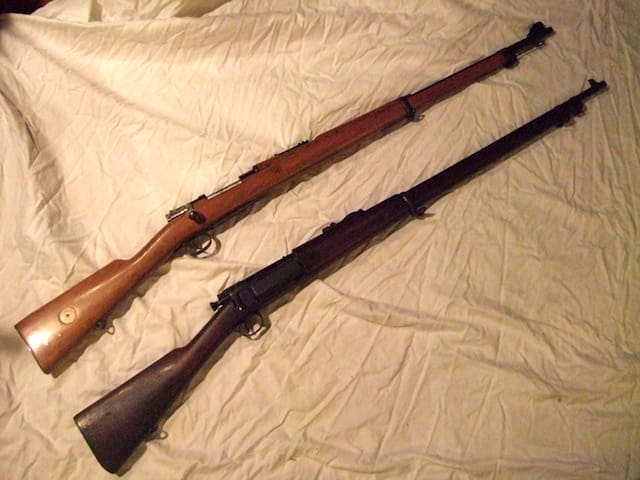
During the first week of January, I bought my first official new gun of the year. It’s a model 1898 Krag-Jorgensen chambered in .30-40 Krag, and it’s 111 years old. That’s the same as Bilbo Baggins when he celebrates his eleventy-first birthday in The Lord of the Rings. That’s seven years older than the state of Oklahoma and eight years older than the Model T Ford.
Unlike tens of thousands of its unlucky brethren, my Krag somehow escaped the saws and files of the sporterizers and the choppers who are today snarkily referred to as “Bubba” by internet gunnies. But in the early days of the 20th century, surplus Krags were just old, cheap guns, almost given away by the government–they sold for as little as $1.50 through the CMP and the NRA.
A little extra cash, and a little bit of work by a gunsmith, and voila, the military-trimmed Krags became handy little deer rifles. During the lean years of the Great Depression, a cheap, easily-sporterized surplus rifle could mean the difference between eating meat and potatoes or just potatoes, especially in the rural, hardscrabble parts of America.

The .30-40 Krag cartridge was the very first smokeless cartridge adopted for widespread use by the US military. While considered underpowered today, its .30 caliber bullet traveling at 2000 feet per second meant it could effectively kill anything on four legs likely to be encountered in the lower 48 states.
On my Krag, the words “Springfield Armory” appear on the left side of the receiver, directly under the “U.S.” stamped in a font at least twice as big as the other letters. The stock is worn almost black in places by the natural oils from untold hands and the accumulation of dirt and grime of more than century.
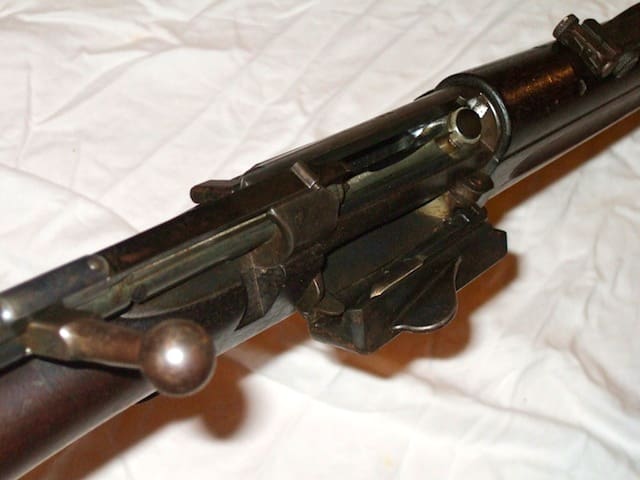
Pressed into the dark wood above the trigger guard is a small rectangle with squared-off corners, containing a cursive script JSA and the number 1900. A little searching revealed that the J, the S and the A are the initials of master armorer J. Sumner Adams, showing the rifle had been accepted for use by the US government.
A quick check of the Krag serial number registry from the National Parks Service, available on-line at many web sites, confirms that my rifle’s serial number is among those accepted into inventory sometime during fiscal year 1900, probably later in the year rather than earlier.
And these numbers are part of the reason why I bought this Krag. My grandfather and namesake, Roy Hale, was himself born near the end of 1900, close to the time when this Krag was made.
I don’t have any reason to believe that my grandfather ever owned or fired a Krag. But this rifle is certainly a thing from his time. And I know he truly appreciated a good rifle.
It didn’t help that right when I was trying to decide if I really wanted the rifle or not, one of my cousins unexpectedly mailed me a photo of my grandfather taken in his youth, framed alongside his hand-written special chili recipe. Like I needed an omen as an excuse to buy yet another gun.
But chronological connections to my grandfather’s birth are not the only reasons why I plunked down my hard won cash (that’s c-a-s-h, R.F…..cough, cough….but ammo is a currency all its own, too) for a military rifle that’s four times more out of date than Beach Boys 8-tracks.
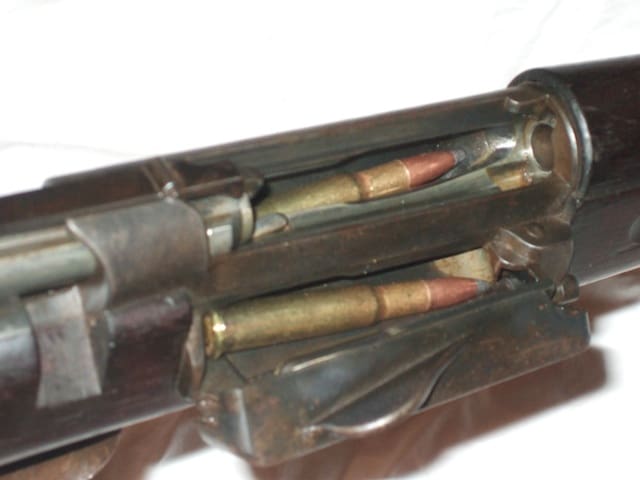
My Krag is four feet of wood and steel, and smells of cosmoline and old dust. The strange, right-side box magazine with its rolling internal feed lever is a contraption from the time when the candlestick telephone was still a magical creation of modern technology. When my rifle was made, nobody outside Ohio had ever heard of either Orville or Wilbur, and Kitty Hawk, North Carolina, was just another lonely stretch of empty southern beach.
My Krag is graceful and beautiful. For being 49 inches long, it is surprisingly lively and balanced. I was amazed at the difference in feel between it and my Model 96 Swedish Mauser, also made in 1900. The Swede has been my favorite rifle to shoot for several years, and I used to think it was graceful and easy to handle. But compared to the Krag, it hefts like a chunk of oak planking. I think it’s because the extra metal of the Krag’s weird mechanism puts more weight between the shooter’s hands, instead of in front of them, like with the Swede.
The Krag also features a smooth bolt action, albeit a one-lug design that requires the .30-40 cartridge to be loaded at lower pressures than many other modern rifle cartridges. Some have written that the Krag’s bolt is one of the smoothest ever designed. It is certainly smooth and easy to manipulate. Out of all my rifles, only my Remington 700 from D&L Sports in Wyoming has a smoother, easier bolt. The Krag’s bolt is smoother than my Swedish Mauser, my Winchester Model 70, and my Ishapore 2A Enfield. I won’t even mention my Mosin Nagants. If you’ve handled a Mosin, you know why.
The really intriguing part of the Krag is the magazine. I can push my thumb against the angled flange atop the long metal box on the right side, and it flips open. Five cartridges drop neatly into the opening, and a little pressure on the outside of the flange causes the lid to snap shut. On the left side, up near the bolt is the magazine cut-off lever. With the lever down, the five cartridges in the funky magazine are kept in reserve, and the rifle has to be fed one cartridge at a time. Flip the lever up, and the Krag feeds and shoots exactly like any other bolt action rifle.
The magazine cut-off lever is a holdover from an old military doctrine that emphasized single, well-aimed shots instead of firepower for the common infantryman. The belief was that soldiers should load and shoot single shots during most combat, but they could flip up the lever and quickly rattle off five rounds if they were in danger of being overrun.
As soon as I got the Krag home, I took it out to my backyard range, and ran five rounds through it. The operation was smooth and flawless, and the recoil surprisingly light. Four of the shots grouped very tightly around the little dot I stuck onto a target 40 yards distant, and the fifth shot splattered a gallon jug of water in a most satisfying manner.
And those are all the reasons why I bought that old Krag, which was obsolete by the time it first appeared in combat in Cuba during the Spanish-American War in 1898.
Its combination of history, interesting machinery, smooth handling and operation, and personally-significant dates meant that there was simply no way that I could walk away, and leave that Krag in the gun store, all by itself. Besides, a buddy texted me that getting the Krag would give me a real excuse to find a liberated Cuban cigar and some good rum to go with.





Geez, I hate when that happens! I walked funny for a week the last time my bouncy ball got aroused.
The Krag was short lived in US service but long lived in song:
“Damn, damn, damn the Filipinos, cross-eyed kakiack ladrones,
Underneath our starry flag, civilize ’em with a Krag,
And return us to our own beloved homes.”
Thanks for the writeup on an excellent rifle.
Great writeup and great story. Thanks Roy.
Great job, Roy. The romance of the classic rifles lives on and on and on.
Thanks for the positive responses.
I loved writing this one.
You said
“A quick check of the Krag serial number registry from the National Parks Service, available on-line at many web sites,”
I cannot seem to find the serial registery anywhere – please help
I have a 1898 Krag carbine I want to look up
thank you
A Krag was the first rifle I bought on my own, fifty years ago. I was sixteen and paid $15 at an auction. The local VFW was the consigner.
A cousin is still putting meat on the table with it. As far as I know, it has never been modified. The end of the barrel needed work. Someone did a poor modification to shoot blanks at funerals. Once that was corrected, it became a 300 yard deer killer.
Great pic of your son, Frank. I wish him and all his comrades a swift and safe return. FYI, my first rifle was a Nylon 66 that I received over 50 years ago when I was twelve. I would have killed for a Krag, but I was thrilled with that .22.
I was told by several different sources that “the .30-40 Krag was formerly
popular, in demand, and well liked by Idaho elk hunters.” In fact the 180
grain bullet loading of a .30-40 Krag, .303 British, and .300 Savage would
probably duplicate each other for killing power on large game: moose,
caribou, elk, bear, etc. There is no need for a magnum if the hunter utilizes
common sense, places their shots with practical accuracy, and don’t exceed
the limitations of both gun and load. The venerable 7mm Mauser (7×57)
would certainly qualify in this scenario too. In fact, the 7mm Mauser or
7mm Spanish Mauser/.275 Rigby was also developed and introduced in
1892, the same year as the .30-40 Krag.
The Krag Carbine is also one of those beautifully balanced (meaning more than just center of gravity) rifles that just feels good in the hands. It is easy to carry, comes up to the eye well, operates smoothly, and is simply easy and fun to shoot. The magazine disconnect single shot mode is very similar to the Semi vs, full auto controversy of today. I would never feel poorly armed with a Krag.
“A little extra cash, and a little bit of work by a gunsmith, and voila, the military-trimmed Krags became handy little deer rifles. During the lean years of the Great Depression, a cheap, easily-sporterized surplus rifle could mean the difference between eating meat and potatoes or just potatoes, especially in the rural, hardscrabble parts of America.”
True, but I still don’t see that “sporterizing” a rifle does anything to improve its ability to kill deer.
My Paternal Grandfather and his elder brother carried these with the Third Infantry Regiment in the Philippines in 1900. My son, the rifle collector, has one for himself. The truly are fine rifles.
Thank you for a fascinating look at a beautiful old rifle. I love looking over the old military surplus rifles at my local gun shop/range. I appreciate their history, and craftsmanship. By the way, I own a mosin nagant 1891/30 rifle built in russia circa 1933. believe me, the mosin is NOT smooth! It works as advertised, but I find myself slapping that bolt around most of the time.
Beautiful rifle. My father, brother, and I each own one Krag. Sort of an accidental tradition.
For Krag .30-40 military collectors…I have 11 bandoleers of Model 1898 ammunition dated June 1907 for sale. 10 of the bandoleers are still in the wooden box they came in from the Frankford Arsenal. Email me if you’re interested.
Just picked up a Krag yesterday…..of course this is now the years after your post of having rounds for it. In curious if you still have them and if they still work?
how much do you want for the lot?
Cute kid. My son is about the same age. He’s not interested in shooting a gun yet (unless there’s a computer mouse attached to it!) 😉
I have a Krag – all original – dated 1903 that I purchased complete with leather sling, also dated 1903, in 1968. The stacking swivel has a broken arm. I would like to purchase a replacement – must be original and not a repro. Any help on where I might find this part would be appreciated.
I have an original Krag with original leather sling. Belonged to my grandfather. It’s operational. In good condition. It has not been modified since he was issued it on the way overseas in WWI. The last time it was fired was in the late 1950’s.
Been in a case ever since.
Will sell or trade. I am looking for a new high end AR15 equipped with a slide fire stock.
I’ve got a 1894 krag all original it was my great grandfather’s and he let me deer hunt with it I loved that gun more than anything and for a 13 year old girl it was out of place to say the least but I’m 16 now my great grandpa gave me the rifle and he’s still alive at 86 he’s my best friend, he can still out shoot me but that rifle is my first gun and we collect military surplus and war weapons anyone got any ammo though ?????
At that price, it better turn into a pizza and a six pack at midnight.
Well I know how he feels.
Ms. Jihad January 2014
*88* AR-15s? How many cops are there in the county? Do some cops get two?
It’s progress. Good work CalGuns. Keep up the fight. Seeing regulations fail in California makes me happy, Cali’s laws are too often held up by anti-gunners as some kind of gold standard.
My dad has a KRAG 1898 chrome plated parade rifle. Could anyone tell us the value? It is in original mint condition.
Nice review. Not sure if anyone pointed this out. I live in norway, and the Krags here dont use a rimed cartridge. loading and chambering goes a lot smoother with out rimmed cartrides on thoose krags;)
I also have a chrome model 1898 US Springfield SN365***. Can these be fired.
I have a U.S. Springfield Armory 30/40 model 1898 serial # 316677 30 inch barrel with overall length of 49&1/2 inches. It has a custom stock which we were told by my uncle, who was in the U.S. Air Force, was a parade or ceremonial stock when he gave it to my Dad in 1958 or 1959. The stock has black plastic forearm tip and checkered forearm grip and a checkered stock grip and a raise cheek plate. I would also be interested in the value,Thanks a lot for any input.
Well, I inherited a what looked like a mess when I got it, a 6.5 x 55 with a make shift stock of oak…..and lots of external rust. I’ve removed the rust, ordered a Boyds laminated stock and will have http://www.murraysgunstocks.com do the shaping and inletting. Randy does excellent work. I still have a problem. The rear sights cleaned up fine but the front sight is missing totally and I’ve about run out of options looking for a replacement. I want to find the right one or at least one to replace it properly before I do the reblueing. Oh, and another surprise my rifle is marked Steyr. Finally found out that yes they made many of the rifles in Austria on contract per spec. I fired it and have set up to reload it but I’ve gotta find that sight or go to a scoped sighting system. HELP! 435-787-0888 is my office number.
Mine is dated 1897!
Does anybody have the clips that hold the hand guard on top of the rifle barrel on a 1896 krag rifle?
I am working on a 30-40 Krag that my Dad got from a person in the American Legion.
He used it a number of year to get deer that fed us. He made the mistake of having the barrel cut down.
I am now in the process of removing the cut down barrel and replacing it with a original rifle length one.
Also have order a bayonet to go with the rifle.
Have reloaded and shot the rifle over the year and will enjoy getting it to original.
I own a U.S. Model 1896 Krag rifle that my father bought in a local department store back in the early 1960s. The stock is dated 1897.
I think he paid around 15 dollars for it at the time.
I have shot it a couple times over the years and I find it to be a very smooth action to operate.
Eventually I will pass it down to my son or grandson.
I have a US Krag model 1898 which has 1/K/17 on the right side of the stock opposite the shooters side. I think that this particular rifle was used issued to Company K- First Battalion -17 Inf. Does anyone there know if the 17th marked their rifles. There also is a name N E STOUT stamped below 17th Inf.
Excellent article about an excellect firearm used over the years by excellent men who were excellent shots — I, too, have fired and handled the Krag. Unfortunately the one I would have owned was lost in a fire. Time and situations have prevented me from being lucky enough to have a replacement but, at 85, things may change (one can hope) as i may be able to acquire one before I leave this world. That would please an old man who has dabbled in acquiring many firearms in his lifetime. Each of you who do have a Krag now, cherish them and pass them (along with the history of them) to your children so they can pass them to their children. That is how REAL history becomes known for what it was. My congratulations on your good fortune, sir.
Bill
I have a model 1896 30-40 Krag that my dad had when I was a kid. Yes, it has had the barrel shortened. He was a Colorado cowboy, & carrying it in a saddle scabbard, the butt stuck out past the horse’s rump…it caught in the oak brush & knocked against the quakie trees, so he had it cut down. And yes, the stock has been repaired with black electrical tape. Porcupines being the cattleman’s nemesis, he used it to club one rather than waste a shell on it…times were tough, & ammo wasn’t cheap…you did what you had to do.
Even with these flaws, I wouldn’t give it up for any kind of money-like some of the comments above, it took uncounted deer, a few elk, and a bear or two-provided meat for the table for years. The snobs who look down on modifications & flaws can kiss my ass, to put it bluntly…this is a family heirloom & a symbol of the way things were in the West.
He retired the 30-40 when he bought a Winchester 88 in .243…quite a step up…