

If you’ve shot a suppressed AR-15 for more than a magazine or two, you already know the tradeoff. The can makes your rifle quiet, but it also sends a chunk of that gas right back at you. Eyes, lungs, bolt carrier group, all of it.
That backpressure problem, combined with a new and, in my opinion, overdue focus on the health of the shooter, is why “flow-through” suppressors have become one of the most talked-about developments in the suppressor world over the last few years, and why a lot of shooters, myself included, are now choosing gas management over outright quiet when it comes to suppressor choice and features. So today, we’ll talk about what is actually different between the two designs, and where each one makes sense.
How Traditional Suppressors Work
Traditional suppressors trace their lineage back to Hiram Maxim’s original designs, and they’re still the most common type on the market. The concept is simple: stack a series of internal baffles, shaped like coins with holes punched through the middle, inside a tube. As the gas and the bullet move through, the baffles trap and slow the expanding gas, giving it time to cool down. Cooler, slower-moving gas means less noise at the muzzle.
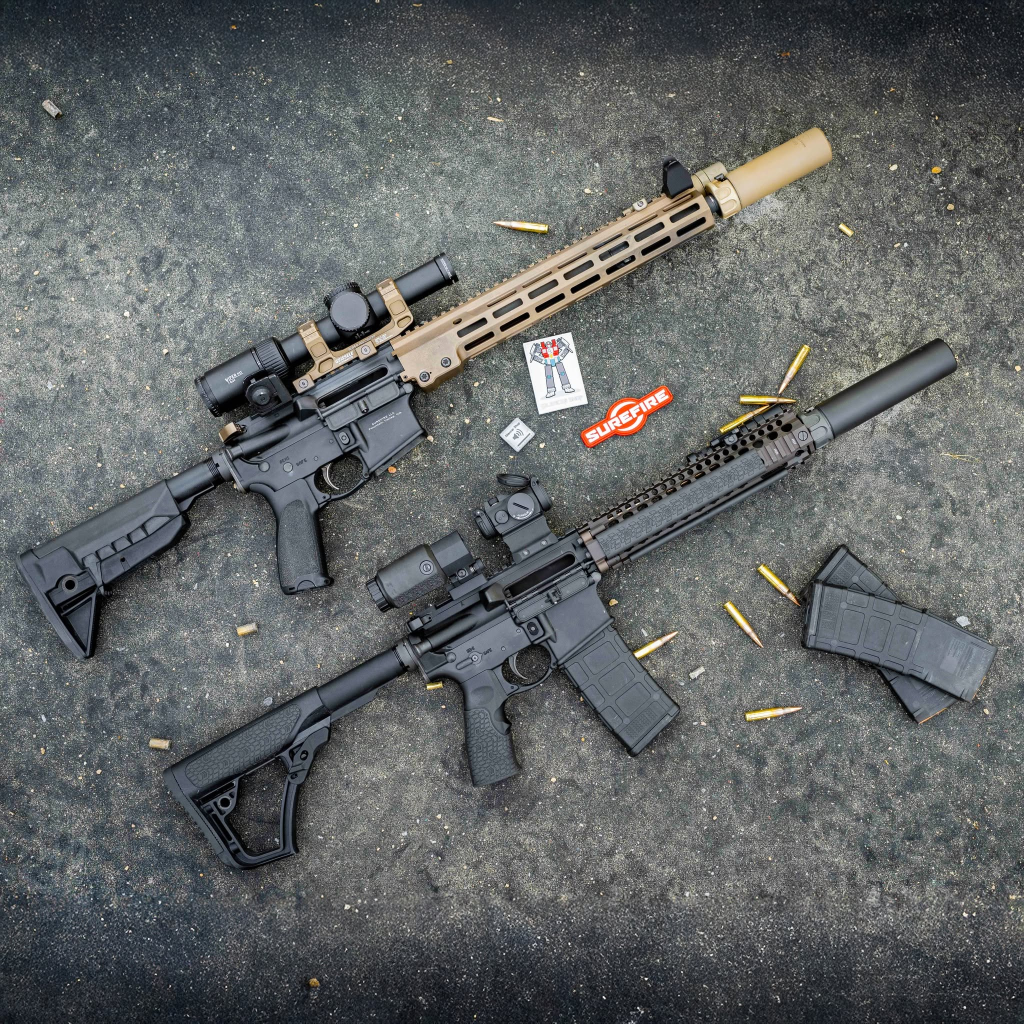
Silencer Shop’s own breakdown of suppressor mechanics puts the goal plainly: every design is built “to slow the speed, slow the expansion, and cool the gunshot gases before they hit the ambient air.”
That holds true whether you’re running an aluminum can or a titanium one. The baffle stack is just the most common way to get there and, quite frankly, the simplest in terms of both manufacturing complexity and design complexity.

The reason the traditional suppressor design will likely never die is twofold: 1. It works, and 2. The manufacturing barrier to entry is quite low when compared to the end result.
Traditional baffle stacks are still some of the quietest suppressors you can buy, which is why bolt-action shooters and hunters tend to stick with them over the complicated geometrical magic that is contained within modern DMLS, CMF, or LPBF “3D Printed” suppressors.

The problem shows up on gas-operated semi-autos. All that trapped gas has to go somewhere, and a good portion of it gets shoved backward into the action. On an AR-15, that means more gas blowback into your face, more carbon fouling in the bolt carrier group, and, on certain platforms, real reliability headaches.
Guns like the Steyr AUG or FN SCAR 17S, which run hotter and more gas-sensitive systems to begin with, can see accelerated wear or cycling issues when a traditional can adds even more backpressure on top of that.
How Flow-Through Suppressors Work
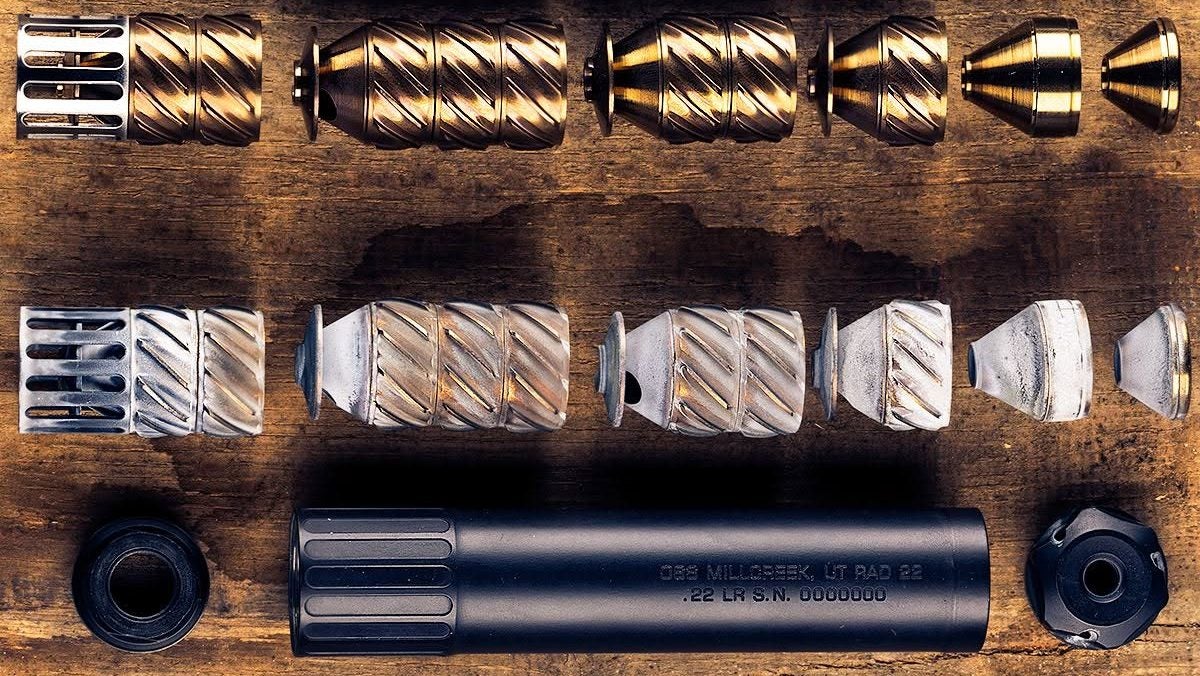
Flow-through designs flip the priority. Instead of trying to trap as much gas as possible, they’re built to move it forward and out, fast. Internally, that usually means specially shaped vanes and channels instead of conventional K- or M-baffles, often produced through 3D-printed (DMLS) manufacturing. Some manufacturers, like HUXWRX with their patented Flow-Through technology, use a single machined “monocore.” Others build a stacked baffle setup that’s still engineered around venting rather than full containment.

Think of it like the difference between a kitchen sink with a slow drain versus one that flows freely. A traditional suppressor is the slow drain: it holds the water (gas) back, which does its job of slowing things down, but the sink backs up.
A flow-through design is the wide-open drain: gas keeps moving, pressure doesn’t build up behind it, and the system downstream (your rifle’s gas system) stays a lot happier.

The result is less backpressure pushed into the gas system, which translates to smoother cycling, less gas in your face, and noticeably less carbon getting blown back into your bolt carrier group. Shooters running high round counts, or guns that are notoriously over-gassed (almost any carbine-length gassed 16″ AR), tend to notice the difference immediately.

Silencer Shop’s writers describe backpressure itself this way: it’s “gas pressure that’s pushed back up the bore of the barrel toward the firearm,” and it’s the root cause of most of the discomfort and reliability complaints suppressed shooters bring up. Flow-through designs exist specifically to address that one mechanism, rather than trying to out-engineer it with a better baffle shape.
The Real Tradeoff: Quiet vs. Reliable
Nothing’s free. Flow-through suppressors generally give up a few decibels of sound suppression compared to a traditional can of similar size and weight. That’s the nature of the design. Letting more gas move through and escape forward means less of it gets trapped and cooled, and trapped, cooled gas is what makes a suppressor quiet in the first place.

So the question isn’t really “which is better.” It’s “what’s the gun actually doing, and what do you need from it?”
- Bolt guns, precision rifles, hunting rigs: There’s no gas system to overpressure, so a traditional baffle stack usually wins. You get better sound suppression for the money, and there are simply more traditional options on the market to choose from.
- Gas-operated semi-autos, SBRs, AKs, SCARs, or any host known for running hot: Flow-through designs solve real problems here. Less blowback means less time scrubbing carbon out of your action, more reliable cycling under sustained fire, and a noticeably more comfortable shooting experience, especially indoors or on an extended range day. If you’re building a suppressed SBR specifically, this is where host compatibility matters most.
- Subsonic ammunition: This one cuts the other way sometimes. A little extra backpressure from a traditional can actually helps some guns cycle reliably with subsonic loads; this is especially true for Integrally suppressed designs like the ones from Angstadt Arms. A flow-through design’s lower backpressure can occasionally work against you here, depending on the platform.

Cost and Selection
Traditional suppressors are typically less expensive, and there are far more models to pick from since the design has been around for over a century. Flow-through suppressors tend to carry a price premium, reflecting the more complex internal machining, and the field of available models is still smaller, though it’s growing fast as more manufacturers roll out their own takes on the concept.
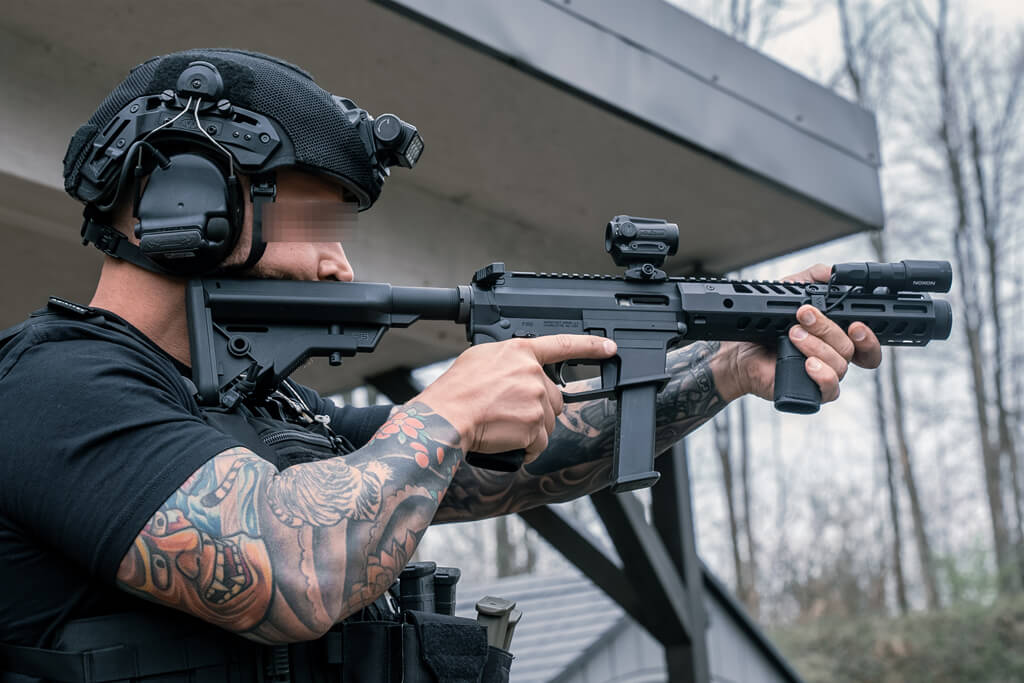
Before you spend the money, be honest about what gun the can is going on and what you actually do with it. A suppressor that’s perfect on a bolt-action .308 hunting rig might be the wrong call on a high-round-count AR build, and vice versa. If you’re not sure how a specific host handles backpressure, that’s worth researching before you commit, since NFA items aren’t something you want to guess on twice.
Silencer Shop’s product pages break down suppressor specs side by side, including mounting systems, decibel ratings, and host compatibility, which makes it easier to compare a flow-through option against a traditional one for your specific rifle before you buy.
Final Thoughts
Flow-through suppressors aren’t a universal upgrade, and traditional baffle stacks aren’t outdated. They’re built around different priorities. If sound suppression is your main goal and you’re running a platform that doesn’t fight you on gas, a traditional can is still hard to beat.
If you’re tired of cleaning carbon out of your bolt carrier group every range trip, or your gun runs hot enough to make backpressure a real problem, a flow-through design is worth the look, even with the small hit to sound suppression. Either way, the right call depends on your specific gun and how you actually shoot it, not just which design is newer. How do you choose between the two?

Photos Courtesy of SilencerShop.com
More Suppressor Articles Sponsored by Silencer Shop on TheTruthAboutGuns:
- Best Suppressor for a 16-Inch 5.56 Rifle
- Why Suppressors Have Minimum Barrel Length Requirements
- Scout Rifle Reflex Suppressors and the Reflex Suppressor Mount

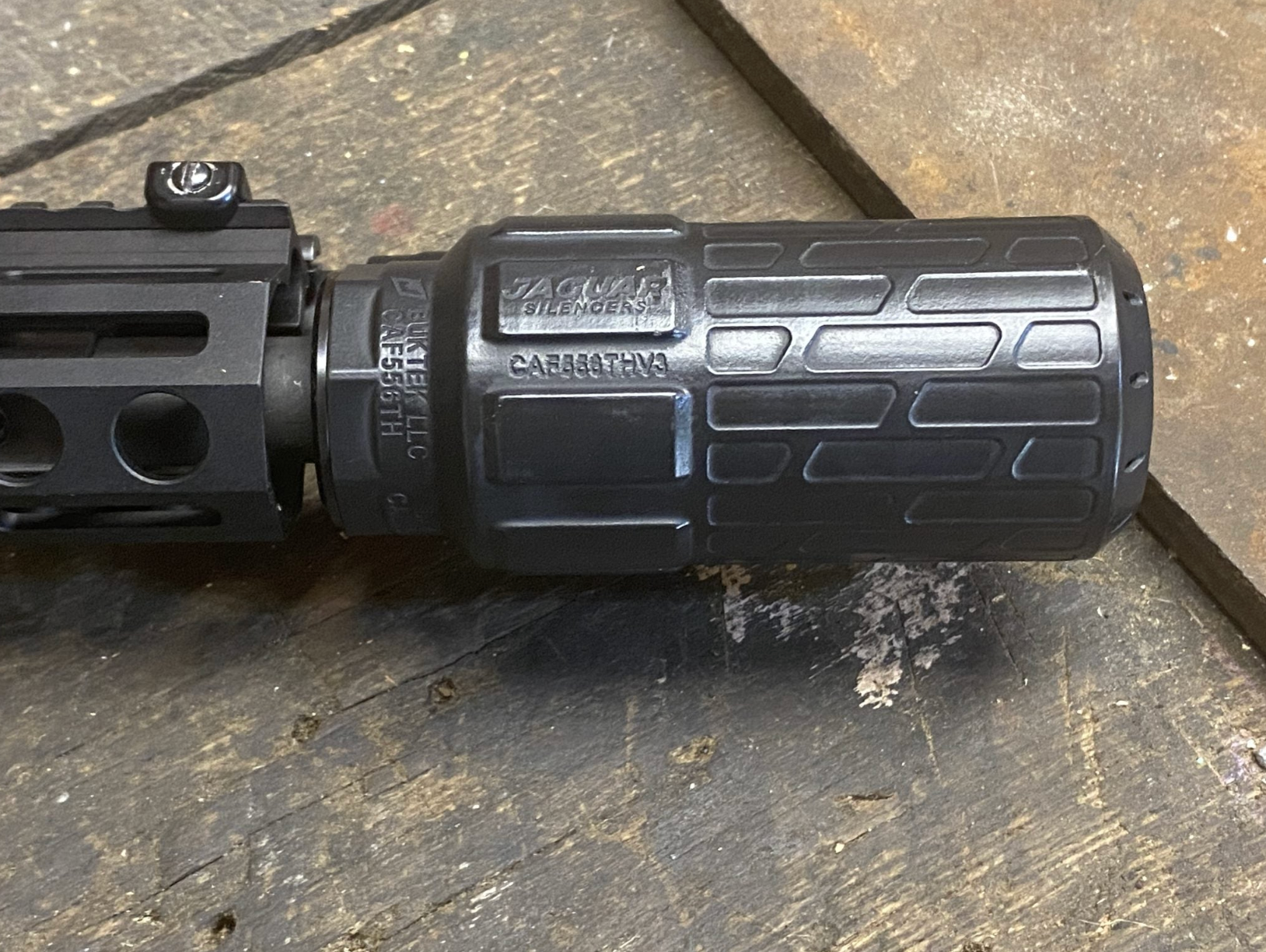
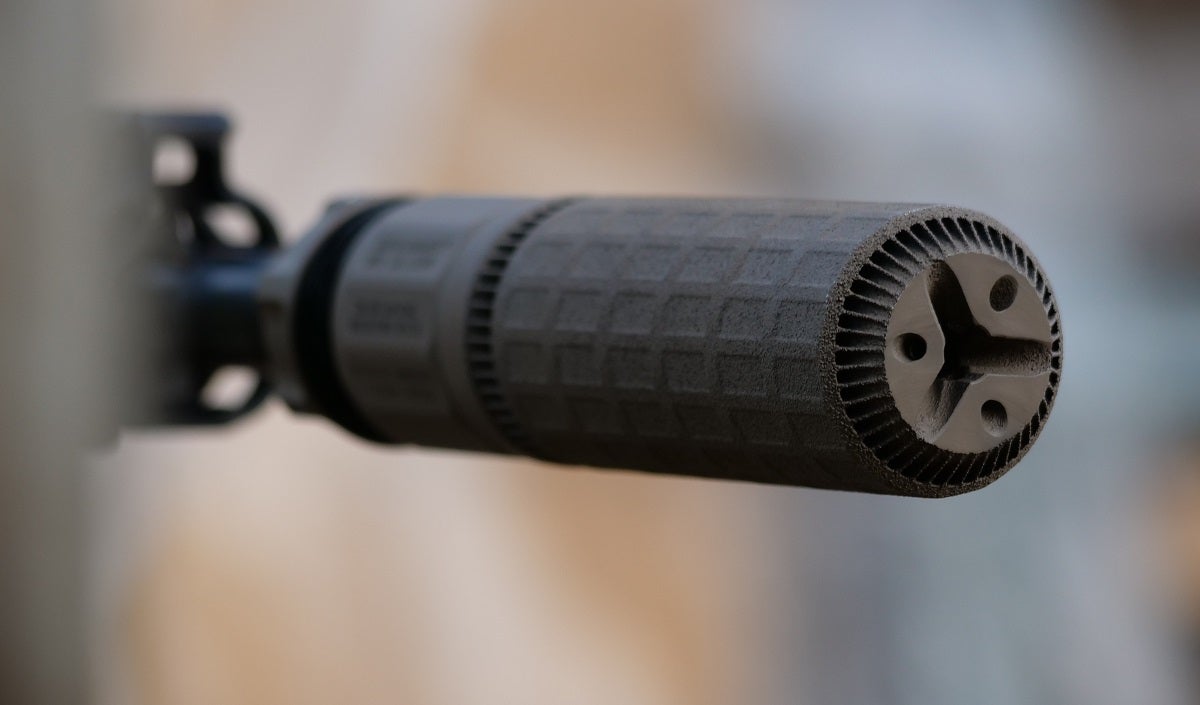



That suppressed AK looks bad ass.
AB goes halvsies in their cans, arranging the baffles in a spiral instead of straight walls, to keep the gas moving. Reducing backpressure while keeping most of the performance of traditional baffles.
Ignorant question: if a semi-auto fired from a closed bolt, and was shot slowly enough, would that eliminate the baffle suppressor problems?
At a guess not for gas coming back at your face. I do wonder if the product mentioned by ThaddTheChadd above would be a good option for a piston operated semi auto though. Either way will certainly be looking into a few cans after the move.
I’m not entirely sure what you’re asking here but I’ll take a stab at it.
I sort of assume you’re asking if we can reduce the overgassing issues that come from adding a traditional baffle suppressor to a semi-auto without going to a flow-through design? If not, ignore the following.
TL;DR: that’s kinda the point of adjustable gas keys. They’re not *perfect* but they’re a rational workaround.
If you look at an AR for example, the gas or piston system isn’t beginning to impinge on the BCG/unlock the bolt until after the round has left the barrel, unblocking the barrel and allowing gas to flow freely out the muzzle/muzzle device. So, the bolt is closed and locked until after the bullet has left the barrel and barrel pressure has started to rapidly drop. It’s the carried kinetic energy of the gas that was siphoned off wanting to expand that drives the BCG (or piston). How much gas is siphoned off, and into what volume of space is determined by a combination of the gas port size, gas key, gas system length and distance from the gas port to the muzzle (hence various length gas systems), the latter of which when mixed with ammo choice sets the dwell time (time during which gas is being siphoned off) for the system.
Shooting the rifle faster or more slowly will not change this. It’s set by the physical attributes of the system itself. This gets into the entire 14.5″ debate which I won’t rehash here.
If we add a suppressor to the end of the muzzle we increase the amount of time that it takes for the barrel pressure to drop because the gas can’t expand to the volume it “wants” to as fast as it “desires”, which you could look at as increasing the dwell time for the system. In fact, that is what you’re doing.
In some regards it’s not as pronounced as it would be with a longer barrel (a longer time with a narrower passage for the gas to expand in before the bullet exits the muzzle and uncorks the system) in other ways it’s more pronounced since the gas expansion time is longer than bullet transit time for the length of the suppressor.
Said another way, the dwell time is longer but the impulse is slightly reduced as we get near to the end of the new dwell time. For any given port size, gas key, and gas/barrel length system the amount of gas in the gas system will increase as compared to shooting unsuppressed.
From your point of view, and unrelated to the cycling of the weapon, this is seen as a reduction in muzzle blast and therefore sound. Related to the cycling of the weapon, you may (or may not depending on what’s in your hands) see this as overgassing, rapid fouling and increased overall wear on the gun as the parts take heavier shots than shooting unsuppressed because the system is siphoning off more energy than it was before.
You could, at least in theory, play with the dwell time, gas port size, gas system length and gas key to create a rifle that shoots “normally” while suppressed. In fact, some natively suppressed system do this as I understand them (which may be incorrect on my part).
However, for general use it’s really not worth the time or effort since you’d be creating something for a specific set of suppressor/ammo specs that wouldn’t shoot “normally” without a can of close to those specs and ammo in the range this was designed for. Besides, the bullet being supersonic (in many cases) will produce enough of a crack as to nullify the advantages outside special circumstances. The gun would then be a “one trick pony” in the eyes of most manufacturers. These things exist in my understanding (certainly natively suppressed weapons do), but you won’t see a stack of them at your LGS right now because of market conditions.
An adjustable gas key is the relatively simple “solution” to this, IRL it’s a tradeoff, but it will reduce overgassing from your point of view. Ditto flow-through suppressors. These also help prevent the rifle from beating itself to death if it wasn’t really built to be suppressed.
There are other ways to fine tune this as well. Buffers and springs, different mass BCGs etc but at that point you’re optimizing for a single use rifle. The stuff to do this is easily acquired but generally not standard on factory ARs of which I’m aware. The latter changes also don’t really address “overgassing” they simply reduce the effects of it. Again, most manufacturers don’t want to get into specialty stuff like that because they don’t want some guy buying it and then trashing it as unreliable when he’s using it outside what it was designed for.
I would note that some rifles in the AR family are built in a sort of “middle ground” from the factory, even without an adjustable key. They’ll run pretty well suppressed or not. The RRAs I’ve had were like this, because the base design was .gov contract work which might be suppressed or not. They’re never “dialed in” but they work well enough both suppressed and unsuppressed so the only “problem” with them is that they get dirty much faster suppressed than unsuppressed. Their ejection pattern changes a bit if you add a muffler but not enough that you’d be seriously worried and start thinking you needed to address it.
Such middle ground may exist in piston drive systems, I honestly don’t know, the ones I’ve seen are DI.
Thanks! Far more than I expected, and I did forget about the gas which was siphoned off.
I specified closed-bolt because that is more like a bolt action. But that’s irrelevant as long as that siphoned-off gas bypasses the barrel for cycling the action.
Sometimes my ignorance surprises me. Other times I don’t know what I don’t know….
Well at least the notes of things to look up when they become relevant options ie flow through for AR and be ready to fiddle are remaining consistent. Piston may be niche enough that it doesn’t/will not have much to go on. But need to build the land purchase funds first for any of that to matter.
Honestly, while I get the legos for adults thing, for this just buy a decent AR, probably in the $1000-$1500 range, and put a flow-through on it. 99% chance you’re not going to need to go any farther than that. At least when you start out.
Unless you’re actively trying to min-max something it’s not worth chasing much more than this as long as your ejection pattern remains reasonable. (Generally between 3 and 4 o’clock on the ground and around 3 o’clock in the vertical axis).
Past that, my general advice on this is that people treat it like working out or martial arts. Ignore the details and numbers people love to throw at you, lest you obsess over them and start focusing on shit that doesn’t actually matter.
For. 556 that is essentially the realistic plan. Legos will come more into play for .458 (socom, 45-70, Lott), .375, 9mm
That makes sense for most of the calibers you list here depending on what you’re using to throw them downrange.
9mm probably won’t give you troubles unless you try to suppress something odd, like a G43, in which case get the SiCo kit meant to do that. There probably are some fixed barrel blowback pistols that will take a beating from a suppressor and the wrong load.
In an SBR it won’t likely matter at all.
IRL, quality AR 5.56 builds very likely won’t care about flow-through vs traditional stack, at least not in 16″ barrel lengths. None of mine have. Still, with flow through being an option these days… why bother taking the risk of a headache?
[Breaking] SCOTUS Drives a Stake Through the Heart of Hawaii’s Vampire Rule, Ruling it Unconstitutional.
https://www.shootingnewsweekly.com/gun-control/scotus-drives-a-stake-through-the-heart-of-hawaiis-vampire-rule-ruling-it-unconstitutional/
Bollocks. This is just what the capitalists want you to believe so that they can sell you dangerous items unfettered by reasonable regulation.
IRL, suppressors use the energy of the bullet passing through the first part of the suppressor to activate the device and draw zero point energy from other dimensions which is then used to focus a narrow beam of gravitrons into a point about 2/3rds of the total suppressor length from the muzzle and open up a micro wormhole that sends a portion of the sound impulse to the shadow realm after the bullet passes by this point.
The downside is that the constant pulses of Right Wing energy into the shadow realm cause disturbances in the interdimensional fabric, which reverberate in our reality by turning a child trans. This is most common with children who’s parents have properly aligned their chakras during pregnancy to maximize the intelligence of their offspring, so liberals IOW. The disturbance of those chakras is then passed to the children when the chakra energy bleeds over into quantum space and rearranges the child’s DNA at the atomic level via string entanglement.
If you want to know more, ask your local POC because they’re far more in tune with the real workings of the actual universe thanks to their different ways of knowing.
So, in short, don’t even think about buying a suppressor. It’s for the kids.
Plus you’ll end up on a list and that would cause government to notice your existence, something they were totally oblivious to before.
This is The Science. Trust it, because you’re not a quantum-chakra-biophysicist-political-science expert.
Thank you for the very technical and informative post.
My brother in-laws, baby sitters, mailmans, neighbor, a professional uber driver, when not working at KFC, says basically the same thing.
So I’m forgoing suppressors, probably giving up ear pro altogether.
For the children