
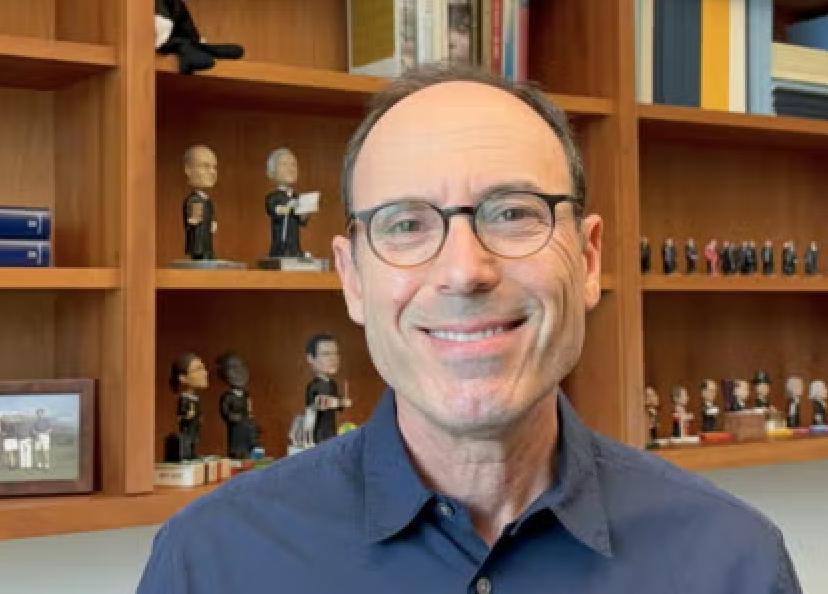
Many TTAG readers were well acquainted with Adam Winkler, proclaimed by gun-ban advocates as a Second Amendment expert, but who is really an anti-Second Amendment expert.
Winkler is the Connell Professor of Law at UCLA Law School and widely touted by those on the anti-gun side of the Second Amendment debate. Now, he’s back in the news, still whining about the 2022 ruling in New York State Rifle & Pistol Association v. Bruen, which he claims has been instrumental in the U.S. Supreme Court making “a mess” out of gun laws.
As most readers will remember, the Bruen ruling established a two-factor standard for courts considering challenges to laws on Second Amendment grounds. First, the court must ask if the Second Amendment’s plain text covers the plaintiff’s conduct. If so, government must prove the modern law matches the nation’s historical tradition of firearm regulation by providing a historical “analogue” from the founding era.
In a recent interview with NJtoday.news, Winkler said two recent rulings—Hemani, where the court ruled it was unconstitutional to deprive marijuana users of their Second Amendment rights, and Wolford, where the court ruled Hawaii’s law making it unlawful to carry a firearm on private property open to the public without express permission—did more than recognize those two laws were an infringement on Second Amendment rights.
“These two decisions expanded the scope of Second Amendment protections in ways that could have far-reaching effects,” Winkler said in the Q&A. “Although the justices in the majority in both cases insisted that the rulings were narrow, the underlying reasoning is quite broad. In both cases, the majority found the challenged laws unconstitutional because there were no similar laws in the 1700s and 1800s.
“Under that logic, it is hard to see how numerous widely accepted gun regulations today would survive judicial challenge, including background checks and categorical bans on felons possessing firearms. There was nothing like pre-purchase background checks in early America nor categorical rules barring criminals from having guns.”
If it sounds to you like Winkler, while trying to make his point that the court has run amok since Bruen, just admitted that nearly every gun law on the books is unconstitutional, you’re right. And that’s a point we have been making since the ruling was handed down. Take just about any current law in which the Second Amendment covers the conduct, and the government will have a darned hard time proving a historical precedent in the founding era because there aren’t any.
Winkler’s real beef over the Bruen standard is the historical precedent test, which he says is too confusing for lower courts to apply.
“When the Supreme Court issued its ruling in Bruen, it established that the current gun law has to be consistent with the history and tradition of gun laws in America—and, in particular, the gun laws that were in effect in the 1700s when the Second Amendment was adopted and the 1800s when it was expanded to apply to the states. ‘History and tradition’ is ambiguous in many ways and often not very helpful in understanding modern gun laws…
“The Court has said the government need not show a ‘historical twin,’ but figuring out how close the match between historical and current laws has proven to be elusive and unpredictable. Bruen said that relying on history and tradition would reduce judicial discretion, but the test is so unclear that, instead, the lower court decisions are all over the map.”
In truth, lower court decisions are “all over the map” because many liberal-leaning judges and courts don’t take the Bruen standard seriously and simply make up their own standard by which to decide cases in order to preserve unconstitutional laws. That, in effect, gives the middle finger to the Supreme Court, basically saying we can do what we want when it comes to the Second Amendment.
Ultimately, Winkler worries that many of California’s multitude of anti-gun laws and restrictions might eventually be overturned as a result of Bruen—a good thing for California gun owners, but not for gun-ban advocates.
“One thing for sure is that California’s gun laws are, if you’ll excuse the metaphor, in the justices’ sights,” he concluded. “UCLA Law’s home state has several innovative gun laws that seem likely to run afoul of the history and tradition test, from the requirement that handguns available for purchase first gain state approval to a 10-day waiting period for gun sales.”
Winkler’s right about one thing: The Bruen ruling ensures that pro-gun advocates will win more and gun-ban activists will lose more as Second Amendment cases work their way through the judicial system. But that’s a good thing, not a bad one.





I do not agree with either the “common use” test or the historical-precedent test as the proper starting point for interpreting the Second Amendment. Both risk shifting attention away from the actual command contained in the constitutional text:
“the right of the people to keep and bear Arms, shall not be infringed.”
“Shall not” is prohibitory language. It tells the government what it may not do. The operative word that follows is “infringed” meaning to encroach upon, limit, or interfere with a right.
My argument is therefore fundamentally textual: before asking whether an arm is “in common use” or whether some arguably analogous regulation existed 200 years ago, the first question should be whether the challenged law infringes the right to keep and bear arms. If it does, the words “shall not” should carry the legal force the Framers gave them.
The Constitution is not primarily a list of permissions granted to the people; it places limits on government power. From that perspective, the burden should not be on the citizen to prove that a particular arm is sufficiently common or historically acceptable. The government should have to confront the constitutional prohibition against infringing the right in the first place.
Current Supreme Court doctrine does not go as far as this argument. District of Columbia v. Heller (2008) recognized an individual right while stating that the right is “not unlimited.” N.Y. State Rifle & Pistol Ass’n v. Bruen (2022) adopted a text-and-historical-tradition framework, and United States v. Rahimi (2024) clarified how historical analogues may support modern firearm regulations.
I disagree with that framework at a more fundamental level: I believe “shall not be infringed” should be given its ordinary prohibitory force. If “shall not” permits the government to restrict the protected right whenever courts develop an exception, then the constitutional command risks becoming a presumption rather than a prohibition.
Starting many moons ago I for one no longer waste time trying to explain the Second Amendment to a bunch of ignorant busy body sacks of sht. Busy body ignorant sacks of sht who are guaranteed to be nowhere around to help should one of their coddled criminals try to do bodily harm to me, mine, etc.
No matter what they say or do sht like the nutty professor cannot whitewash Gun Control simply because History Confirms Gun Control is the best pal Racism, Slavery and Genocide ever had.
No matter how hard the sicko busy body sacks of sht try to sugarcoat and repackage their Gun Control the truthful Historical Anologies surrounding Gun Control sets the pace. That’s Chiseled.
OK, he’s a “Law Professor”…so why are we listening to a scrawny looking adult “academic” with a whole bunch of toys on his shelf and little West Hollywood glasses about militia weapons? Rather listen to Rosa Delauro the blue haired 83 year old “Congressman” on the topic, but instead I listen to Clint, 75th Rangers, JSOC and Delta guys who have earned the right to speak through war.
A winkler is a British term for one who touches his winkle, bet his hands are as soft as a baby’s bottom and he would blister at the sight of a wrench. This is a person who deserves only derision when he wanders into the firearms arena because of obvious cowardice and weakness. So let anyone like this know that if I have a gun and you don’t, I’m their best friend and they’ll do virtually anything for me!
Why, if I ask him to walk a buck naked handstand backwards down the middle of the street with a whole bunch of burning law book pages rolled up his rear end…he’d say “Yes, sir, and thank you sir”. I used that to silence a bachelor party full of lawyers, they’re the weak and cowardly who hate the strong and brave, confront them and make it personal….
But what if I’m weak and cowardly too?
I saw a lawyer from Kansas City on Ninja Warriors, he wasn’t weak and cowardly.
What if I’m in a room full of KC ninja warrior lawyers.
Oh gawd, a room full of KC ninja warrior lawyers dressed up like Native Americans in a Muskogee Oklahoma hotel on a Friday night.
If you are weak and cowardly, I suggest seeing a psychologist to help you with your problem.
I will second that suggestion.
“… numerous widely accepted gun regulations today …” — Adam Winkler
And the legal response to that is, “facts not in evidence”.
First of all, Adam Winkler did not provide any evidence to support his claim of “widely accepted gun regulations”. Second of all, even if he did provide evidence, wide acceptance of laws which violate a U.S. Constitutionally enumerated right does not make them legitimate.
If states or federal government passed laws prohibiting free speech and there was wide acceptance, does that makes those laws legitimate? The obvious answer is a hard “NO!”
the anti-gun *ssholes expect we will bitch anyway so they don’t tell the truth.they are actually trying to mislead the American population so they can pass bad laws.
They don’t need to prove historical context.
They just need judges who will rule in their favor.
As if rulings have anything to do with arguments. 🙄
Shire-man,
There is a reason why there is an official term, “venue shopping”.
Winkler is just another educated idiot who cannot read and comprehend clearly written English, e. g. , the 2nd Amendment.
Not educted. INDOCTRINATED!
“Under that logic, it is hard to see how numerous widely accepted gun regulations today would survive judicial challenge, including background checks and categorical bans on felons possessing firearms. There was nothing like pre-purchase background checks in early America nor categorical rules barring criminals from having guns.”
If someone is too dangerous to own a gun, they’re too dangerous to have knives, household chemicals, a car, blunt objects, etc. Dangerous people should be locked up. Anyone not proven to be a danger to others should have their full rights. End of story.
But how would democrats (read current commie shift version) ever win an election? You sir advocate for voter suppression. In case it is not obvious sarcasm applies here. Although I would probably be reassigned to the department of corrections and community supervision if your idea ever came to pass because………..damn that would be a lot of people here.
It is my understanding, criminals, specifically those found guilty of a felony; have lost their citizenship rights. No voting, no firearm possession. That has been in existence a long time and would not be endangered by a pro 2A ruling.
Well back in the 1800’s even convicted murderers who were not hanged and released after serving their time, were given back their firearms!!!!