
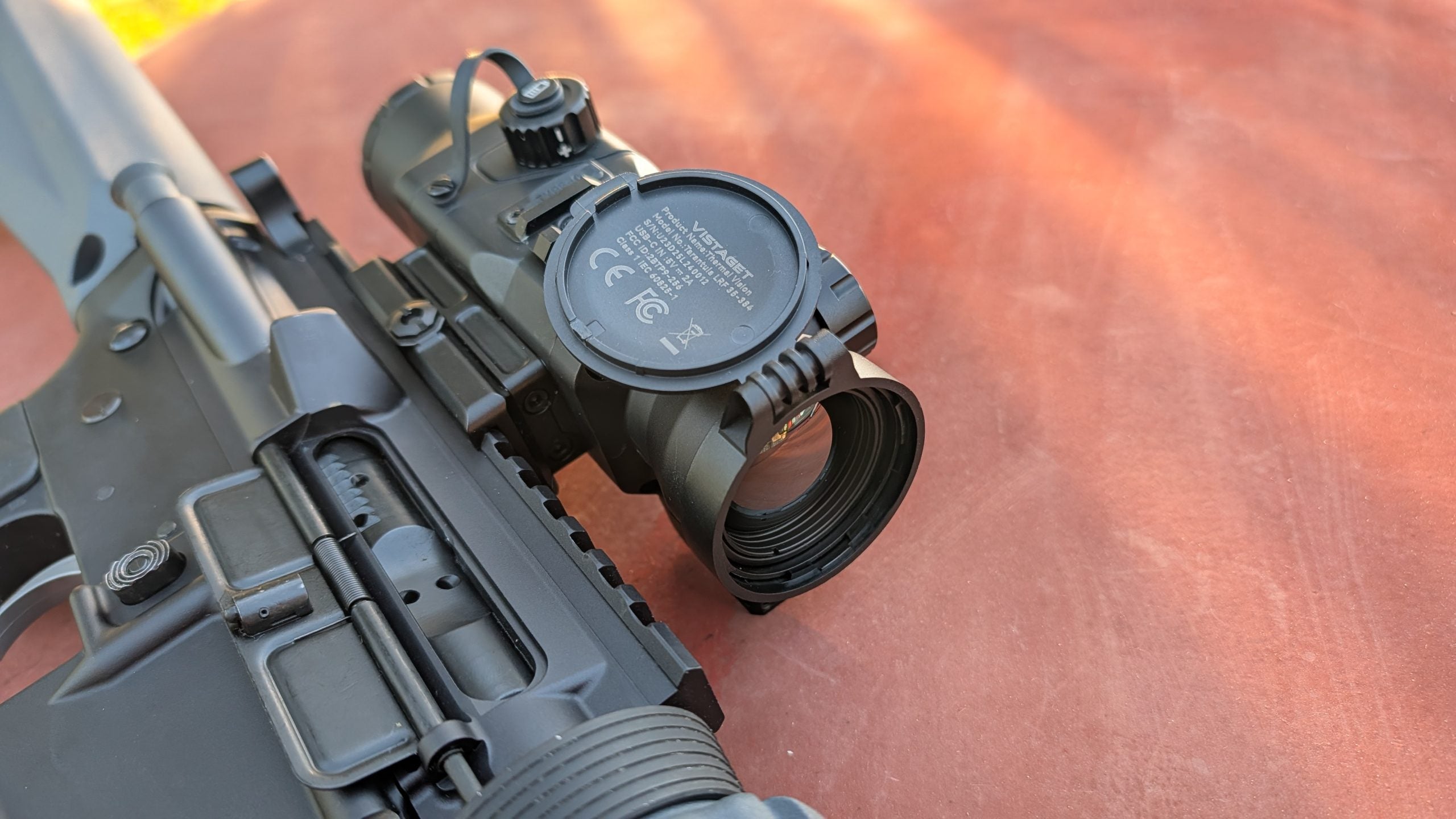
Thermals are dropping in price rapidly. They still aren’t what I’d call cheap, but recent price points and feature sets have made them more desirable and accessible than ever. The Tarantula LRF series comes in at under a grand for the 25-256 model and under two grand for the 35-384 model. Vistaget sent me the LRF 35-384 to review.
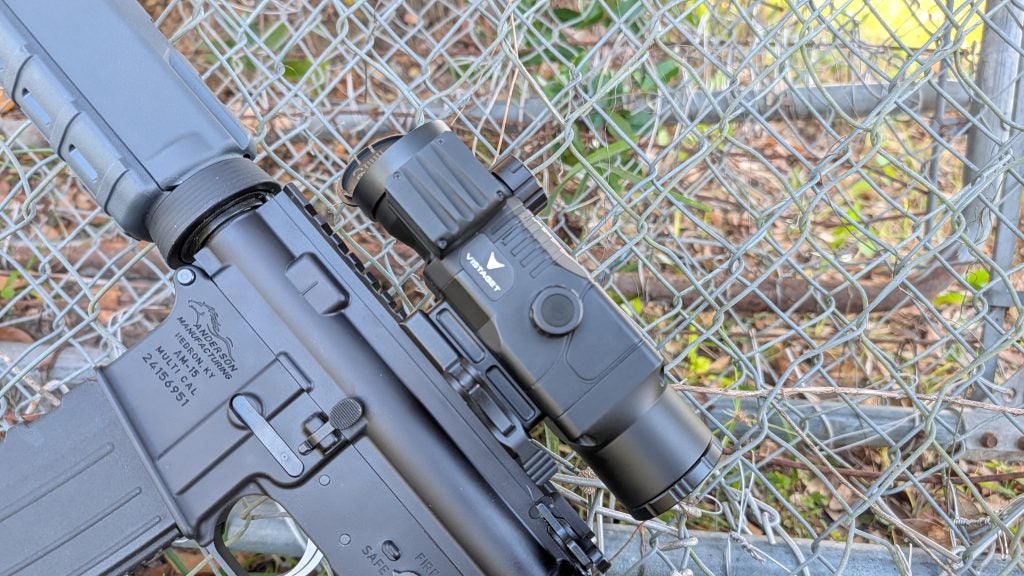
Thermal optics as a whole are fun. I have fun with it when I’m not shooting with a thermal. I live in the middle of nowhere, and I like to take a dismounted thermal out and just look around at night. The first night I had the Tarantula, I did just that and spotted rabbits hopping through the fields. It’s amusing to go from pitch black to seeing a hidden world.
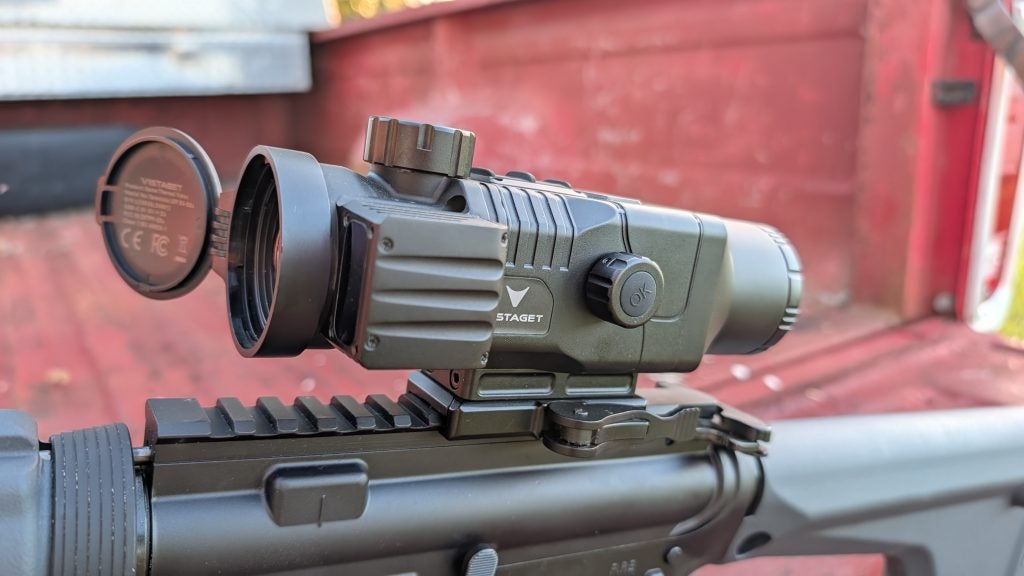
The Tarantula LRF
I’d be lying if I said I had heard of Vistaget before I got an offer to review the Tarantula. Maybe it’s because I don’t golf or watch birds. They seem to have a history of producing golf rangefinders and binoculars. The Tarantula LRF appears to be their first weapon optic. The Tarantula LRF series is made in China, and Vistaget is based in Houston.
I’m continually impressed by how much smaller, lighter, and clearer they’ve gotten in the last decade or so. I was issued a thermal back when I was a cool guy; it was massive and, at best, showed me white or black globs as it drained somewhere between eight and 12 batteries in about two hours. Modern thermals, even the quasi-budget options like the Tarantula, have come a long way.
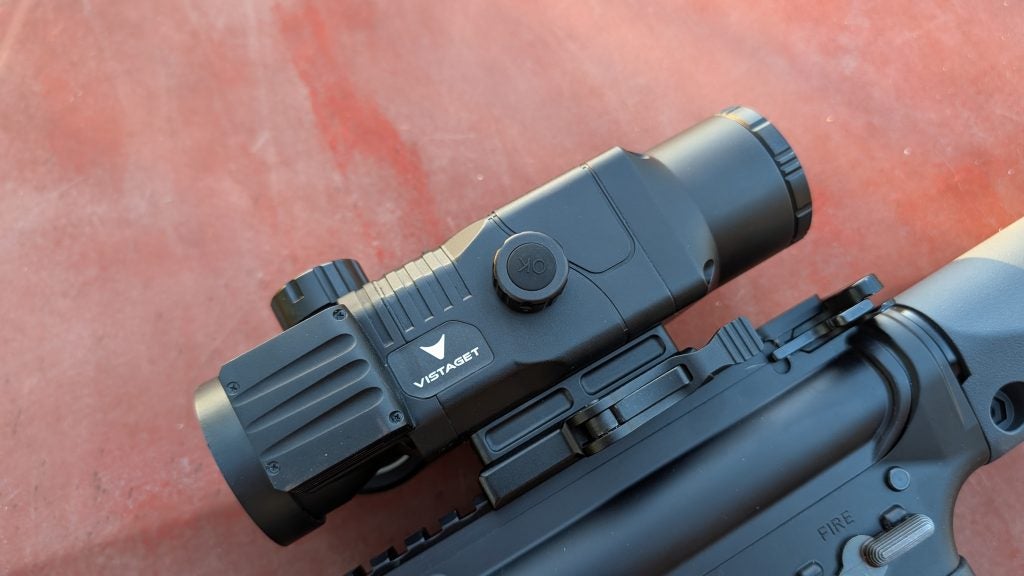
The Tarantula measures out to 6.93 inches long and weighs about 1.54 pounds. It’s not the lightest optic, but it’s a lot lighter than what I used to use.
The Tarantula comes with an internal rechargeable battery, but I can also shove a CR123A into the unit. This allows me to hot-swap batteries if the rechargeable unit dies. Thermals suck batteries faster than I consume nachos, so being able to swap batteries can extend a hunt.
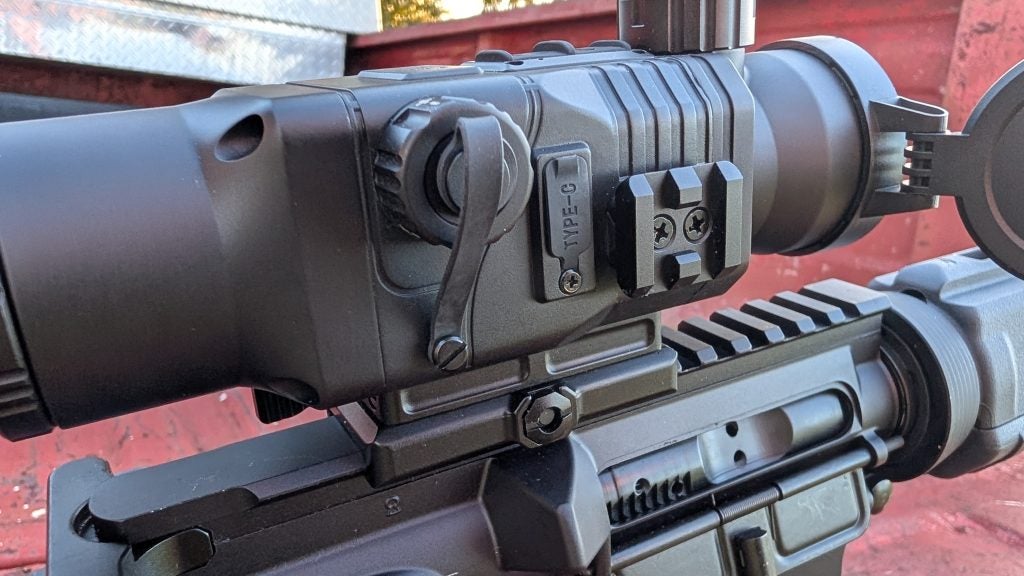
Since thermal optics are cameras at heart, the Tarantula can film and take photos. It even has a recoil-activated mode that takes photos when the thermal detects recoil. Pretty neat for capturing hunts and shots. It even has 32GB of on-board memory.
You can pick between six different color options, including:
- White Hot
- Black Hot
- Red Hot
- Iron Hot
- Emerald
- Highlights
Inside the Tarantula LRF
The numbers 35-384 refer to the 35mm objective lens and the 384 × 288 resolution. The resolution puts it squarely in the mid-tier of thermal optics. The 35mm lens gives you a base magnification of 3.26X, and if I understand thermal optics right, it spreads the infrared signature over more pixels on the sensor, giving you a nice, clean image at longer ranges.
It also packs an 8X digital zoom, but digital zoom distorts the image more as you increase magnification. The Tarantula packs a <15 mK NETD. NETD stands for Noise Equivalent Temperature Difference.
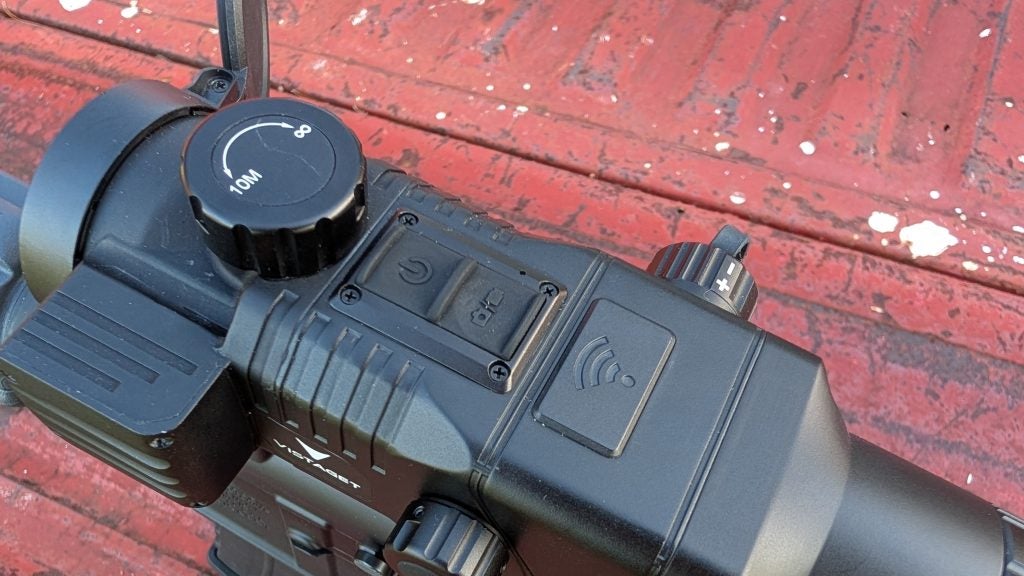
This metric measures thermal sensitivity. For end users, the Thermal LRF can sense temperature variations as small as .015 degrees Celsius. Thermals don’t detect heat; they detect thermal variations. Don’t take it as gospel because environments can affect the sensor’s ability to detect variations, but it shows that the sensor is quite sensitive in optimum conditions.
The Tarantula is highly capable of detecting temperature variations. This type of sensor is almost a necessity here in Florida, where fog and humidity scatter thermal radiation and make targets tough to see.
Behind the Tarantula LRF
We get a promised human detection range of 1,968 yards. I always take these with a grain of salt, kind of like I do with radio ranges. What constitutes detection? A blob that’s roughly human-sized? What environment is this metric ranged at? Plus, with digital magnification maxed out, things get awfully blurry anyway.
I can easily see my dog at 100 yards. (With optic dismounted, of course.) She’s a medium-sized dog, and I can see a clear outline of her body, head, and tail. Finer details like her ears are 100% visible. If she were a hog instead of a dog, I wouldn’t have a problem telling exactly what I was looking at.
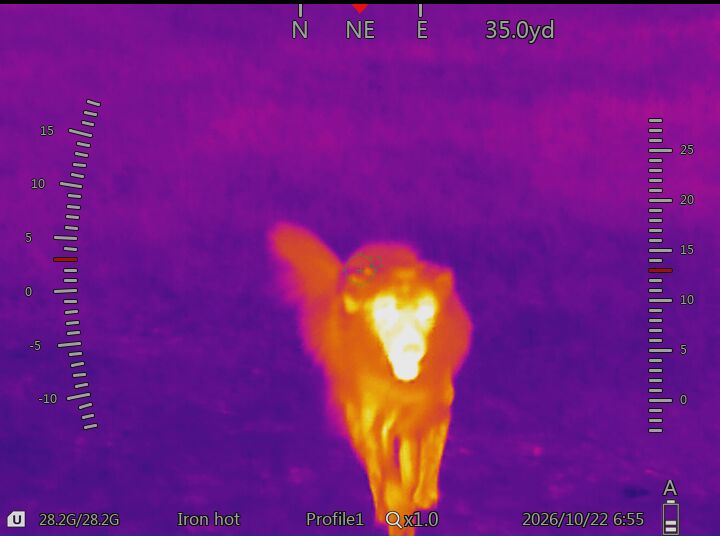
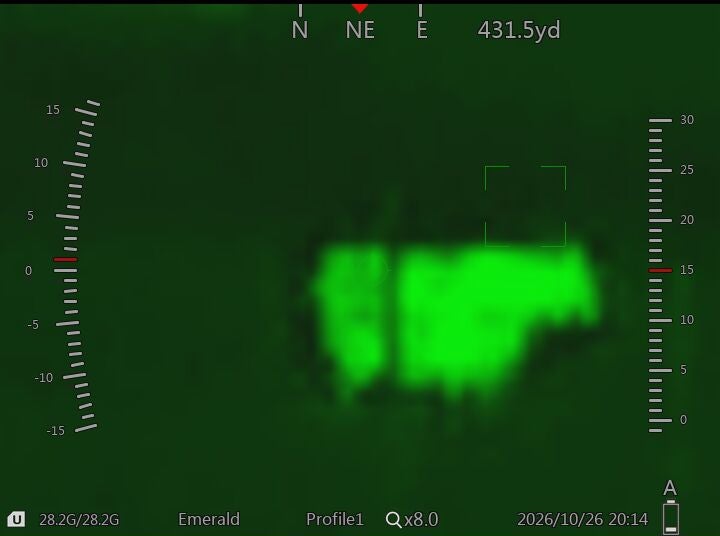
Out to 400 yards, I could easily see vehicles and tell the difference between a half-ton truck and a sedan. I watched cows graze at 200 yards and used the Tarantula to find my daughter’s frolicsome kitten when it escaped into the darkness of a night with practically no moonlight. The details were clear and consistent across each subject I observed.
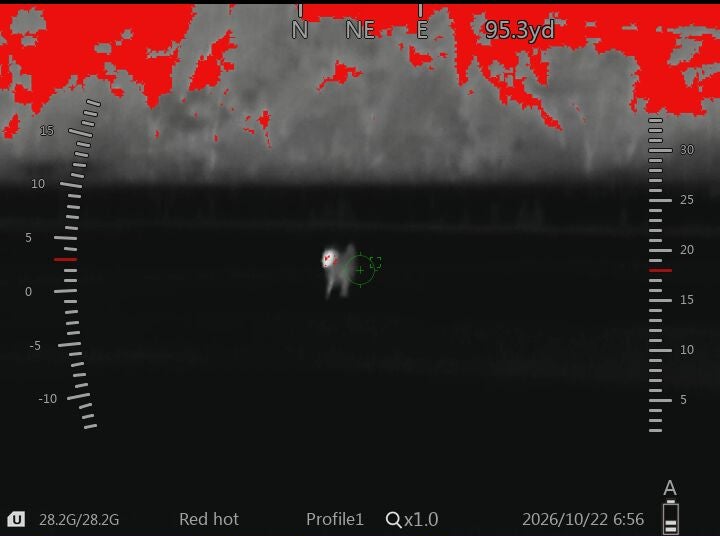
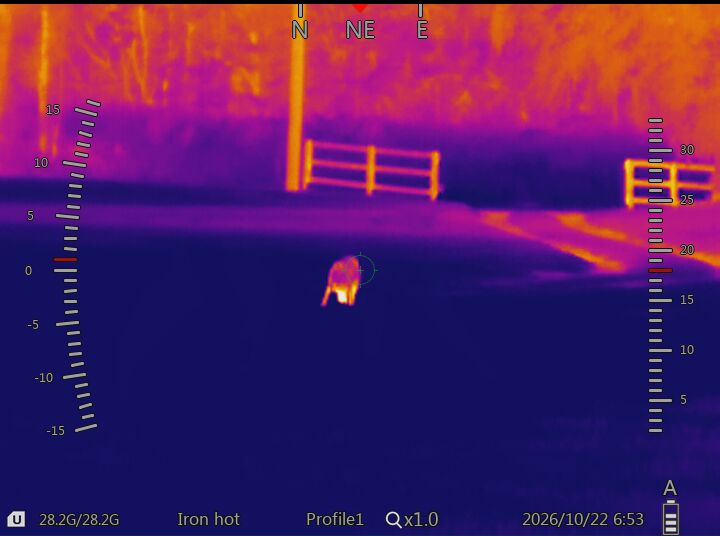
I watched rabbits at ranges between 50 and 100 yards, and they never looked blob-like. I feel confident I could positively identify an animal at the ranges I’d hunt them in low light. I know these specific ranges because the Tarantula has a built-in range finder that can detect targets out to 1000 meters.
Shooting With The Tarantula
Many thermals and even digital night vision offer this feature, which promises you can zero in one shot. Shoot, mark where you hit on the screen, and bam, you’re zeroed. In reality, it’s never that easy. In fact, it can be a real pain. The Tarantula has a similar feature, but it’s much easier to use.
The Tarantula uses a digital zeroing method where the reticle moves on the X and Y axes. You use a dial and switch between the two axes. It’s slow going, but incredibly precise and much easier than systems I’ve used with touch screens and buttons. I zeroed in within a few rounds using a small piece of aluminum foil as a target.
Thermal optics are more sensitive to recoil than standard glass optics. It’s listed as being able to resist 1,200G. To me, that’s like speaking Russian. With a little research, it seems the most powerful bolt-action rifle caliber you should shoot is something like .308. I’m using a basic 5.56 rifle, so I’m not all that concerned.
Due to the nature of thermal optics, it’s a little odd at first. You aren’t looking through the optic, but you’re looking at a screen. Once you get used to it, it’s not hard, but it is odd at first. The Tarantula comes with an eyepiece to conceal the optic’s backlight and give your eye a consistent angle to approach the screen.
Blasting Away
You can buy fancy thermal targets to shoot, and those are great, but I’m a simple man. I just fill up water bottles and freeze them. In a quasi-warm environment, the frozen bottles glow brightly and are cheap reactive targets.
Hell, thanks to the sensitive temperature-variance sensor, I could still see my steel targets out to 200 yards. If I can see it, I can hit it, well, as long as I do my part. It’s satisfying to see frozen water bottles explode one after another at 50 yards. The frozen debris glowed nicely under the Tarantula’s sensor as it littered the ground.
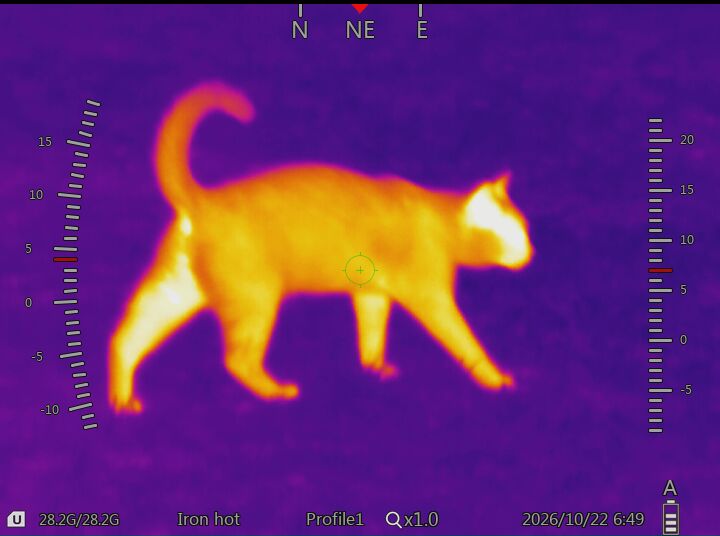
The Tarantula allows you to save multiple zeroing profiles, so it can swap weapons fairly easily. Additionally, if you’re using something like .300 Blackout, you can save profiles for subsonic and supersonic loads.
One of the neater modes allows you to program a ballistic profile into the optic, and then, using the rangefinder, it can provide a hold for you to make your shot. It’s a pseudo-smart optic feature that I wish I had more range to properly utilize.
The Downsides
The digital zoom increases in 0.1 increments. While precise, it takes forever to get meaningful magnification. If I’m trying to zoom in on a small, moving target, I’m endlessly dialing in the magnification.
I’ve also found the turret that you use to control magnification, the menus, and zeroing to be oddly sensitive. Sometimes you dial in a selection and release the turret, and it reverts to a previous selection, whether it’s a reticle, magnification setting, etc. It seems to change the setting before being fully in position.
Additionally, you get the occasional stutter and click when looking at higher thermal-signature variances. For example, if you look at a campfire on a colder night, it will freeze for about half a second before working again.
Cycling through all the menus correctly takes a little practice. It’s a lot of twisting, short presses, and long presses. It’s fine, but not overly intuitive.
Going Dark
The Tarantula LRF 35×384 retails for $1,899, and they often run sales that take about $100 off. At that price point, it’s not super cheap, but it’s priced just a hair lower than the competition. The Tarantula LRF offers excellent clarity beyond 100 yards and helps you establish PID on smaller-than-average targets.
If you’re hunting over large fields and slowly moving toward your prey, the 384 model’s extra range is fantastic, but you’ll pay for it.
That’s great, but if you’re like me and a more casual nighttime shooter looking to plug hogs with holes at 50 to 100 yards, the Tarantula LRF 25-256 might be the better option. It’s a thousand dollars cheaper, and in the southeastern swamps it’s enough range.
Both models come packed with features and have some oddities to them, but none of those are deal breakers if you’re looking to save a few hundred dollars.
I’ve never successfully hunted at night, but my prospects are looking up. With an ever-growing hog problem, I hope to cull a few before the year ends, and the Tarantula will be part of that. Imports are democratizing the thermal world, and I’m betting prices will keep dropping. It’s a new world of night optics, and I’m happy to see it finally land.




I have been seriously wanting a lower-priced thermal scope for night time hog and coyote hunting. For two years now, I have been saying to myself to wait a bit longer for the prices to drop even lower.
The recent election results have me wondering now if Dems will set out to outlaw thermal scopes in addition to outlawing just about everything else that has to do with firearms. I have to put some serious thought now into moving up my timeframe.
To be honest I see more restrictions on 3d printers and drones coming before thermals but I have been wrong on guessing worst case before. In a similar boat for looking at whatever I may want to pick up but keep landing back at property outside of NY and energy/utility independence given our constant rate hikes.
The freezing when you hit an out of range temperature is “autoranging” where the unit resets for the fire at 400+ degrees when it was only looking at low temperatures. So it was operating at say 40-60 degrees, then it had to accommodate 40-400+. Expensive cameras let you do band filters to include or exclude thermal ranges.
We have been using thermal imaging in the Energy Sector since they needed cooling gas, and it is worthwhile to read up on the actual capabilities of thermal imagers. You can also buy a better camera in an inspection handheld for a few hundred, and that will direct you onto targets you can then hit with your I-Squared. Here’s one for $199.00 that even an ignorant, dirt poor former politician can afford if he sells a couple Bersas:
https://www.vevor.com/thermal-imaging-camera-c_11961/vevor-infrared-thermal-imager-thermal-camera-ir-resolution-240×180-2-8-lcd-screen-p_010117537355?adp=gmc&utm_source=bing&utm_medium=cpc&utm_id=604142970&utm_campaign=NC-PLA-All-%E9%AB%98-US-1st%20level-Electrical-TROAS-20240428-ZQL-%E6%80%BB&msclkid=a445baa542a8145016e9d055ccf4ff73&utm_term=4587162525380067&utm_content=Electrical
Might the Idiot DSA Friends of Duly Elected try to outlaw thermal camouflage like Ametrine’s? Mylar, ground glass and spray adhesive, hot patch decoy targets, etc. are just too easy to make…