
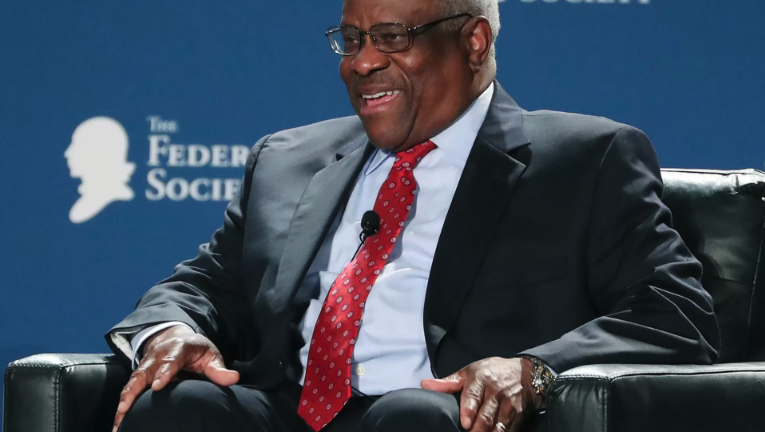
Ask most people where the right to keep and bear arms comes from, and they will point to the Second Amendment. Justice Clarence Thomas says that answer misses the point entirely. The amendment doesn’t hand you the right. It assumes you already have it, and it tells the government to keep its hands off.
That distinction sounds like a small one. It is the whole argument.
What Thomas Actually Said
Speaking with Senator Ted Cruz on the Verdict podcast, Thomas laid it out in three sentences. “The Second Amendment says the right to bear arms shall not be infringed,” he told Cruz. “It assumes a right. It doesn’t grant a right.” The exchange was later highlighted in a video published by Colion Noir.
The Constitution, in Thomas’s telling, created the federal government. It didn’t create the individual rights that government exists to protect. Those rights came first. The government came after, and it received its authority from the people who already held those rights.
That is the ballgame. If the government grants a right, the government can redefine it, ration it, or take it back. Every licensing scheme, every discretionary permit, every “may-issue” carry law, every list of approved gun owners runs on the assumption that the right flows down from the state. Thomas rejects that assumption at its root. Under the Founders’ view, the government isn’t the party that grants. It is the party being restrained.
Why the Declaration of Independence Comes First
Thomas made his point while explaining why you can’t understand the Constitution without first understanding the Declaration of Independence.
The Declaration establishes that rights come from God, or “nature’s God,” rather than from government. People possess those rights first. Then they delegate a limited slice of authority to a government built to protect what they already hold. That order matters. Either citizens receive their rights from government, or citizens already possess their rights and government receives its authority from them. Only the second arrangement fits the American constitutional system.
Read the text of the amendment with that in mind and it reads differently. It doesn’t say the people may have arms. It says the right “shall not be infringed.” The command runs against the government, not toward the citizen.
The Founders Already Assumed an Armed People
Thomas is describing something the founding generation took for granted. The debate over the Constitution, as the National Constitution Center explains, turned on a fear that the new federal government held almost total authority over the army and the militia. Anti-Federalists worried this would strip the states of their main defense against federal overreach. Federalists answered that the American people were armed and would be nearly impossible to subdue by force.
Buried inside that argument were two shared assumptions. First, that the Constitution gave the federal government sweeping power over the army and militia. Second, that the federal government had no authority at all to disarm the citizenry. Both sides agreed on that second point. They disagreed only over whether an armed population could actually deter federal tyranny.
That’s why the Second Amendment passed so easily. There was widespread agreement that the federal government should not have the power to infringe the right to keep and bear arms, any more than it should have the power to shut down speech or ban the free exercise of religion. The right wasn’t being invented. It was being fenced off from government reach.
The Supreme Court Has Said the Same Thing
Thomas wasn’t floating a fresh legal theory on a podcast. He was restating in plain English what the Court has already ruled.
In District of Columbia v. Heller, the Court considered whether the District’s ban on usable handguns in the home violated the Second Amendment. Justice Scalia’s majority opinion held that the amendment protects a private, individual right to have arms for self-defense, not merely a right tied to militia service. The Court described the right as pre-existing. It didn’t manufacture a new privilege in 1791.
Scalia’s opinion also settled a long-running fight over the amendment’s grammar. The Second Amendment breaks into two parts: a prefatory clause about a well-regulated militia and an operative clause protecting the right of the people. The prefatory clause announces a purpose. It doesn’t limit the operative clause. A statement of purpose can clear up an ambiguity, but it can’t shrink the command that follows. The right belongs to the people.
Two years later, in McDonald v. City of Chicago, the Court held that this same individual right applies against the states through the Fourteenth Amendment. Thomas rested his own vote on the Privileges or Immunities Clause rather than the Due Process Clause the other justices used, but all five in the majority agreed the states could no longer infringe the right.
Bruen Put the Burden Where Thomas Says It Belongs
Thomas later wrote the majority opinion in New York State Rifle & Pistol Association v. Bruen, which held that ordinary, law-abiding Americans have the right to carry handguns in public for self-defense. Bruen struck down New York’s “may-issue” scheme, which forced applicants to demonstrate “proper cause” and let officials deny permits based on subjective judgment.
Bruen also threw out the “means-end” balancing tests lower courts had leaned on to uphold nearly any restriction placed before them. The framework that replaced it tracks Thomas’s podcast argument exactly. First, the challenger shows that the plain text of the Second Amendment covers their conduct. If it does, that conduct is presumptively protected, and the burden shifts to the government. The government must then prove its restriction is consistent with the nation’s historical tradition of firearm regulation.
That order is the whole point. You don’t have to prove you need your rights. The government has to justify interfering with them. In United States v. Rahimi, the Court clarified that this test asks for a “historical analogue,” not a “historical twin,” and the Court reaffirmed the framework in Wolford v. Lopez, again naming self-defense as the amendment’s central concern and rejecting judge-created balancing.
Reconstruction and the Practical Case for Armed Citizenship
Thomas tied the right to the aftermath of the Civil War and the Fourteenth Amendment. Freed Black Americans faced intimidation, beatings, lynchings, and murder from former Confederates and white-supremacist groups. The Radical Republicans understood that citizenship meant nothing if freedmen couldn’t defend themselves when authorities wouldn’t.
The right to bear arms was the practical means by which vulnerable people protected their own lives when the government failed them. That history cuts against any attempt to paint the Second Amendment as a dusty relic reserved for militias or rural hunters. Armed self-defense was a civil right for the Americans whose government abandoned them.
Thomas closed the discussion with a story about Justice Stephen Breyer. Breyer described a hypothetical robber armed with a machete and asked what Thomas would be doing on his porch. Thomas answered that he’d be “cleaning my guns.” The line got a laugh, but the principle under it didn’t depend on the joke. Self-defense starts with the individual, because criminals don’t wait for permits, police response times, or a licensing officer’s mood.
What to Take From It
Thomas’s remarks aren’t a ruling and not a forecast about any pending case. They’re a clean statement of the principle that should frame every Second Amendment fight.
When you hear a proposal to license carry, ration ownership, or approve only certain gun owners, ask the question Thomas’s framework demands. Who has to justify themselves here? If the answer treats you as the party seeking permission rather than the party already holding the right, the proposal has the Constitution backwards. The government didn’t give you the right to keep and bear arms. The Constitution orders it to leave that right alone.





If .gov treats gun owners like they DO just imagine being disarmed!!! My Mexican mechanic has one gat. I told him I had 7. He thought that was a lot😀😃😄!
Some dismiss Heller’s protection of the individual right, observing it was “a narrow 5-4 partisan decision”. The overall decision was 5-4, but all nine Justices – even those who dissented from the majority’s opinion – agreed on that aspect.
Stevens’ dissent (joined by Souter, Ginsburg, and Breyer) says “Surely it protects a right that can be enforced by individuals.”
Breyer’s dissent (joined by Stevens, Souter, and Ginsburg) says “The Amendment protects an “individual” right — i.e., one that is separately possessed, and may be separately enforced, by each person on whom it is conferred.”