
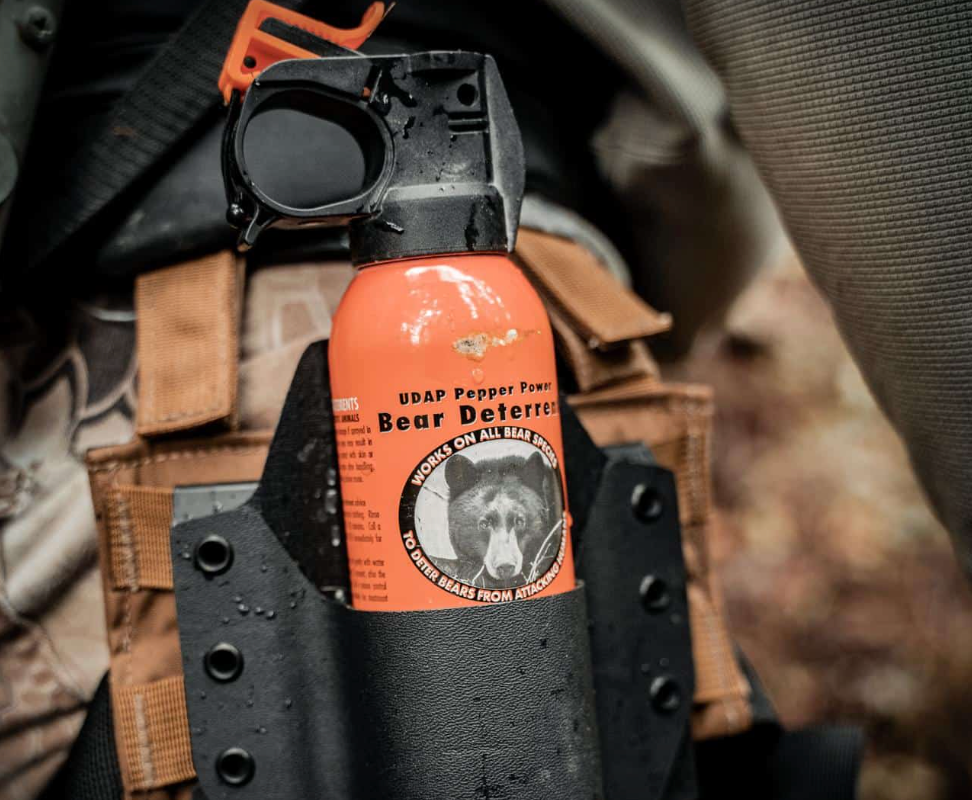
If you carry a defensive tool into bear country, you probably want some confidence that it’ll work when several hundred pounds of teeth, claws, and bad intentions are coming your way.
The good news for gun owners is that the old claim that handguns are useless against bears doesn’t hold up particularly well against the available evidence. The bad news for anyone looking for a tidy “guns beat bear spray” conclusion is that the numbers aren’t nearly as clean as they’re often presented.
The “Handguns Don’t Work on Bears” Myth Needs to Die
The idea that a handgun won’t stop a bear — or that you’re effectively no better off carrying one than carrying nothing — largely comes from older analyses that have since been fairly picked apart.
Firearms writer Dean Weingarten and others have spent years documenting cases in which people actually fired handguns while defending themselves against bears.
The dataset now includes more than 170 North American incidents, with a reported success rate of roughly 98%. And that isn’t simply a highlight reel of successful shootings. The project includes known failures, too.
The calibers involved run the gamut. People have successfully defended themselves against grizzlies, brown bears, and black bears with 10mm pistols, .44 Magnums, 9mm handguns, and even .22s.
That doesn’t mean your pocket .22 just became the ideal grizzly gun. It does mean the blanket claim that handguns don’t work against bears is difficult to square with the documented record.
Bear Spray Works, Too
None of that makes bear spray snake oil.
In the widely cited Alaska bear-deterrent study, 72 spray incidents stopped undesirable bear behavior 92% of the time with brown bears and 90% with black bears. Larger collections of incidents have shown bear spray’s effectiveness to be roughly 90%.
In other words, both handguns and bear spray have pretty impressive track records.
That’s also where people tend to get themselves into trouble with the statistics.
No, You Can’t Just Compare 98% to 90%
It’s tempting to put a roughly 98% handgun success rate next to a roughly 90% bear-spray success rate and declare the pistol the winner.
That isn’t what the data actually tell us.
The handgun and bear-spray datasets were assembled differently, examine different types of encounters, and don’t necessarily define “success” the same way. Weingarten himself has cautioned against treating the two percentages as an apples-to-apples scientific comparison.
There’s also an unavoidable selection problem.
Nobody writes a news story about the bear that wandered away before anyone drew a pistol or pulled the safety tab off a can of spray. We know about encounters where something happened. We know much less about all the encounters where nothing happened.
That makes sweeping conclusions difficult.
What the available evidence does support is simpler: handguns work against bears far more often than some conventional wisdom would have you believe, and bear spray works very well, too.
The Fatality Numbers Are Harder to Ignore
Fatal encounters give us another way to look at the issue because deaths are considerably less likely to disappear from the record.
Here, the documented history becomes particularly interesting.
Fatalities among people who actually fired a handgun in defense against a bear appear to be extraordinarily rare. The commonly cited exception involved a guide in Svalbard who attempted to defend against a polar bear with a .22.
By comparison, there have been multiple fatal bear attacks in which spray was deployed, including incidents involving experienced backcountry travelers.
That doesn’t prove a handgun is statistically superior. The sample is small, circumstances vary wildly, and bear attacks don’t happen under controlled laboratory conditions.
But it is a data point worth considering, particularly when the argument shifts from simply stopping undesirable bear behavior to stopping an attack that has become immediately life-threatening.
The Park Service Has a Point
The National Park Service recommends bear spray over firearms, and there are legitimate reasons for that recommendation.
A cloud of capsaicin doesn’t require the same precision as placing a bullet on a charging animal. That matters when someone has little firearms training, adrenaline is dumping into the bloodstream, and a bear is covering ground far faster than most people realize.
There are other considerations. A poorly placed shot can wound a bear without stopping it. Missed rounds have to go somewhere. And handling a firearm under extreme stress creates its own risks.
In one documented Alaska encounter, a hiker successfully stopped a charging brown bear with a 10mm handgun — then accidentally shot himself in the foot as he went down.
He stopped the bear, so the handgun unquestionably worked. The incident also illustrates why simply possessing a firearm isn’t the same thing as being prepared to use one under pressure.
Carry What You Can Actually Deploy
The practical takeaway isn’t particularly complicated.
A handgun is a legitimate bear-defense tool, and the idea that guns simply don’t work against bears needs to go.
Bear spray is also highly effective and has some obvious advantages, particularly for people who aren’t skilled enough with a handgun to make fast, accurate hits on a moving animal under extreme stress.
Environmental conditions matter, too. Wind can make spray less predictable, and cold temperatures can affect aerosol performance. Firearms come with their own limitations, legal restrictions, and consequences.
That’s why carrying both isn’t an unreasonable answer.
Whichever option you choose, accessibility and competence matter more than internet arguments over percentages. A 10mm buried at the bottom of your pack isn’t much help when a bear is already closing. Neither is a can of spray you’ve never practiced drawing and deploying.
Carry it where you can get to it immediately. Know how it works. Practice getting it into action. Understand the laws in the places you’re traveling.
Because when a bear decides you’re the problem, the best defensive tool isn’t necessarily the one with the best percentage attached to it.
It’s the one you can get into the fight in time.






Once, I thought I a bear had run into my car.
It was late at night, around 11 PM and I was coming home from the lab. Rounded a tree lined unlighted blind curve I had driven through thousands of times, and suddenly there is this black shape on all fours running into my car from the side. We do have an occasional bear sighting, but around that time we had had several that week and it was probably the same bear rummaging through garbage cans. So I thought it was possibly a bear. I mean, it was big and bulky and on all fours and it was dark and I only caught a brief glimpse of something as it hit the side of the car so I really could not tell.
So I stop and look back and see this black shape on the road a ways back just laying there. So I grab a can of bear spray from the trunk and approach some with flashlight in hand, bear spray in the other, and my EDC in its holster. I see its not a bear, just one of our local raging left wingers that weighs around 300 lbs. I got to where he was and didn’t see any blood or bleeding or cuts or gashes and he is starting to move around some. So I asked him if he was hurt, he said “Urghhmpfff” then threw up. Then the smell hit me, he was drunk.
I sprayed him with bear spray, and called 911.
I love a happy ending! Thanks for the laugh.
Bears attack because they are afraid of losing their arms and I would too because every Harry Dick and Tom think they have a right to them.
What works best on leftists?
Labor
I’ve never heard of being self incapacitated firing a hand gun into the wind.
Rnelson,
You stated my biggest reservation when it comes to bear spray.
I will also state my big reservation with respect to deploying firearms against bears: permanent hearing loss. Of course permanent hearing loss is better than being dead. At any rate, I am in no hurry to lose any more of my hearing.
My “go-to” solution for an attacking bear is my .44 Magnum revolver with 6-inch barrel that I carry in a chest holster when I am out in the wilds. I hope and pray–and try very hard to ensure–that I never have to use it.
Outside with at most 6 shots the hearing loss shouldn’t be too terrible considering alternatives. Worse than typical unsuppressed hunting but better than indoor 9mm unsuppressed I would guess.
I’ve been up close to a couple of black bears over the years. I always had a firearm. Never had to use it.
My thought was that bear spray is an up close weapon. If it fails will you have time to deploy a firearm?
If the bear has chosen the fight I’m starting with the lethal option.
Same. I grew up being near them quite a bit, so I never really used to view them as threatening which can be dangerous. I guess it’s like Floridians growing up around gators, so they don’t think twice about going swimming in a river or lake which sounds insane to me.
I have heard that a box cutter can be an easily carried and very effective tool for bear defense.
You just reach down with it, cut your buddy’s shoelaces, and run away like a scalded bunny.
Bear spray failure: Fatal Glacier Grizzly Attack Report Confirms Hiker Emptied Bear Spray.
“On Sunday, May 3, 2026, at about 9:30 pm, Anthony Polio was attacked by a mature grizzly bear on the Mt. Brown Lookout trail in Glacier National Park. Polio had time to draw and empty his 7.9-ounce Bear Guard bear spray before he was killed by the bear.
The official report on the incident has been released by the Interagency Grizzly Bear Committee (IGBC) Board of Review. The Board of Review consisted of 10 people: 4 from federal agencies, 1 from Wyoming Game and Fish, and 5 from Montana Fish, Wildlife, and Parks. From the official report, p. 10:
Claw marks on a burned tree and a displaced stone suggested that the bear launched its attack from this point (Photo 4). This is also where the discharged canister of bear spray was located.
The bear spray can was fully discharged. The empty can weighed 84 g. A new, full can of the same brand with the same expiration date weighed 312 g, a difference of 228g. The advertised quantity marked on the label was 225g.
…”
ht* tps://www.ammoland.com/2026/08/glacier-grizzly-bear-spray-failure-report/
[note: Bears are like the rampaging rabid left wingers at their ‘anti-ICE protests’. Once they get started on their rampage they are hard to stop, and it takes more than just irritating them or making them uncomfortable to stop them. It takes something definitive that brings them to a dead stop right where they are.]
Bear spray is better against NUISANCE bears.. i.e. bears wandering in your camp ground or garbage cans… they may be on the trail but not attacking you (yet.) Bear spray can be used (and is) for such events and when bears actually attack.
Handguns are better for violent attacking bears. In fact that is the ONLY time you can use the handgun!!
Thus virtually all the data with handguns is when bears actually attack while bear spray may very well contain non-violent bear incidences. And that puts their success ratio into question.
As for carrying both.. can be done. Use bear spray on nuisance bears… and handgun for violent bears.
All in all though, if one is skilled with a handgun.. I’d pick the handgun. If not skilled.. the bear spray.