
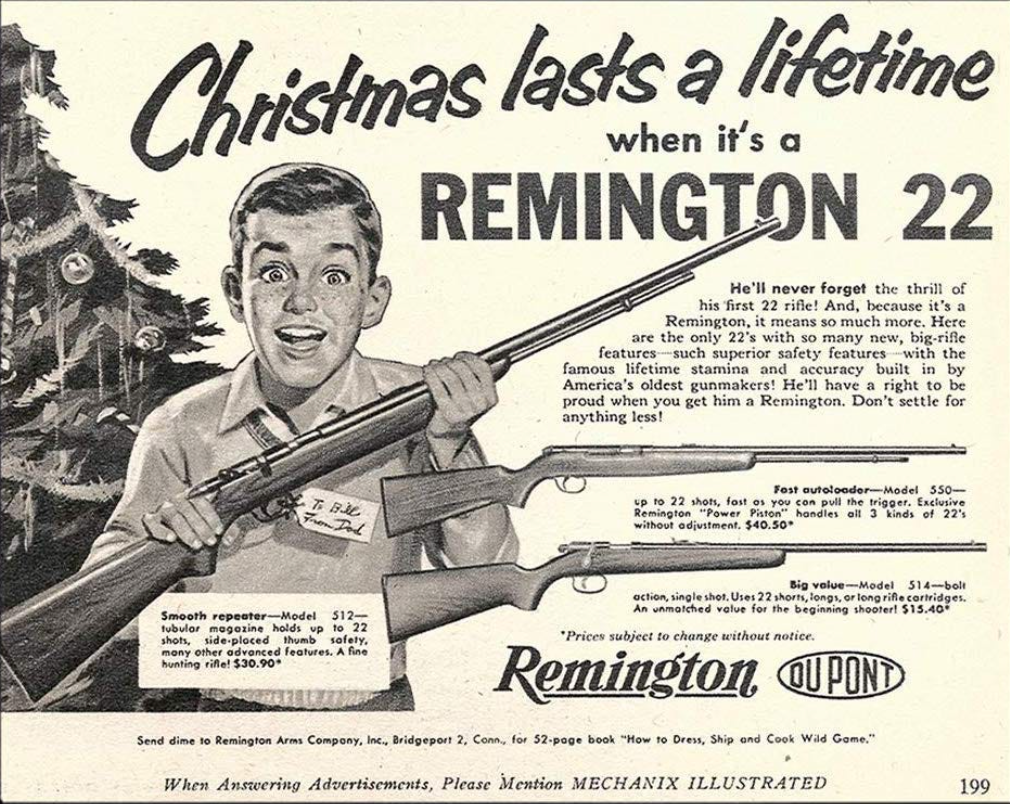
A widely shared theory holds that Baby Boomers became a “nation of guns” because toy makers hooked them young. The argument, laid out by graphic designer Steven Heller in a recent PRINT Magazine column and circulated again on the enthusiast web, runs like this: realistic replica toys that actually shoot, backed by heavy advertising, planted an “inexplicable urge to hold, aim and shoot” in children “before we had a chance to learn otherwise.” Heller frames the whole thing as manufactured desire — indoctrination by catalog.
That theory has a hole in it, and the hole is history. Guns are older than cowboy radio shows, detective magazines, video games, and replica toys combined. People invented and adopted firearms long before any marketing department existed to sell them. If the appeal of a gun depended on the ad campaign, the appeal would have started with the ad campaign. It did not. So before you accept the idea that a generation was programmed into gun ownership, it helps to look at who the Boomers actually were, what surrounded them growing up, and what a simpler explanation offers.
Who the Boomers Were and Why the Generation Was So Large
The Baby Boom generation covers the surge in births in the United States from 1946 to 1964. Over those nineteen years, nearly 76 million babies were born — a generation 60 percent larger than the one before it. It is the only generation the U.S. Census Bureau distinctly recognizes, with the boom period running from mid-1946 to mid-1964.
The popular belief that the boom happened simply because soldiers came home from the war doesn’t fully hold up. Births began rising before the war ended, and the surge lasted far too long to be explained by returning troops alone. A fuller picture includes the recovery of birth rates after the Great Depression and World War II, the long economic expansion that followed the war, higher marriage rates, and fewer job opportunities for younger women. A lull in immigration under the Immigration Act of 1924 also meant the generation started out with an unusually low share of immigrants.
The scale matters here because sheer numbers reshaped everything the generation touched. Los Angeles county opened, on average, a new school every month from 1946 to 1964. When a group that large develops a shared interest in anything, it looks like a national movement — because it is one.
What Actually Surrounded Boomer Kids Growing Up
The world these children grew up in was saturated with firearms long before any toy Colt reached their hands. World War II left behind enormous quantities of military arms and industrial capacity. As veterans returned home and factories shifted back to civilian production, the American firearm market absorbed both the surplus and the influence of wartime design. Affordable surplus rifles and handguns introduced many civilians to firearms, while Winchester, Colt, Smith & Wesson, Remington, Ruger, and Savage repositioned themselves for a peacetime market built on hunting, target shooting, home defense, and outdoor recreation.
Popular culture reinforced the connection without needing to invent it. The number of American households with televisions jumped from a handful to more than nine in ten between 1946 and 1964. Westerns filled those living rooms with images of Colts, Winchesters, lawmen, and frontier justice. Even when the stories were fictional, they tied firearms to history and identity in the minds of the audience. So a Boomer child grew up with a father who may have carried a rifle in the war, a household that owned a hunting shotgun, and a television that ran cowboy dramas after dinner. The replica toy was a small part of a far larger picture.
The Cold War Backdrop
The mood of the era added another layer. The Korean War began in 1950 and reminded Americans that World War II hadn’t bought a peaceful century. Firearms returned to newspaper headlines, and the value of arms production and readiness stayed in the national conversation. Children of the period grew up with air-raid drills, military newsreels, and a widespread belief that being prepared mattered.
That environment didn’t fetishize guns for fun. It treated them as tools tied to survival and national defense, existing in the shadow of a dangerous world. A child taught that readiness matters is not the same as a child sold a fantasy by an advertisement.
The Boomer Gun Market Was Real and It Was Rich
The demand of this era produced some of the most collectible firearms ever made in America. Several milestones landed in the mid-1950s alone. Colt introduced the Python in 1955, Smith & Wesson launched the Model 29, Ruger introduced the Blackhawk, and Colt revived the Single Action Army in 1956. These were signals of a strong civilian market with room for prestige, power, and craftsmanship.
The same country buying televisions, cars, appliances, and suburban homes was also buying beautifully made revolvers, rifles, and shotguns. The catalog of the period reads like a collector’s wish list today: the Smith & Wesson K-22 Masterpiece, the 1950 Colt Detective Special, the Colt Woodsman Match Target, the 1949 Savage Model 99, the Winchester Model 42, and the 1962 Colt Gold Cup National Match. Some reflect target-shooting culture, some hunting and outdoor life, some the prestige of the major makers. None of them were made for children, and none of them needed a toy to sell.
When the Mood Shifted
The optimism didn’t last the whole period. The assassination of President John F. Kennedy in Dallas on November 22, 1963, changed the national mood almost instantly. Firearms, mail-order availability, public security, and political violence all became part of a much larger and more anxious public conversation. That event marks a clear cultural break in the Baby Boom firearms story.
By 1964, the first Boomers were reaching adulthood and the country was entering a decade of unrest. The phrase “pre-64” became collector shorthand for more than a manufacturing date — it stood for a belief that something had changed in how American guns were made and how Americans thought about them. The roots of the modern federal gun-control framework, which would produce the Gun Control Act of 1968, were already visible in the public concern following high-profile violence.
A Simpler Explanation Than Indoctrination
The indoctrination theory asks you to believe that desire for firearms was implanted by marketers. A plainer reading fits the evidence better. Children are drawn to controlling powerful things as an extension of the instinct to survive — the same drive that leads young animals into mock battles within a litter. Creative play built around power and defeating an imagined foe is normal for kids. A company using that natural leaning in its advertising doesn’t make ownership indoctrination.
Add the real backdrop — a country awash in surplus arms, a shooting and hunting culture, a Cold War premium on readiness, and a founding tradition that treats an armed citizenry as a check on tyranny — and the “nation of guns” needs no conspiracy of toy makers to explain it.
What to Do With This
If you own or inherited firearms or replicas from this period, treat them as historical objects. The pre-64 designation carries real meaning for collectors, so identify the maker, model, and year before you assume a piece is ordinary. Guns made between 1946 and 1964 sit at the edge of two manufacturing worlds, and that context is what gives many of them value. Understand the era that produced them, and you’ll see the appeal for what it was — a large generation living in a country where firearms were already woven into work, sport, defense, and daily life.







As a survivor of that generation allow me to add an additional reason for the attraction to firearms for men of the period. We grew up in a mechanical age. Our toys were mechanical. We played with things like steam engines and erector sets. Guns were an extension of those things. Once television became a social narcotic things began to change slowly to a less existential experience. Communication became faceless and isolation became more normal. Fast forward 80 years and we arrive at today where a steam locomotive going across country brings thousands of spectators who have never seen such old “technology” actually operate. Those crowds used their sensory perception to feel, smell and taste the past. On witnessing that I feel that there may be a small portion of society who have had their interest in mechanical things reawakened. I hope so for their sake. I hope so for the country’s sake. Drop the iPad, look people in the face, experience your existence, make things work using your hands and skill. For the benefit of some young people today teach them how their toilet works. I know one young man who communicated with people around the world without leaving his home, but couldn’t understand the applied physics necessary to clear a toilet.
As a Boomer in a jammed packed year for births(we had split shifts & 2 grade classes in grade & high school)I can relate. We played war as kids. I got a Mattel “machine gun” & a cool shiny 38 for Christmas. The 38 looked real. Went shooting with my dad as a kid. Dad had a NRA sticker on the front door. Went to the local gun show too. He just had a 22 rifle & a 22 revolver. I remember shooting a 410(?)in the Boy Scouts. Nothing changed afterJFK got murderd!
We were raised by a generation that had survived the depression and ww2. These were folks that had seen the absolute worse the world could throw at them. They were all armed.
And we boomers learned at their knee.
Hopefully you had better haircuts than the kid in the advertisement.
That kid just screams “When I grow up I want to be a used car salesman so I can fuck people over good and hard with shitty products and payment plans with high interest! Caveat emptor, losers!”.
The ad is true to fact…Only useful idiots suckered into siding with Gun Control an agenda History Confirms is the best pal Racism, Slavery and Genocide ever had would object.
I am a boomer. We did not get the kind of magazines that had ads for firearms in them We got Life. We had Bonanza, cap guns and we made guns out of tinker toys. No one in my family owned a firearm. No one hunted. (Actually, my father likely hunted when he was in his teens in the great Depression. He came from backwoods Pennsylvania where everyone hunted, legally or illegally, during the Depression when jobs and money for food was scarce.) I bought my first rifle, a Savage .22, because my kids were enjoying shooting a pump pellet rifle. And I went from there. I still don’t read gun ads (just reviews). But I have a nice collection of rifles, pistols and revolvers.
Born in 1957, the same year the M-14 was adopted as the US service rifle, the same year as the classic ’57 Chevy, bubble wrap, the Burger King Whopper, and Tang drink mix all made their debut in 1957.
I’m a proud Boomer.
Yes, I got toy guns for Christmas.
Crossman M-1 carbine BB gun @ 8.
My older brother and I took turns kneeling so the other could rest Dad’s.22 pump (Savage 29B) on our shoulder so we could shoot it.
Created my fastination for takedown rifles.
First shotgun (H&R Topper 20ga) at 12,
first rifle (Winchester 190) at 14.
69 now, planning on going to the gun show this coming weekend.
Love those old catalog ads, I used to always dog-ear the gun pages in the Sears Christmas Wish Book.
Have a Good Day
And I forgot, my absolute favorite TV show was Combat, starring Vic Morrow, sponsored by AC Spark Plugs, The Ring of Fire!
Great show. I saw an interview with a young-ish Marine, I think, about a battle in Iraq (Fallujah?). He said they were in a bad position and he was trying to figure away out when he remember an episode from Combat! and what they did in a similar situation. SO he went with it and it worked! I was telling some young troops I used to work with I wasn’t surprised seeing as how lots of writers and actors in Hollywood at that time were WWII and Korea Vets and it only made sense they’d use their real world experiences in their writing.
I can’t tell you how many cops I killed when I was a kid. Loved my Lone Ranger cap guns! Some of the cops played shot! Just like life should be.
But my first real gun was a Marlin 80DL .22. Really nice target gun my dad bought from the Sears Catalog; I think he paid $12. He was forced to offload that gun years later because of the law changes in NY and it was technically illegal because he didn’t know it had to be “registered”. Sure wish I could find another one with both peep sights and the fore shroud.
I enjoyed the article, thank you to the writer! My memory of Hunter safety course taught by a competent sportsman is a treasured one. We got to shoot single shot .22 rifles at the Milwaukee county indoor police range. The ceilng downrange was all shot to shit and I could envision excited cops blasting away with Tommyguns spraying lead everywhere! I still have the orange shotshell patches from those classes.
I don’t love guns just like I don’t love the socket wrench in my toolbox. They are tools not a wife. Jeez what a stupid article.
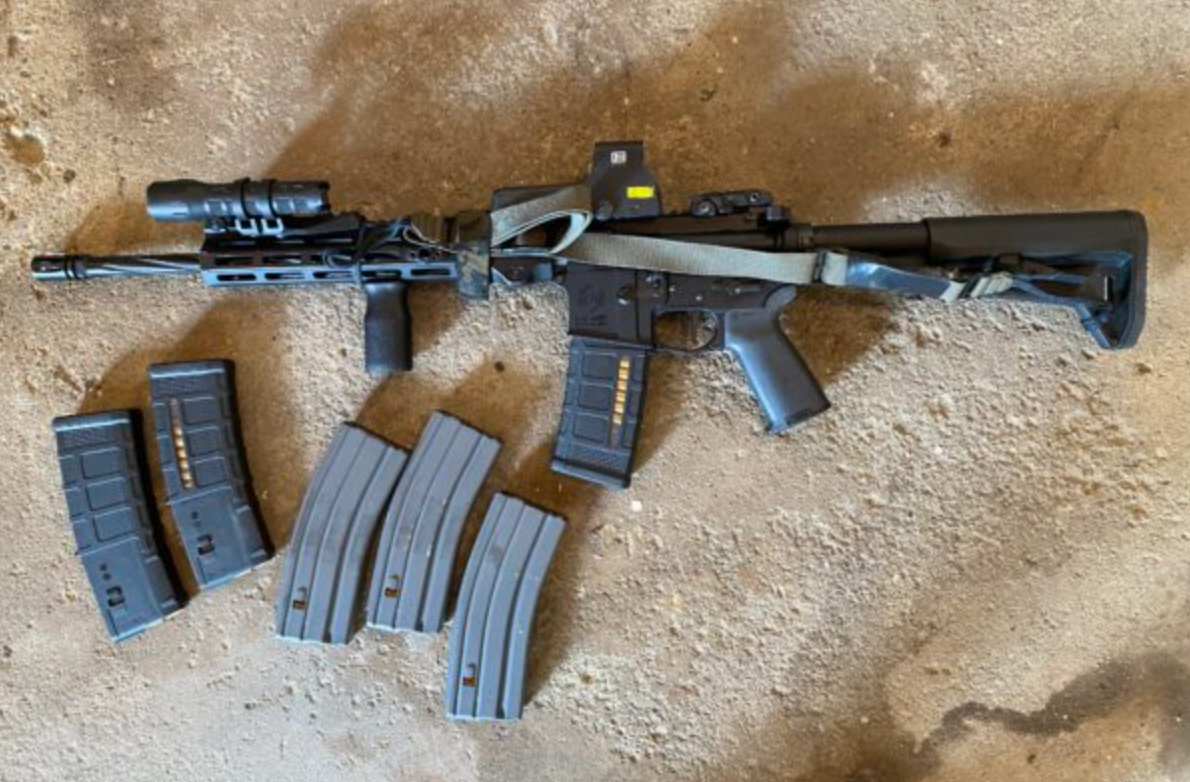
On the contrary, Bob. A number of years back, I got a really nice stainless tricked-out heavy-barrelled target AR-15 rifle for my wife.
To this day, I still consider it one of my best trades !
I’m a Proud Boomer (Est, 1961)
Firearms were as natural as the one or two deer heads in practically everyone’s Living Room/Den. They were part of our “Dangerous Freedom” as Thomas Jefferson said – except in our case the dangerous freedom were our toys that mirrored – on a small scale – some of the dangers that made up life. We learned many things were really fun! But we also learned through our own (& our friends) mistakes they needed to be respected so no one was hurt. We had the branding iron hot dinosaur maker, chemistry sets that could cause all sorts of mayhem, HO trains that could shock you if you picked up the controller the wrong way and a myriad of extremely fun but somewhat hazardous toys we all loved. They were a primer for life to come. Firearms were tools, but fun tools that demanded the highest respect – a respect we first learned to give through our magnificent toys.
On a personal note, the Remington ad made my heart ache. My first real rifle was a Remington 510 Target Master I bought from a friend the summer before my senior year for the princely sum of $22 in ’78. She had a lot of “character” inflicted on her walnut stock, but she shot straight & true. Her markings revealed she came into this world in August of 1942 – the same month our Marines hit Guadalcanal. Even in war, we were still turning out some firearms for ourselves. She went to my Dad as a long term loaner as I gallivanted around the world in the service & as a contractor – and we shot her together whenever I visited. When he pasted, my glorious little shooter was no where to be found, a minor tragedy flying wing on the major. I still miss her abused little stock, I had planned on passing her to the grands. My hope is she’s in someone’s hands teaching a young’un the fundamentals of good marksmanship – and giving the same amount joy and happy memories she gave me.
I don’t think there’s anything particularly special about the Boomer generation with regards to guns. It’s the changes that follow them (historically speaking) that matter more.
As such, I think it’s an urban/rural thing that has to do with more to do population concentrations than anything else.
I grew up in an area out in the middle of fucking nowhere (it was a four hour drive if you wanted a fridge, stove, dishwasher etc) where guns were extremely prevalent, mostly as tools for hunting. They were “popular with kids”, particularly boys because they were associated with adult behaviors that boys love to mimic. Everyone had guns, it was just the norm. Everyone hunted, often every season available, because most people were poor and it was the only reliable source of meat.
Boys want to be like the adult men around them. The adult men had tools for accomplishing required tasks. One of those tools was a rifle, so every boy wanted a rifle. Pistols, due to Michigan law and the aforementioned poverty were not particularly common. Boys might like the toys but pistols were not generally considered objects of desire because they were not seen as a common marker carried by adult men. Ask a kid in 1998 in my area what they wanted and a compound bow would come out far ahead of a pistol but also well behind a rifle.
It wasn’t until I left the U.P. that I even started to realize how “not normal” this was for most people. People in more urban settings didn’t hunt, didn’t have the concentration of guns and were far, far more likely to see them as, quite specifically, as murder weapons.
I probably should have realized this earlier, due to the “leafers” and their fear of rifle season/disgust at hunting but it didn’t really occur to me that it was an opinion that permeated numerous social levels in the area such people came from. I just thought “leafers” were kinda uptight pussies and that this was due more to being the type to be a “leafer” than the geography of their life.
However, later I realized that the vast majority of the people I went to college with had never seen a gun IRL unless it was on a police officer’s hip. Even the young men were, statistically, more likely than not to see them as a dangerous foreign object than a common tool. Interestingly, in terms of “gun owners created” by myself, it was split about 70/30 in favor of females who had a MUCH higher appreciation for handguns.
Given that nearly all of them came from the areas around Cincinnati or Columbus, I’m not exactly shocked by the breakdown or the favorability of a handgun.
==
As for “Boomers”, I think this is much the same.
They just came up at a time when the country was much more rural and firearms manufacture had gotten reliable enough to mass produce quality firearms at a rational consumer price and before legal restrictions on what you could buy were much of a thing.
This resulted in firearms being easy to acquire on a normal income combined with an relative ease of finding places to use them. At the same time, post-war, firearms were seen as a tool of adult men. This trifecta made guns common and therefore common objects of desire of children seeking to mimic the adult behaviors they saw on a regular basis.
Which also explains why they’re seen as tools by “Boomers” and as “tools” (see city slicker slang such as “ratchet”, “tool”, “hardware”, “hammer” etc) by inner city thugs, btw. In both cases, it’s about the work that they’re seen as helping an adult accomplish. In one case that’s hunting or home defense and in the other it’s protecting turf. They’re really the same thing to kids: adult work.
Christmas last a lifetime when you stick the gun in your mouth and blow the back of your head off.
For 1996 birthday I got a bakerlite (heavy plastic) replica (about 4/5 scale) of an MP40 that had a removable magazine. The magazine held 20 plastic projectiles about 9 mm diameter that went about 15 plus feet from a very powerful spring.
Technically the first semi auto I owned before a Ruger 10/.22 as a teenager.
The same toy would have you arrested or shot now.