
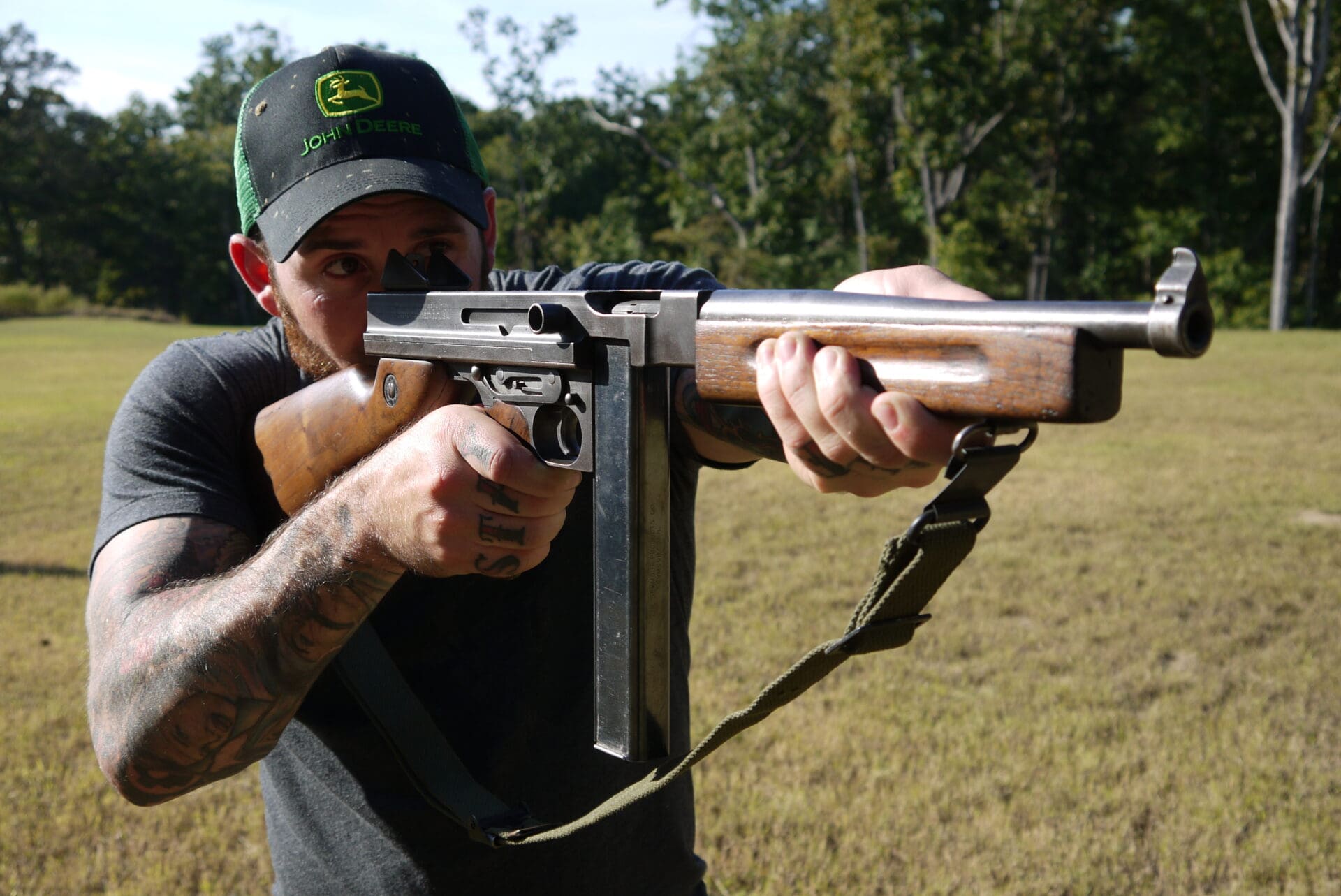
There are very few truly iconic firearms, ones that the lay public as well as gun nuts can identify at first sight. Not only are those instantly recognizable guns a perfect representation of the era in which they were designed and first used, but they have a look and feel all their own that sets them apart from the rest of the firearms world. They’re ambassadors for their era, giving us a unique insight into the mindset and the technology of their time. And in my opinion, only four firearms make the cut: the M16, the Glock, the AK-47, and the Thompson SMG. Until recently, I had never fired the last one on that list. But thanks to Kevin Brittingham, that oversight has recently been corrected . . .
To understand the Thompson SMG, you need to start at the beginning of the story.
The realities of trench warfare during World War I were simply too much for the technology of the time. Guns had developed based on the idea of the traditional European battlefield, with tightly choreographed regiments of soldiers marching in formation, all firing in unison. Firing faster was an interesting concept, but even though Maxim’s machine guns had been around since 1889, it was only very recently that they had been adopted in large numbers by the armies of the world.
Even then, they were more like fixed artillery pieces instead of portable force multipliers. So when a single round from an FN Model 1910 touched off the powder-keg of Europe, the primary weapon in the hands of the average soldier was still a bolt action rifle designed for pitched battles in open fields. What they found instead was that their accurate long-range rifles were simply too big and too slow to be an effective weapon in the confines of an enemy trench.
General John T. Thompson recognized the issue immediately. The average soldier needed a weapon that was compact enough to not get tangled up when fighting in a trench, but accurate enough to hit targets some distance away. It needed to fire multiple rounds of ammunition in quick succession, but be simple enough that the average soldier could clean it and disassemble it without losing the important parts in the mud of France. It needed to have as little recoil as possible, but project enough lead to kill the enemy. It needed to be perfect, and Thompson had a solution.

The first version of the Thompson Submachine Gun didn’t have a stock. While gun control advocates of today wrongly claim that the AR-15 was designed to be fired from the hip, the Thompson SMG actually was. It could be fired while aiming down the sights, but when clearing a trench “point shooting” from the hip was a more effective method.
For the ammunition, Thompson chose the .45 ACP cartridge. The U.S. Army had recently adopted John Browning’s Model 1911 handgun as the replacement for their Single Action Army models, and since Thompson envisioned his gun being used at the same distances as the M1911 was intended to be used it only made sense that they used the same ammunition. At the time, shoulder fired firearms were almost always chambered in a full size rifle cartridge of some sort, with an emphasis on long range “stopping power” being a key requirement in the design. But Thompson understood that in order to keep the gun controllable in such tight quarters, he needed to use a cartridge with much less recoil. And the .45 ACP was an existing and accepted design already in the arsenal of the U.S. Government.
The operating mechanism was the final link in the chain that made the gun ideal for the conditions in France, and made it possible for the average soldier to use it. Instead of adapting one of Browning or Thompson’s gas piston systems to make the firearm automatically reload the firearm while firing, Thompson showed his true genius by adapting the recently discovered Blish principle to make the first blowback operated firearm.
John Blish’s discovery that two dissimilar metals would create an abnormal amount of friction when under pressure allowed Thompson to design a gun where the friction between the brass case of the cartridge and the steel of the chamber would keep the barrel sealed long enough for the projectile to exit the barrel, and then that pressure from the barrel would provide the rearward force required to cycle the bolt. It was a genius concept on par with any of Browning’s designs.
The only problem was that by the time the gun was ready, the war was over. Peace had broken out all across the world, and there was no need to clear any more trenches. So Thompson did what any self respecting capitalist would do: he threw a stock on it and sold it to the American public.
This is where the Thompson SMG starts to influence history in more ways that one. Throughout the 1920’s and the prohibition era, the Thompson was the weapon of choice for gangsters. The ease with which one could be concealed and the firepower it wielded was previously impossible to accomplish. As a result, gangsters and law enforcement officers bought the guns in droves. The gun’s identity as the weapon of gangsters was cemented in history after the St. Valentine’s Day Massacre near Chicago where it was used to gun down five rival mobsters. That event was the tipping point in the politics of the day, and would eventually lead to the 1934 National Firearms Act which would kick off the drive for gun control in the United States.
The Thompson SMG had already earned its place in history as the firearm that caused the first national gun control legislation to be passed, but the story doesn’t end there.

In many ways, the Thompson and its history reflects the character of the boys sent overseas to fight in World War II — scrappy dogfaces with lots of fight and some mischief in their background who were shipped out to do a job and do it well. That interesting parallel alone is enough to give it its iconic status, but the gun’s performance in combat leaves no doubt.
The Marine Corps had been using the Thompson SMG for years before WWII started, but after the United States entered the war, the Thompson finally was placed in full production to stock the arsenals of the United States. While it may have come along too late for the first great war, the Thompson SMG proved to be one of the most effective and desired firearms in the hands of U.S. soldiers around the world. Some even argue that had the Thompson not been in the hands of American soldiers, we might not have won the war.
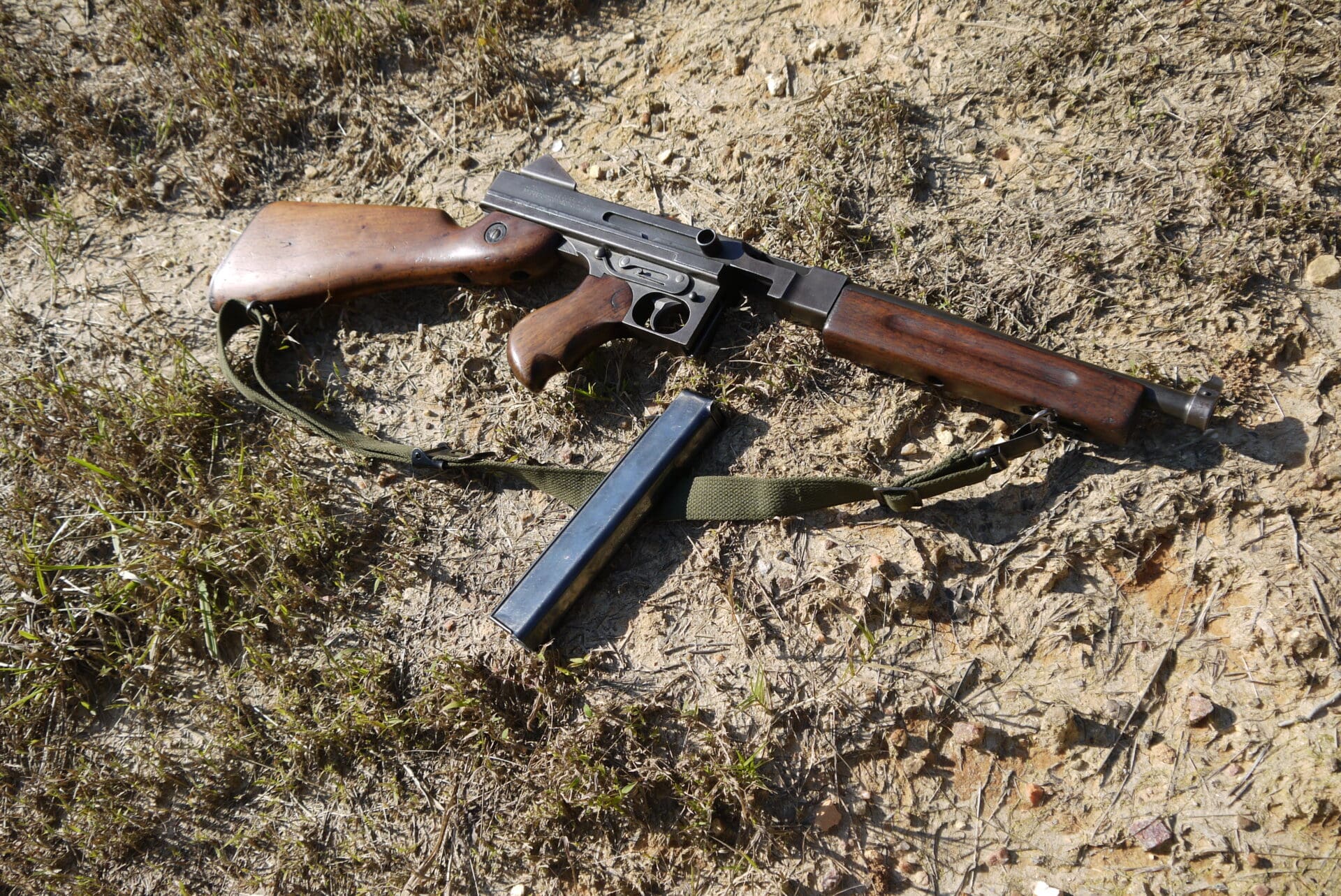
The Thompson SMG I fired was a later model, introduced for the soldiers in WWII and simplified to make the manufacturing process easier. Gone were the drum magazines and ladder sights of the earlier models. Instead, a fixed peep sight and straight 30-round magazines were introduced. The elaborate vertical foregrip was also removed and replaced with a more traditional handguard design. And while you may think that this makes the gun less controllable, you’re dead wrong.
The choice of caliber and the weight of the gun make this one of the lightest recoiling firearms I’ve ever fired. The gun just doesn’t move, even during sustained full-auto fire. The only time when there is any appreciable recoil, as evidenced by the video, is when the heavier modern loads slam the bolt all the way to the end of its travel and make it slam into the back of the receiver. Otherwise, the moving mass of the bolt keeps the recoil extremely light.
While the recoil is downright pleasant, the ergonomics aren’t so much. The gun was designed to be fired from the hip and you can feel it when you shoulder the gun. I’m a pretty big guy and the gun felt big and bulky in my hands. I can’t imagine what it must have felt like in the hands of my relatively malnourished and stunted grandparents when they shipped out. Plus, the angle of the stock compared to the action was extremely awkward and didn’t provide a good cheek weld at all.
Despite the poor ergos, the gun is amazingly accurate. In semi-auto mode, from 50 yards away, I was consistently nailing a B/C zone steel USPSA target, which is roughly the shape of the vital organs in a human. If you’re testing the combat effectiveness of a firearm, that’s the gold standard benchmark of combat effectiveness — the ability to put rounds in a vital area of a target.
The accuracy of the gun was exceptionally surprising given the operating mechanism. Open bolt guns are notoriously inaccurate, since the “lock time” from when you pull the trigger until when the gun goes off is many times longer than a closed bolt gun. There are a lot of moving parts acting on the gun to throw off your aim. But since all of the parts are in line with the bore of the gun, it all stays on target which is great for accuracy. It was a really pleasant surprise.

The controls of the firearm are primitive, but you can see the beginnings of the fire control system that we still use today. Simple switches control the functions of the firearm, much like the selector switch on the AR-15 platform. But while our selector performs multiple functions, the Thompson uses two different selector switches to control the SAFE/FIRE operation and the SEMI/FULL AUTO functions. The switches themselves are rather flimsy compared to other contemporary firearms of the day (such as the Browning Automatic Rifle and the second generation safety on the M1 carbine), but nearly a century after they were first manufactured they still work perfectly.
The most interesting thing is the position of the magazine release. Instead of placing it somewhere that the shooter can use their trigger finger to actuate it, it was designed to be used by the left hand when extracting the magazine. Even in 1928, John Thompson was trying to force soldiers to get the gun into their “workspace” (right in front of their face) during reloads to look at what they’re doing more closely.

Speaking of inserting a magazine, that’s one of the only things I didn’t like about the gun. Every other firearm from this period has a very clear tactile queue that you’ve inserted the magazine, from the very audible “click” on an M1 carbine to the reassuring “CHUNK” on a BAR. But with the Thompson you kinda just shove it in there and hope it stays. It’s slightly disconcerting, but after a while you get used to it and get a feel for when it’s in place properly.
Oh yeah, one last thing:

It has a reciprocating bolt handle. I know that’s kind of par for the course for things invented nearly a century ago, but the Browning Automatic Rifle had already figured out the non-recip charging handle for its design. That’s harder to pull off in such a small form factor, but hey, I have to find something to gripe about or else Robert starts cutting my pay.
Firing the Thompson SMG was one of the most memorable experiences of my life. It’s such a beautiful gun aesthetically and when you throw in all the technological advances that it represents as well as the history of the gun, it’s simply a magical piece of art. Like I said, it truly is an iconic firearm. And I will never forget the afternoon I spent with it on the range.
Thompson Submachine Gun
Specifications
Caliber: .45 ACP
Barrel: 10.5″
Size: 32″
Weight: 10.6 lbs. empty
Operation: friction delayed gas blowback
Capacity: 20 / 30 round stick magazine
MSRP: $20,000
Ratings (Out of Five Stars):
All ratings are relative compared to the other weapons in the gun’s category.
Accuracy: * * * * *
From a barrel nearly a century old and well past the replacement mark in terms of round count, it was still combat-effective even at 50 yards. And for an SMG of this era that’s all we care about.
Ergonomics: * *
Ambidextrous this thing is not. All of the controls are set up for right-handed shooters. Lefties just have to deal with it. Plus, the tacked-on stock makes the thing less than ideal for a weapons platform ergonomics-wise.
Ergonomics Firing: * * * * *
Oh man, it feels good. Like, really good.
Customization: N/A
If you even so much as suggest changing a single thing on the Thompson then I will personally come to your house and kick your ass. Red Jacket, I’m looking at you.
Overall Rating: * * * * *
Again, this is an iconic firearm. It has all the features that make a classic gun; a great history, it represents a giant leap forward in technology and it’s just a great-shooting firearm. For those with the cash, it’s the perfect addition to any collection.






I don’t really post, but this post, by Farago no less, got me off my butt to write in. There’s something to be said for managed hunting. That is not when it comes to the plight of elephants in Africa. You’re facing a trade that is in the stages of the American Bison; or whale hunting during the 19th century. The herds are WAY too depleted to be “sustainable” when the motivating factor- Chinese herbal medicine- is the driving factor. 1 billion + potential consumers (not counting chinese ex-pats who still practice destructive herbal medicine- Ivory is easily found in San Francisco’s and New York’s Chinatown) will consume anything quickly, but ivory is a special case. The idea of “managing” ivory trade when there is an emerging country with little to no idea of conservation driving the trade and an emerging country with little to no idea of conservation feeding the trade for an endangered animal is ludicrous.
Also, there are ideas of “farming” elephants in a Forbes article. Ridiculous. Elephants have much too large a range, much too complex a social structure, and a non-market-ready commodity- their tusks grow with size. It would be like trying to “farm” redwood trees- they only really have a lot of value when they’re at least 200 years old, preferably more like 400. Elephants have to get older to get bigger, more valuable tusks- it’s like trophy hunters, you need to have little hunting to produce large specimen. Most hunters in America actually care a lot about the meat; with elephants, aside from a few defense of crops and livelihood, there is very little killing of elephants for meat (think the amount of meat an elephant has, and the lack of refrigeration).
I understand you have to generate new content, and like to create out of the box solutions. Fine. A much better idea would be to take stockpiles and confiscated ivory, and instead of a one time sale, to create annual sales based off the number of confiscated/estimated poached animals each year. Less poaching, more sales; more poaching, less sales.
Elephants are some of the most magnificent animals on the face of the Earth, African elephants especially so. I remember the awe I had of elephants as a child, and go to see elephants at least a few times a year. When you read of Hannibal crossing the Alps with elephants, it’s impossible to picture without seeing a real live african elephant to truly appreciate this history. Elephants are a keystone species, a cultural touchstone that cannot be truly valued.
I have a better idea. How about legalizing trophy hunting of poachers. I’m sure there are lots of people all over the world who would pay big money to hunt The Most Dangerous Game legally, and they would be doing the world a great deal of good.
Not much meat, though.
That would be fun.
MSRP, eh?
And then there’s the unmistakable sound of the Tommy gun at full song. A few weeks ago, I heard the Class 3 boys firing off their Thompsons at the range. Lovely.
Maybe some day. I do have the SBR version pending delivery from Kahr, so that will help fill the void until I can buy guns in the used luxury car price range.
Nick, I am not disagreeing with you on this but I would like to make a counterpoint. You say “The realities of trench warfare during World War I were simply too much for the technology of the time. Guns had developed based on the idea of the traditional European battlefield, with tightly choreographed regiments of soldiers marching in formation, all firing in unison.”
The way my ROTC instructor explained it to us in US Military History is that the US learn during the Civil War that faster rates of fire, newer technology, tight unit formations and large open battlefields made for a bloodbath on both sides. Europe did not learn this lesson until WWI. By that time weapons were full auto, gas weapons were being used and armies were still lining up in tight formations and charging the front line. 10,000+ men dead in one day was a high price to pay.
Awesome write up!
Nick is showing his youth. Only the AK-47 belongs on his list. As other’s suggested then Winchester ’73, and the M-1 Garand are much more iconic then the Glock and the M-16. In fact the Glock is too new to really know it it’s iconic. Wait unitl 2050 and then tell me if anybody cares about it. (You will probably need a medium to tell me.)
And Nick, we would have won the war anyway without the Thompson. Not so certain if we didn’t have the Garand.
God that MAGPUL rifle dynamics “operator” stance looks so wrong on that classic weapon, also I’m sure the third degree burn on the inside of his thumb after the first mag wasn’t worth the minor benefits.
But I digress, A truly beautiful piece of engineering.
Hell, I’ll support background checks of all gun buyers…
Run a check on me once, give me a card, and then let me buy as many damn guns as I want, whenever I want, from whomever I want.
The catch is you are not allowed to know when, where, from who, or how many I buy… deal?
And when “universal background checks” fail to lower violent crime & mass murder incidents the gun haters will push for more so called “common sense” gun control laws. Any new gun control laws & the people who support them can FOAD as far as I’m concerned.
We live in Revolutionary Times, soon to be a time of Terror as the Cultural Revolution sweeps over America.
As envisioned by Bill Ayers, approx. 35 million of us will not survive
Keep in mind that the knife cuts both ways. Every poll that says people favor background checks is a poll that says people favor the Coburn Background check amendment, but why is it that the Democrats wouldn’t even allow it to go up for a vote? Why do they hate the American people so much?
I say get rid of back ground checks all together, all these crazies keep passing them and obtaining weapons…
If it doesn’t work why waste the taxes dollars.
I so hope to have the opportunity to fire one of these some day! I’ve never even had the opportunity to hold one.
If NICS was open to private sellers, I’d use it. But the Feds will never open it up, because they could never enforce a record keeping requirement. FFLs can lose their licenses if they don’t have proper records. Private sellers, not so much.
So it’s not about the check. It’s all about the records. Always the records.
One thing that can’t be overstated in these cases is how little the average non-gun-owning citizen (and the occasional gun-owning one) actually knows about gun laws. Nearly every time I get into an argument with a nominally anti-gun acquaintance, they present a laundry list of things that they think should be illegal, 90% of which already are. I’d imagine that if you spoke to the average poll respondent who agrees with a generic statement that “we need stricter gun laws” and pressed them for specifics, they would give you a list of things that are already on the books.
“…shall not be infringed.”
Every one of those laws already on the books, and every one proposed in some gun controller’s wet dreams, is already an unconstitutional law. You cannot dream up ANY law regarding guns that is not prima facie a violation of the Second Amendment.
Sorry, the Second Amendment says, and was intended to say, “The government has no authority to pass any law making the exercise of this natural, civil and Constitutionally protected right illegal under any circumstances.”
Same scenario, different place. An Oregon LEO accidentally grabbed a mag full of live ammunition, and shot a fellow officer while training with submunition rounds. I think this happened a few years ago. It happened at a National Guard training facility. Too bad it hadnt happened on an USAF base, for we probably would have arrested the civilian LEO, then banned the police department from the training facility for life.
I’d like to see the stats on people’s exposure to guns. I.e. Time spent within 50ft of a loaded firearm. Safes don’t count but holsters do. Then compare that to the rate of negligent/accidental death.
This is probably the worst of all worlds in a 9mm carbine. Not 922(r) comp so you are stuck with 10rd mags. The Mags are a butchered uzi hybrid wit a crimp to catch the mag catch/release. Said mags are exclusive to this gun so they will most likely be both hard to find and expensive. Fixed non adjustable thumb hole stock. It’s as if they looked at the USC and thought how can we this idea, and make it worse for the customer.
There is no longer any point in expressing outrage. We know, a priori, that no fault will be found. At most, the guilty cops will be put on paid leave for a couple weeks while an “investigation” is “conducted.”
Nice, easy work if you can get it.
well don’t anybody tell them that just a couple years ago I had several full-auto AK-74 rifles delivered to my house, right in a box on my doorstep, with no background checks whatsoever, for $100 a piece.
of course, the catch is that they just were a big pile of parts that I had to assemble myself, and if I decided to use the included full-auto bits I would’ve been a felon – but, I didn’t, because I’m an honest guy who doesn’t like to break the law.
regardless, all it EVER takes is one person who doesn’t give a shit about the law and will flaunt it in order to victimize others.
I’m sure they would still be scared shitless of that fact, though.
Beautiful foh-togs.
I’ve read a couple of less-than-flattering reviews about this rifle. It saddens me because I have been a Taurus advocate for may years. But I guess the PT92 does not a gun company make.
No one mentioned Marlin Camp Carbine. Was it any good? I do recall there was 9mm and .45 versions and the latter used 1911 magazines.
Sometimes they even pay $50 for bb guns… Go to wal mart, buy a few dozen of the cheapass $20 BB guns, and turn them in for a nice profit!
Heavy, built to exacting standards and a symbol of Made in the USA quality. I’ve had many opportunties shooting both this and a “real” BAR. I’ll never be able to afford one but if I buy the ammo a friend lets me shoot his. I don’t think anyplace that has had television would not know a Thompson. Walk into any store anywhere and people know why you’re there and will give you the cash register!
I have several Class III weapons but none carry a touch of class exhibited by a Thompson. The AR or HK or the like in modern sub guns might be a better SMG but I doubt any will garner the admiration or affection of that Thompson. How about doing a review of the MP-40 or a BAR as another classic test.
I second the MP-40 review request!
I’ve fired most foreign machine-guns (SMGs, assault rifles, & crew-served) while taking an OPFOR weapons course in the 10th Mountain and I enjoyed the MP-40 more than any other one, even more so than the more modern weapons (only up to circa 1996).
I found that the MP-40’s caliber and rate of fire coupled with firing from the open bolt minimized the effects of muzzle climb and allowed for great accuracy.
I’d be very interested in a formal TTAG review!!!
I am lucky enough to have 2, a 1928 and an M 1 that was an amnesty registered bringback. The M1 goes out every time I go to the range. Not to defend Red Jacket, most of thier work is a gun crime, but the Thompson they worked on was a semi. It was converted to full auto and was a restricted firearm only ellagable to be owned by government entitys, then they realy F##×$ it up
If you get a chance to try one again, use your right thumb to activate the mag release (press up). Works quite well. Also, if you release it prior to inserting the new mag, you get a solid “click” when the mag locks home.
What about the sterling l2a3. Awesome sub-gun – possibly the best.
The ergonomics are similar to a m1a1 / Thompson.
A central pistol-grip and magazine, length of stock and angle, protruding upper on both.
I placed a sterling over a m1a1 and everything was in the same positions (except that the mag projects out the side of the sterling)
Go ahead, kick my ass. I put a red dot in place of the rear sight. I use my semi as a proper pistol caliber carbine while 3gunning in Idaho. Ha! Gods caliber 45ACP!