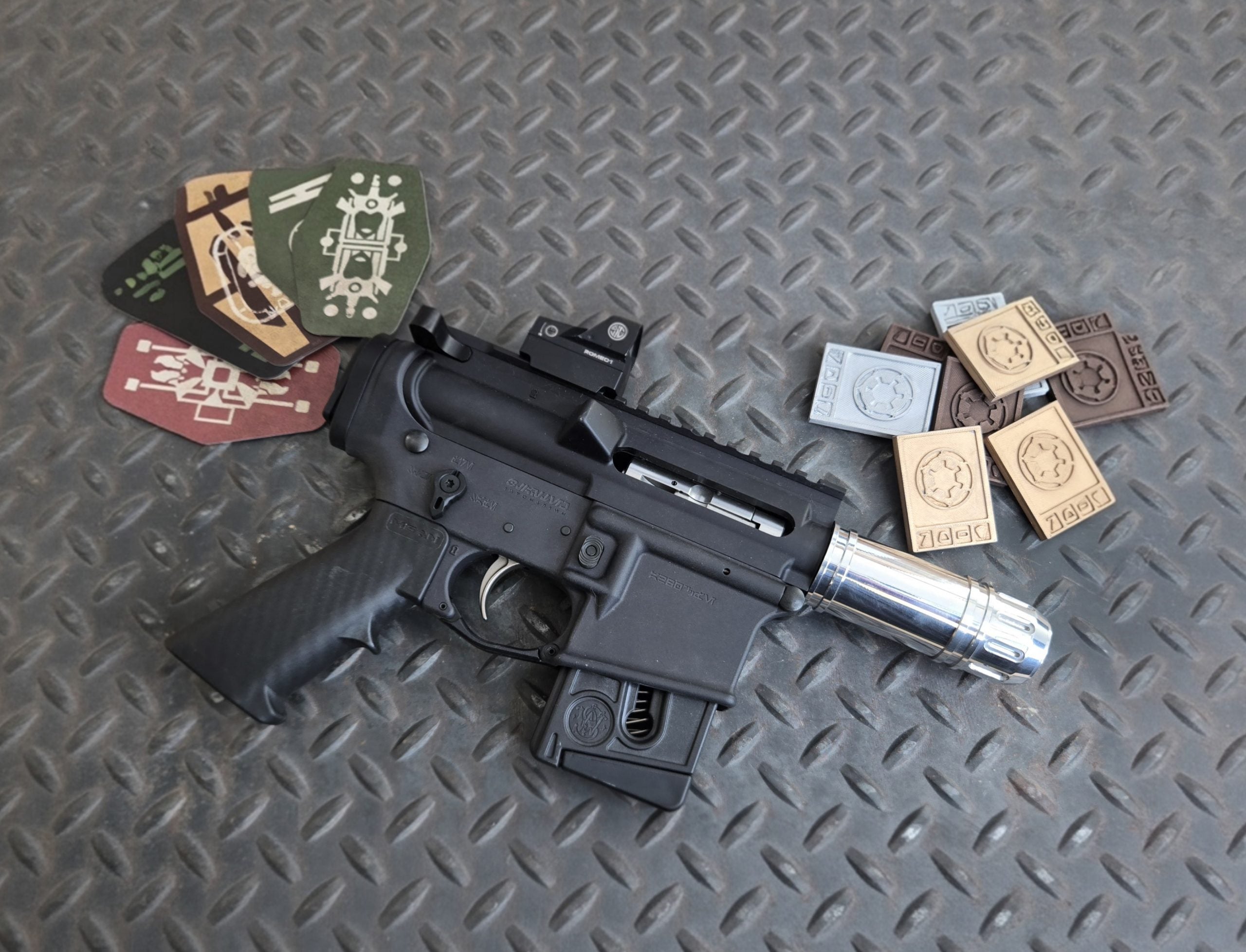
I didn’t actually set out to build an ARPK. The project started with a much less practical idea. I had been kicking around the thought of building a sci-fi-inspired AR for a while. Not a replica of anything in particular, just something with a bit of a blaster vibe that was still a functional rifle.
At the same time, I’d also thought about doing an American take on a squad automatic rifle. The Russian RPK was the obvious inspiration. Take the basic infantry rifle, add greater magazine capacity and a bipod, and adapt it to a support role. You end up with something that fills the gap between a standard rifle and a belt-fed machine gun.
The problem was that I never found the idea of building a big, heavy semiautomatic AR particularly exciting. It might look the part, but it would still basically be a heavy AR with a bipod. Then I got an Atrius Forced Reset Selector, and the two ideas started coming together.
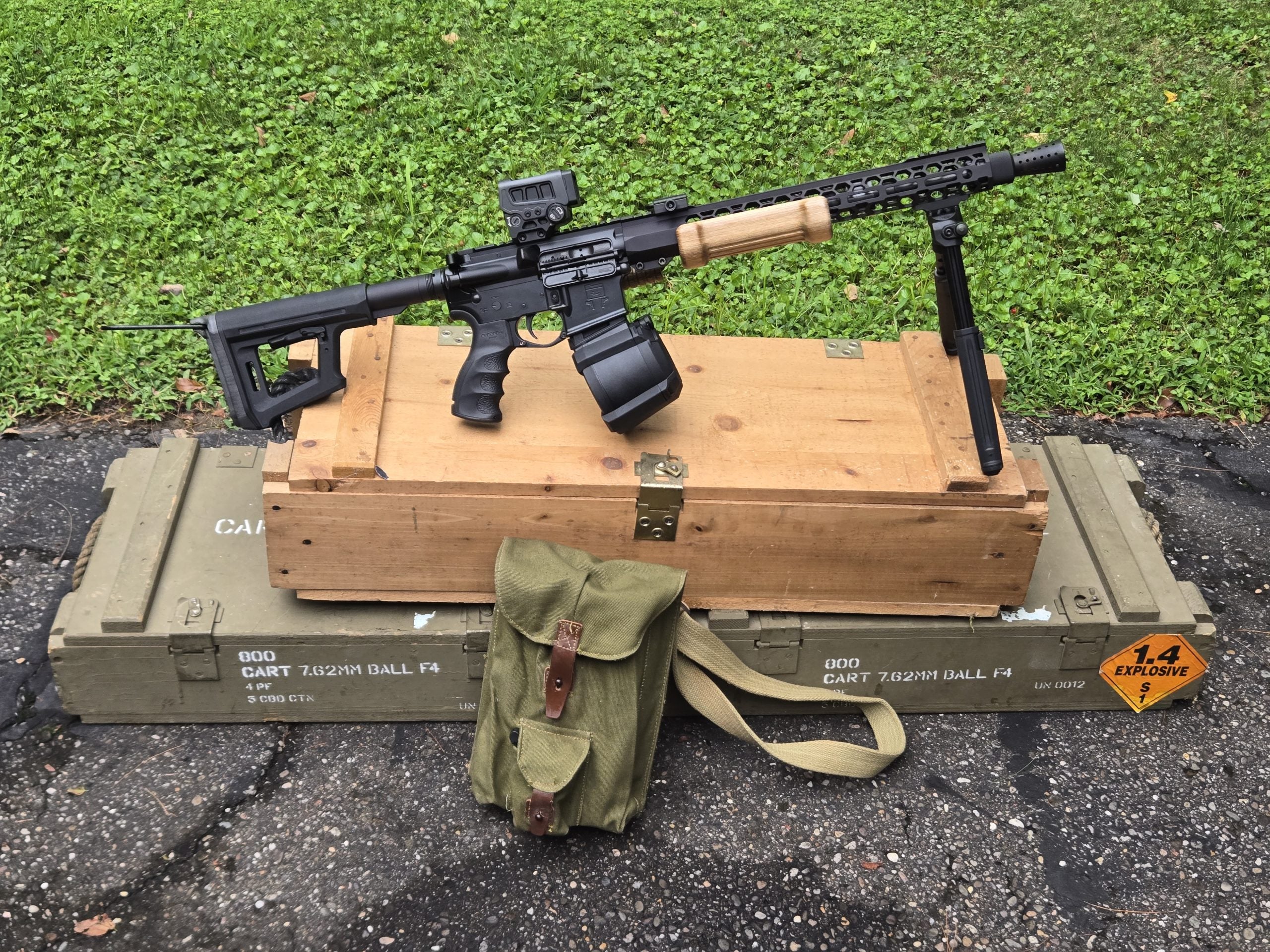
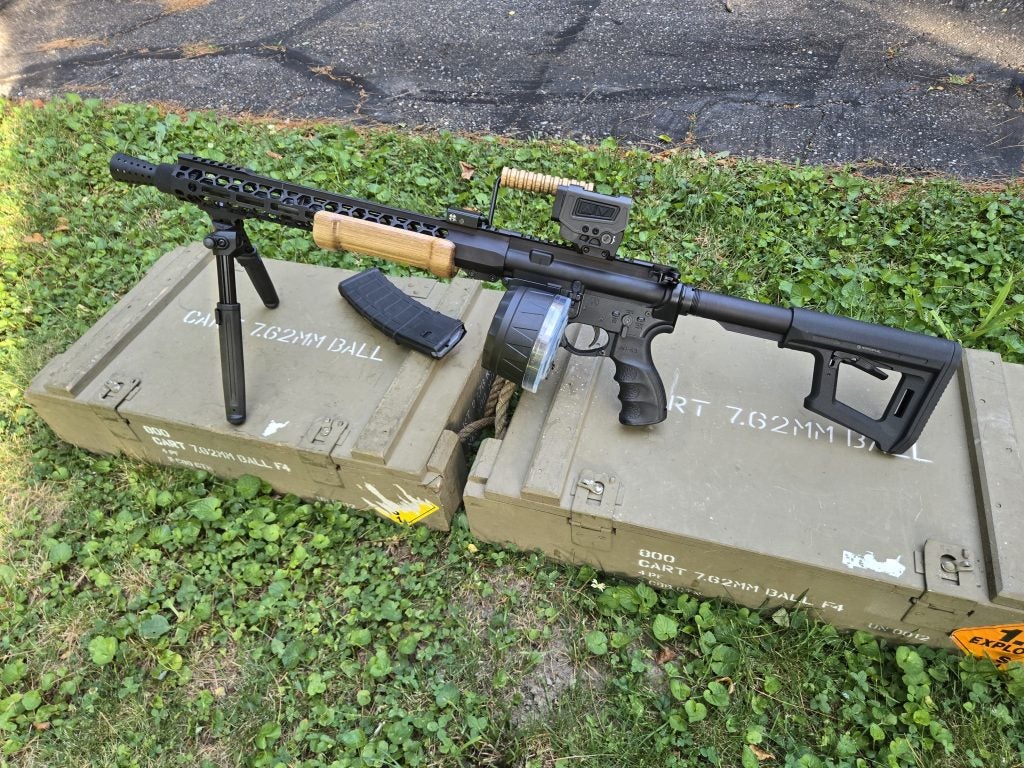
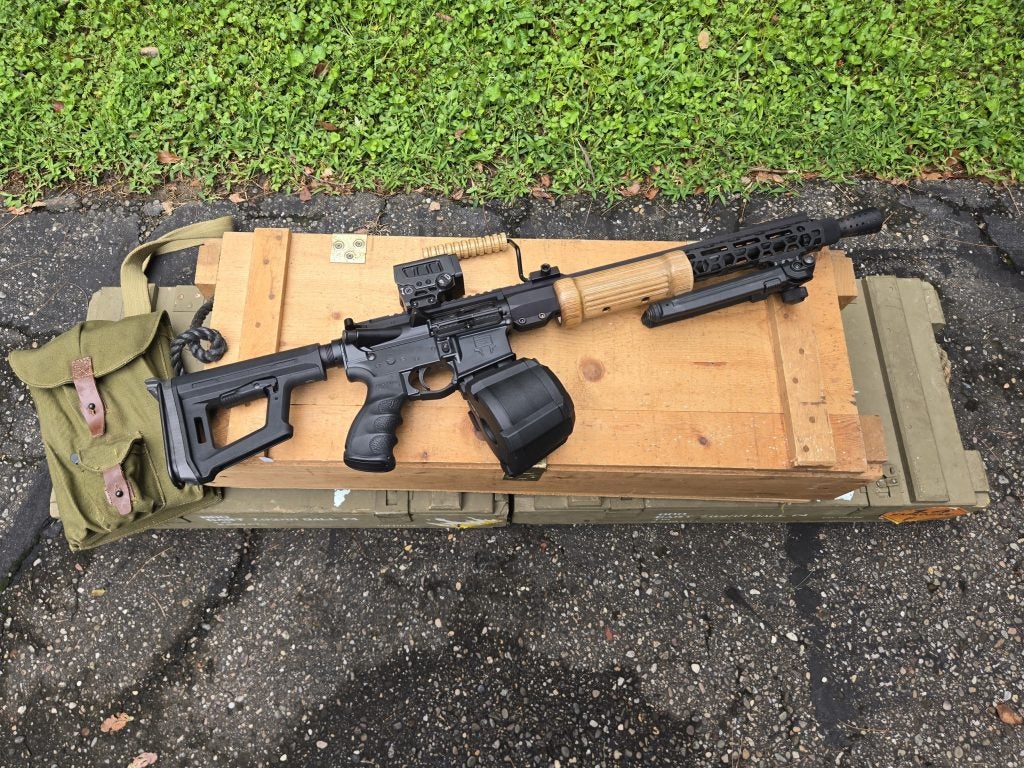
The result is the ARPK, or American RPK. It’s a magazine-fed, squad-auto-inspired AR with a little sci-fi DNA mixed in. There was never a master plan or carefully prepared parts list. The rifle developed organically as I ran across components that seemed to belong on it. Somehow, it all worked.
Building the ARPK
The upper started with a basic flattop receiver from my parts bin. I used a 16-inch B. King’s Firearms 5.56 NATO barrel. It has a mid-length gas system, 1:7 twist and government profile.
I wasn’t trying to duplicate an RPK mechanically. In particular, the BKF barrel isn’t a heavy squad-auto barrel. This is still an AR-15-based rifle. I used components that made sense for the build rather than trying to duplicate every RPK feature.
The barrel sits underneath an ACME Machine M-LOK rail. That became the foundation for one of the components that really established the rifle’s appearance.
I had seen M+M Industries’ wood furniture before, but a recent social media post reminded me of it. After seeing that I reached out to M+M and ended up using its Cold Warrior M-LOK Wood Hand Guard for my build. I paired it with the company’s wood Picatinny Rail Mountable Carry Handle.
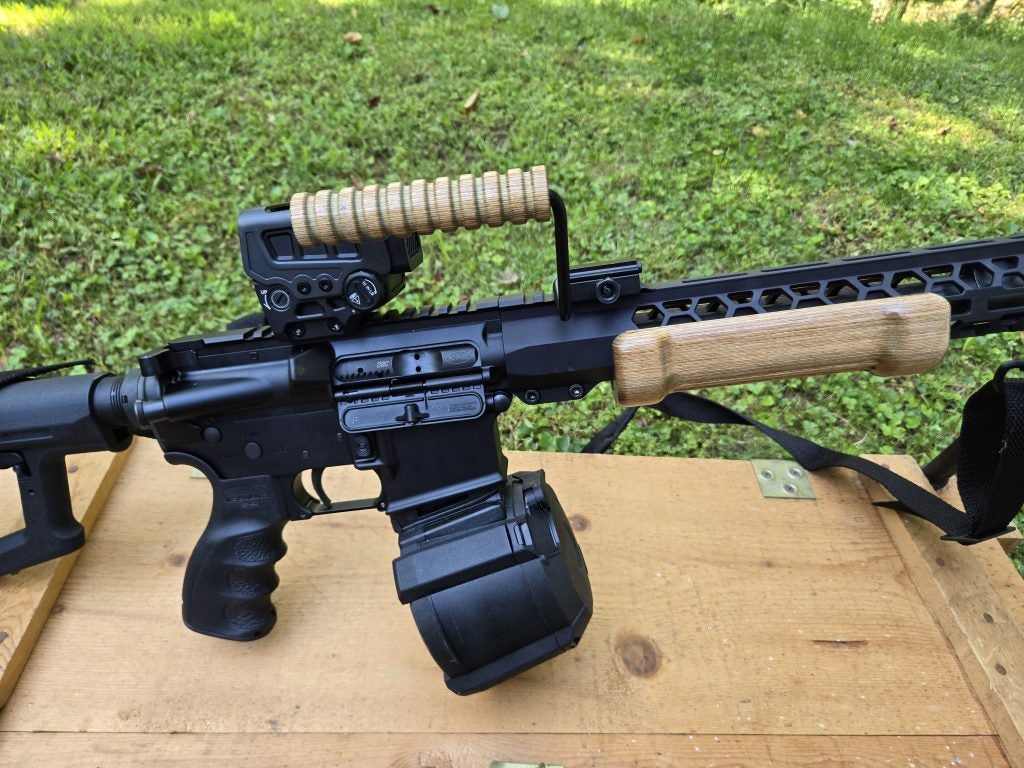
The Cold Warrior attaches directly to an M-LOK rail. M+M maintains a list of rails it knows are compatible with the handguard. My ACME wasn’t on that list when I did the build, so there was no guarantee it would work. Luckily, it fit just fine. I let M+M know, so it may have been added since then.
The wood was an obvious nod to the RPK. However, its shape reminds me even more of the wood furniture used on the Israeli heavy barrel FAL support weapon. The carry handle adds another classic squad-auto visual cue.
It turned out that the wood wasn’t merely cosmetic. Once I started running the rifle harder with the Atrius, the Cold Warrior did a good job insulating my support hand from heat.
An FRS Changes the Equation
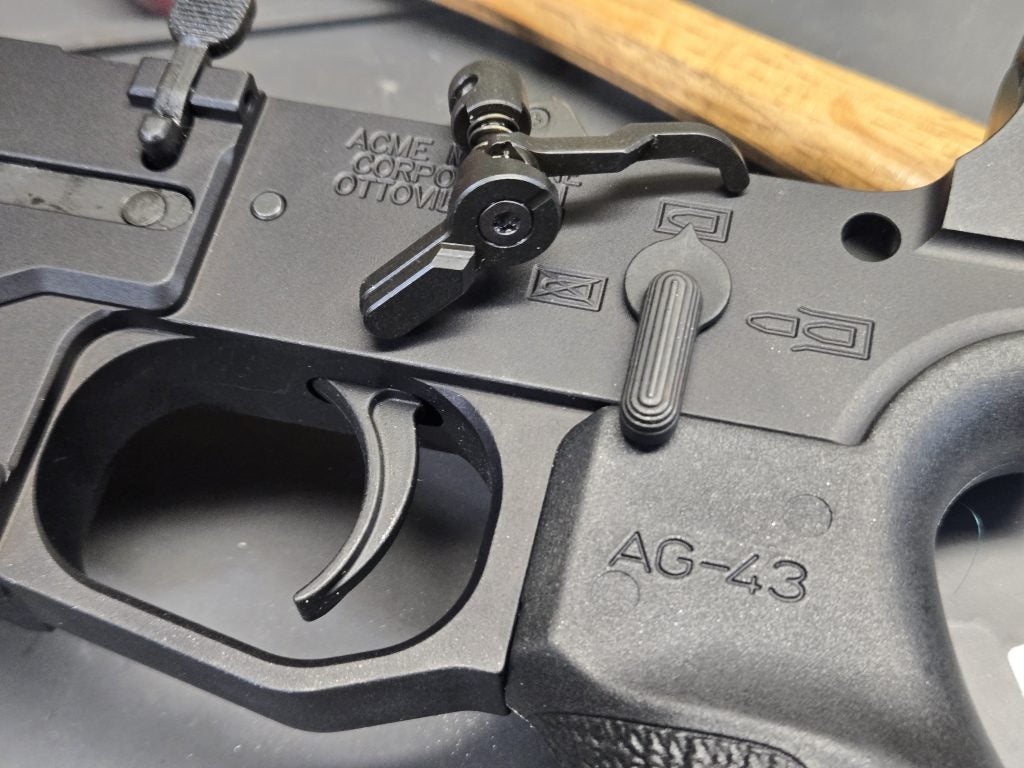
The component that really turned two vague project ideas into the ARPK was the Atrius Forced Reset Selector. Most of the rifle went together like any other AR build, but the Atrius required some fitting.
I had to remove some material from the inside rear of the upper receiver with a Dremel to provide clearance. It’s similar to the upper modification commonly performed when installing a Hoffman Super Safety. Once I had enough clearance, the system ran without issue. The modification also doesn’t prevent the upper from functioning normally in semiautomatic operation if the Atrius is removed.
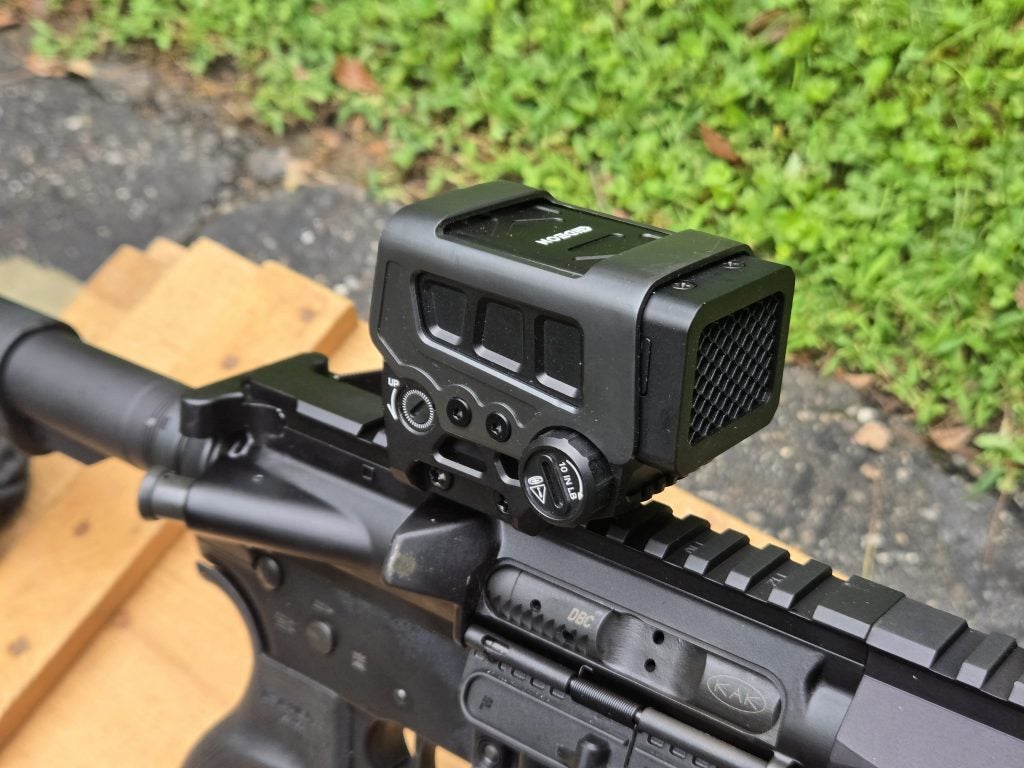
I paired the Atrius with a KAK Industry DBC bolt carrier group. DBC stands for dead blow carrier. KAK incorporates a moving internal weight into the carrier to counter bolt bounce. That’s an issue that can be particularly relevant with forced-reset systems. KAK specifically lists the Atrius FRS among the systems tested with the DBC.
The charging handle is KAK’s Big Latch Charging Handle. At the other end, I used a KAK nine-position A5-style receiver extension. It houses a 5.5-ounce A5H2-style buffer. Combined with the mid-length gas system and the rifle’s considerable mass, the setup is very smooth in normal semiautomatic operation.
The Lower That Arrived Late
The lower receiver is a good example of how little of this rifle was planned in advance. Originally, I built the ARPK on an ACME billet lower. Then I found out that the flared mag well didn’t work with the 100 round KCI drum mag I had. I then switched to a blemished Bad Attitude Department lower that I’d picked up at a discount. It was a perfectly functional receiver. Since I didn’t know what the rifle was going to become, there wasn’t any reason to use something more specialized.
Then Bad Attitude Department released IAR-marked lowers. IAR stands for Infantry Automatic Rifle, so that was pretty much impossible to ignore at this point.
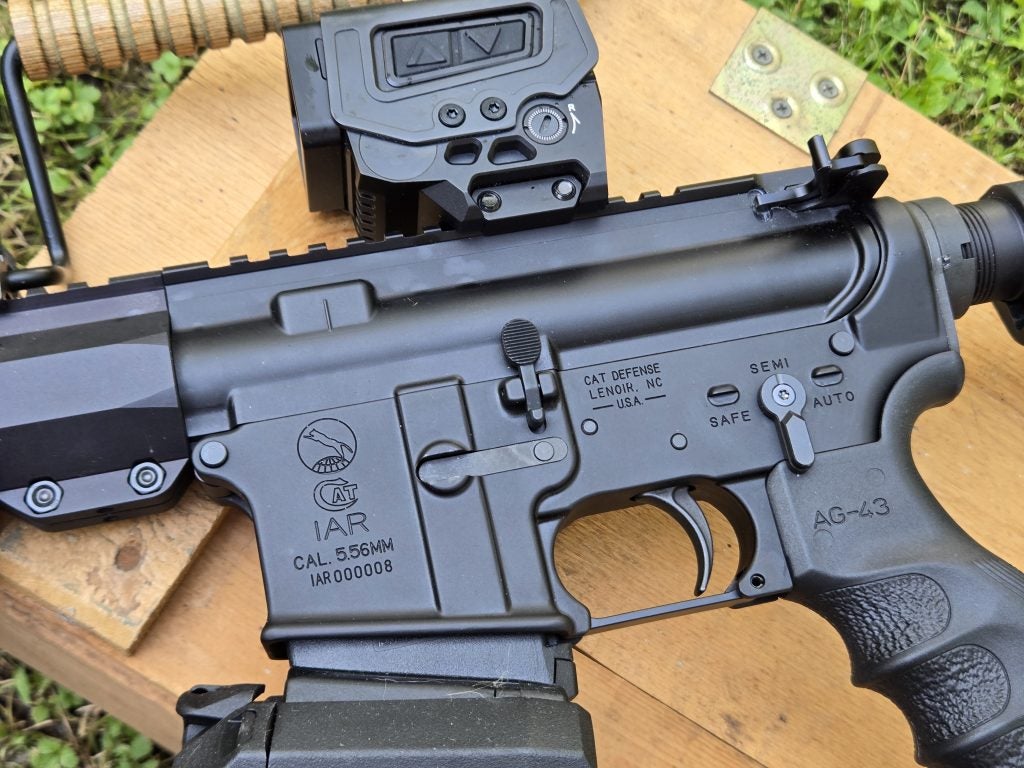
BAD offers a relatively straightforward IAR lower, but I went with one from its Cat Defense line instead. Cat Defense is BAD’s tongue-in-cheek take on Colt. It even has a cat logo in place of the familiar pony. This is a fantasy squad automatic rifle with Star Wars parts on it, so taking the serious route seemed unnecessary.
The Cat Defense lower is marked IAR and 5.56mm. It also has SAFE, SEMI and AUTO selector markings. With the Atrius installed, it looks like I planned the lower for this rifle from the beginning. In reality, it was one of the last pieces I added.
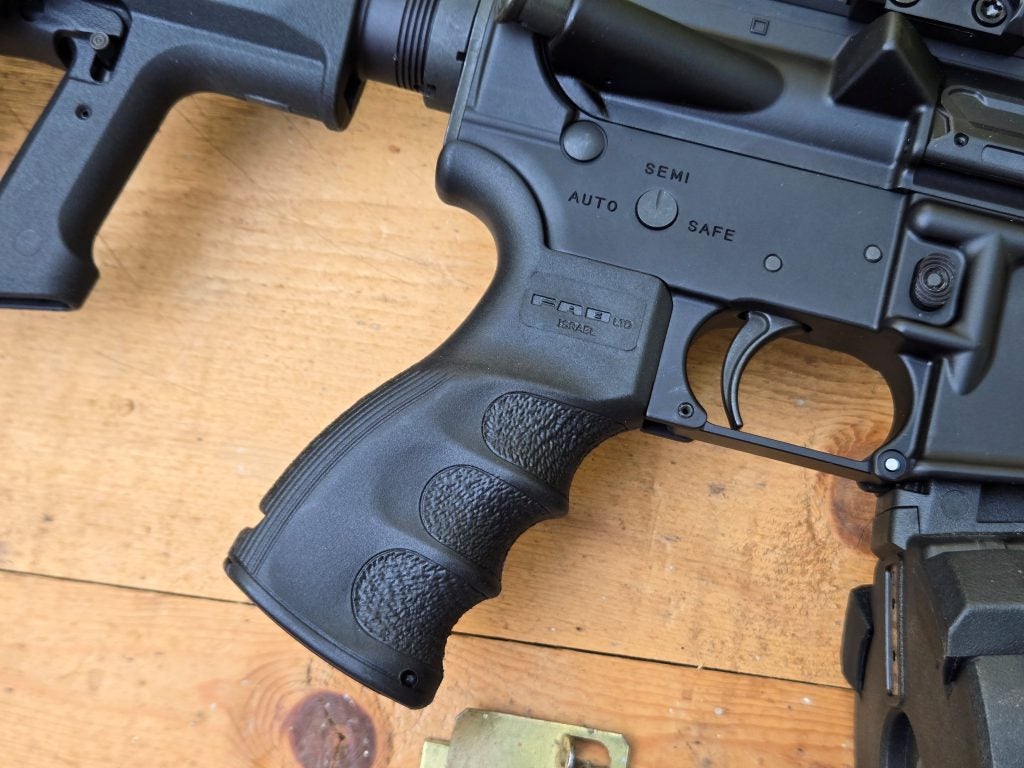
A B. King’s Firearms lower parts kit fills out most of the receiver. The grip is a FAB Defense AG-43. I’ve always liked its contours, and it’s very comfortable on a rifle this size. It also gives the ARPK a different look than another A2, Magpul or B5 grip would have.
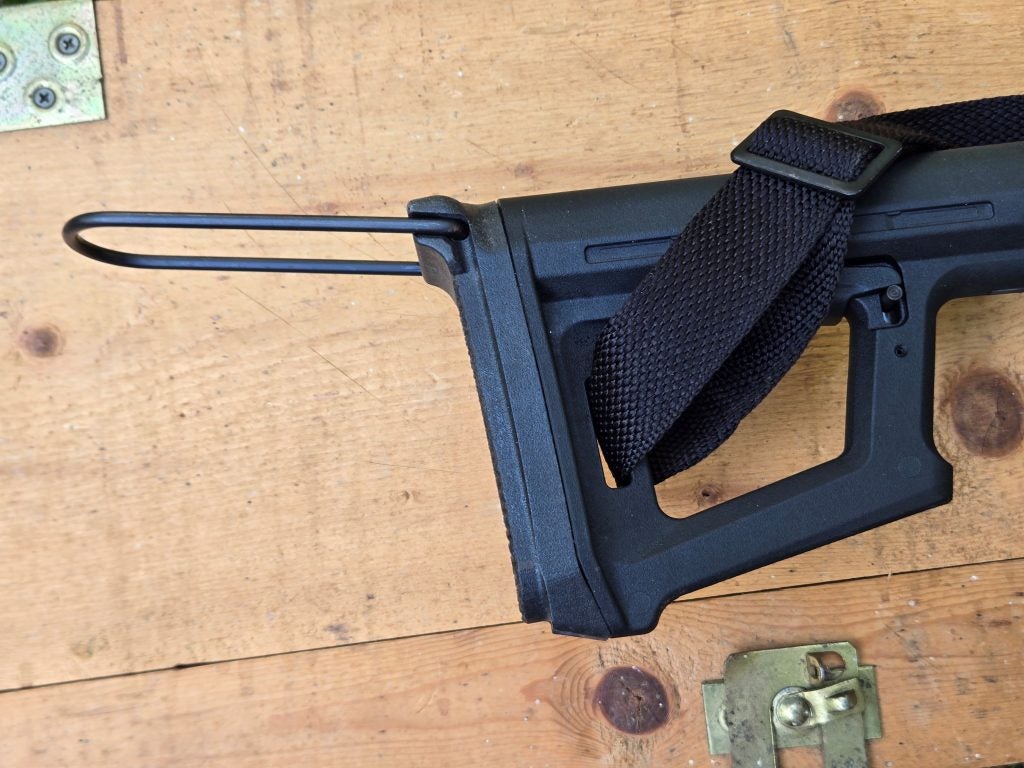
The stock is a Magpul MOE PR Carbine Stock. Its more substantial profile fits the build well. It’s club foot shape even resembles the RPK stock in outline. The interesting part, though, is what’s hanging off the bottom of it.
The Shoulder Thing That Goes Up
I first spotted this particular accessory while covering Stuff & Things at GunCon. As soon as I saw it, I knew where it needed to go.
It’s a Savit-style flip-up shoulder support developed in conjunction with Chestnut Mountain Manufacturing. Stuff & Things sells it under one of the better firearm accessory names I’ve encountered: The Shoulder Thing That Goes Up.
The name references an infamous 2007 interview with Congresswoman Carolyn McCarthy. While discussing legislation that addressed barrel shrouds, McCarthy was asked what a barrel shroud actually was. She couldn’t provide an accurate definition. Instead, she referred to a “shoulder thing” that went up.
The comment became a long running joke in the gun community. Stuff & Things leaned into it by putting the name on an accessory that actually is a shoulder thing that goes up.
There is real squad-auto heritage behind the design as well. The flip-up support is patterned after the Savit-style buttplate associated with M249 SAW stock assemblies. That made it particularly appropriate for the ARPK.
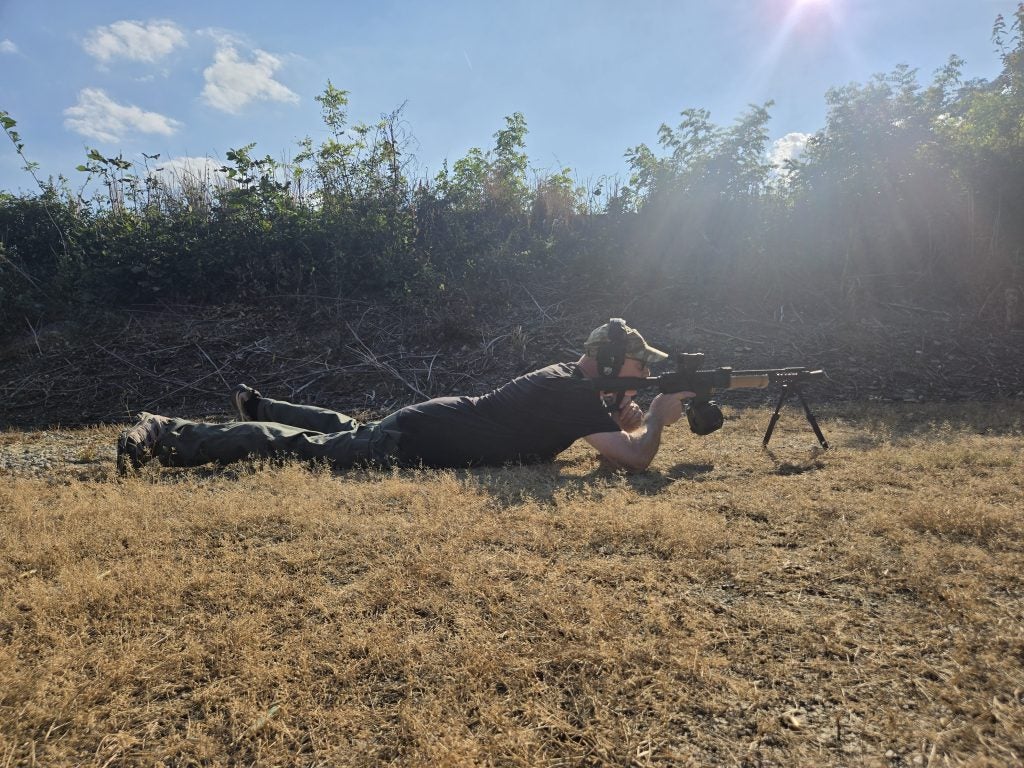
More importantly, I found it useful during actual shooting. I used the support both standing and prone. It helped manage the rifle’s weight and provided additional support during rapid strings. It also helped with recoil management. The Shoulder Thing That Goes Up looks cool, but it works too.
A Little Star Wars DNA
Not everything on the ARPK came from the squad-auto side of the project. Some remnants of that original sci-fi rifle idea survived.
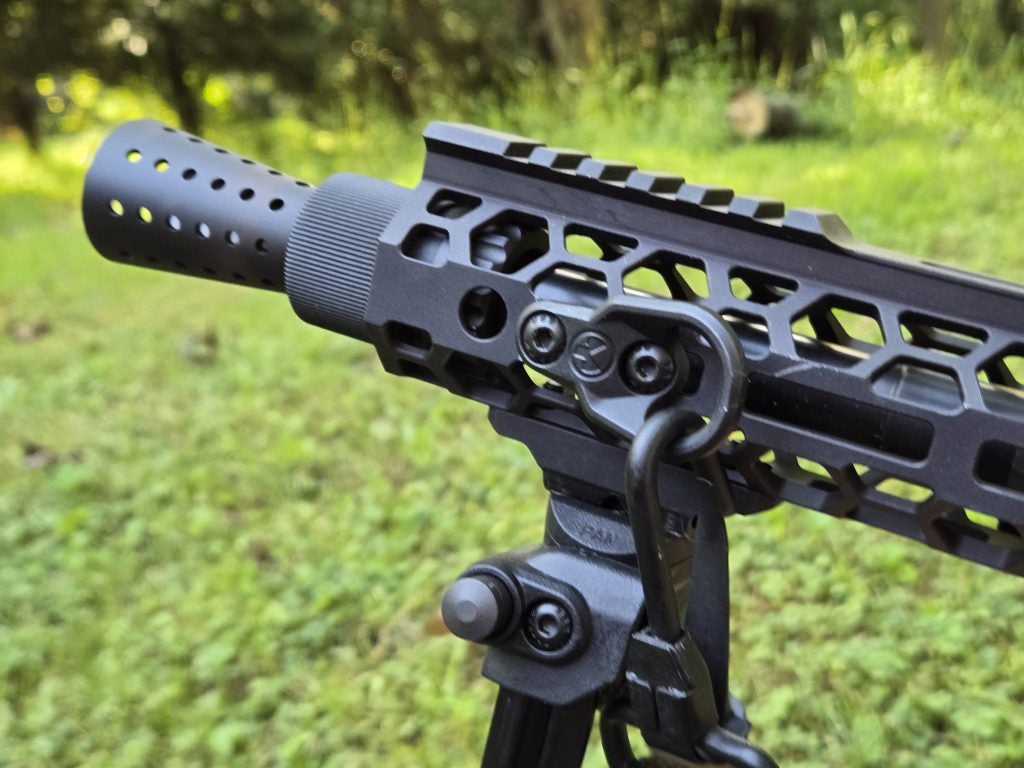
The muzzle device is a Canto Arms DL-44 flash hider. Canto offers it for its DL-44-style Star Wars blaster builds.
That creates a fun circular connection. The original Han Solo DL-44 prop incorporated a flash suppressor from a WWII German MG 81 aircraft machine gun. Canto recreated that look for modern blaster builds, and I put one on a rifle inspired by squad automatic weapons.
I’m not going to claim the Canto device provides some dramatic performance improvement. I haven’t done any testing to establish that. It looks right on the rifle, and that’s good enough for this build.
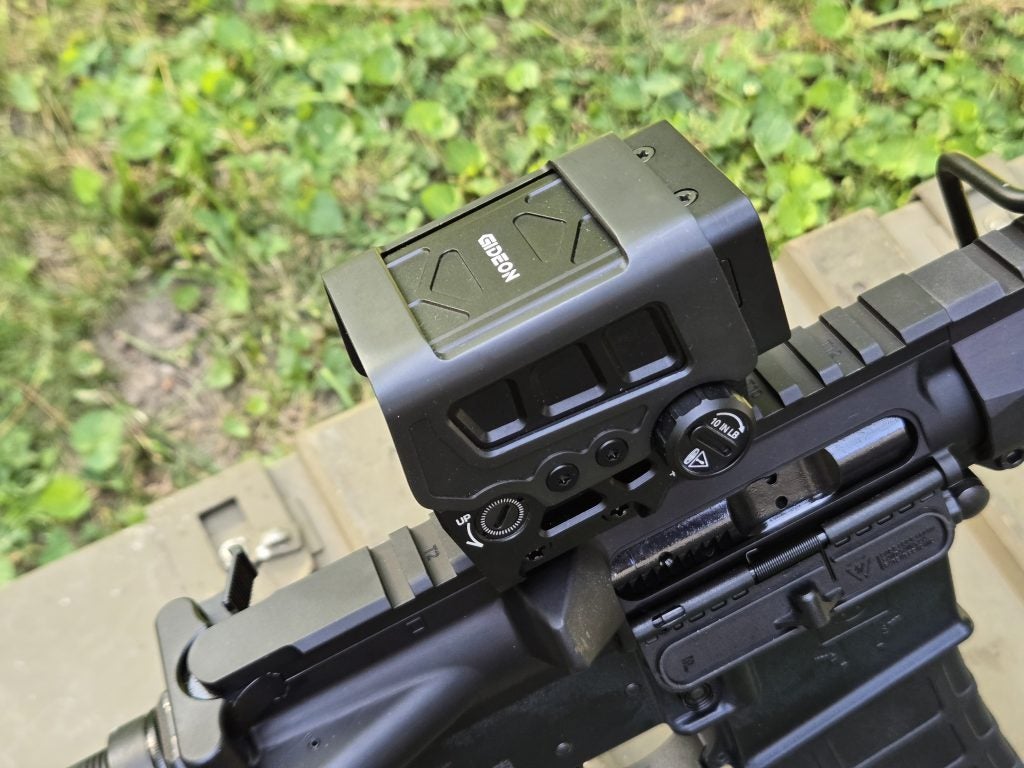
The optic carries some of the sci-fi aesthetic too. I used a Gideon Optics Mediator XL. It’s a big, squared-off optic, but the ARPK isn’t exactly a svelte carbine. The Mediator XL looks proportional on it, and its large window provides an excellent field of view.
I particularly like the circle-dot reticle on this rifle. It’s fast and works well for the kind of shooting I do with the ARPK. Battery life has also been excellent.
The Mediator has shrugged off everything I’ve subjected it to so far. That includes the recoil and vibration from FRS operation, along with a few unintended durability tests. A 9-plus-pound rifle isn’t always as willing to stay leaned against a shooting bench as you think. I’ve misjudged that a few times and sent the ARPK crashing over. The Gideon hasn’t cared.
Feeding the American RPK
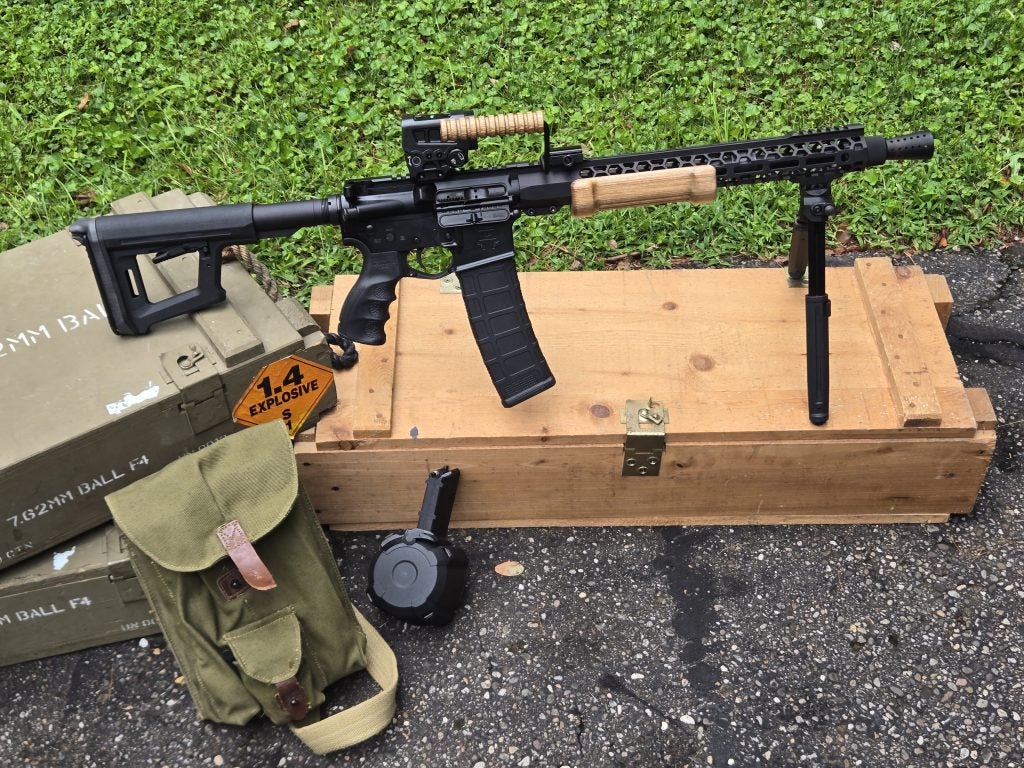
An RPK-inspired rifle needed something more interesting than a standard 30-round magazine. I’ve primarily used two Magpul options, along with the KCI drum. I’ll be honest, I mostly used the big KCI drum as a photo prop. I did most of my shooting with the Magpul mags, and some GI 30 rounders.
The PMAG 40 AR/M4 GEN M3 provides a modern AR equivalent to the extended box magazines traditionally associated with the RPK. For more capacity, there’s the PMAG D-60 GEN M3 drum.
I even carry the 40-round PMAGs in an old surplus Combloc 40-round AK magazine pouch. There are no markings on it, so I don’t know what country produced it. I’m not going to guess. It looks right and works for the magazines, which is enough for me.
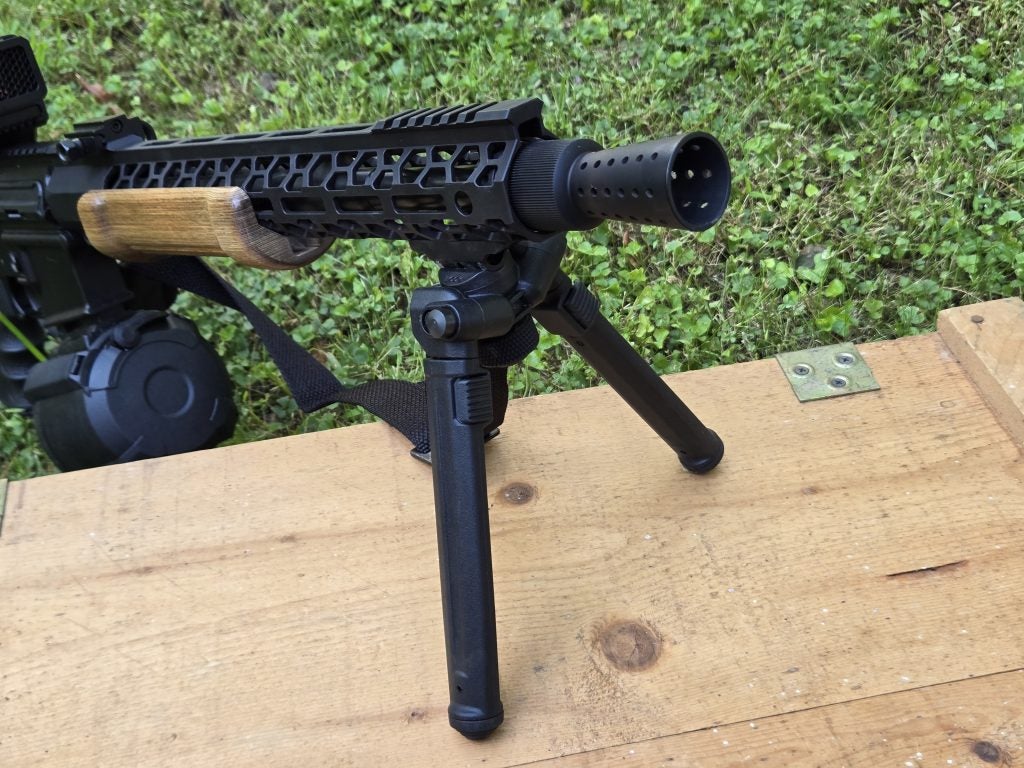
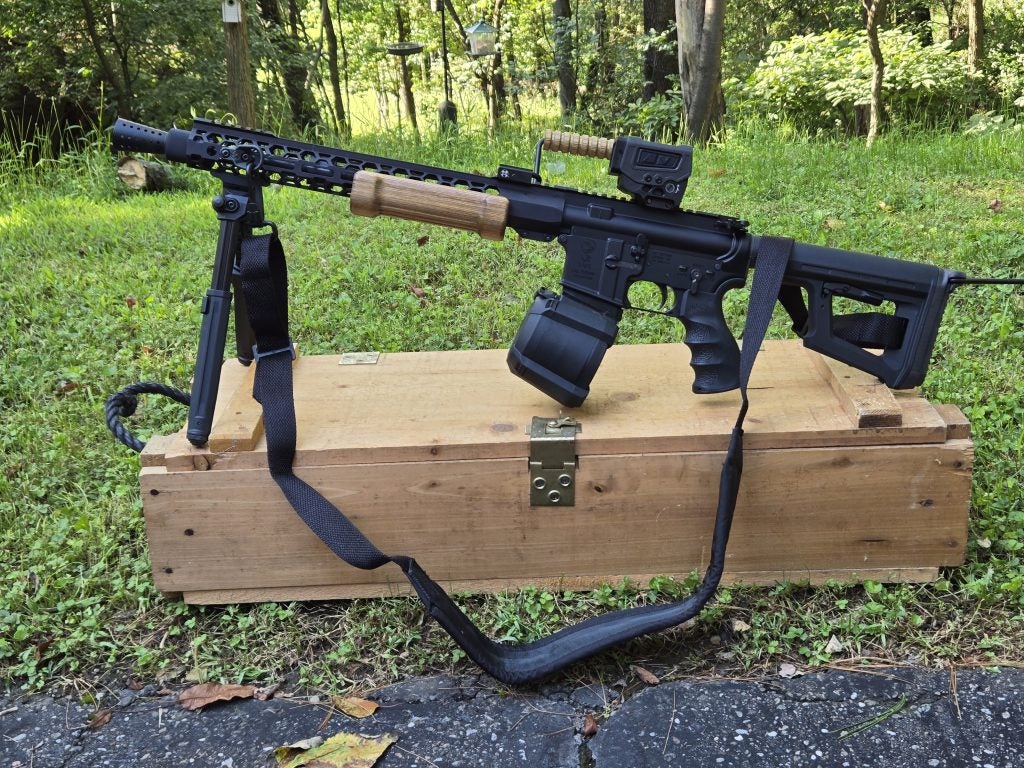
A Magpul M-LOK Bipod handles support duties. I also added a surplus USGI small-arms sling associated with the SAW/M249 family. A Magpul M-LOK Paraclip Sling Mount on the rail gave me a convenient attachment point.
Between the Savit-style shoulder support and GI sling, the finished rifle ended up with a couple of genuine M249 influences mixed in with the RPK inspiration.
A Pig, But Not The Pig
All of this stuff adds weight. With the optic, bipod, sling and an empty 40-round PMAG installed, the ARPK weighs 9.5 pounds. Swap the empty 40 for a loaded D-60 and it hits 12 pounds.
That’s a chunk for an AR, and I have some experience with heavy guns. I qualified expert with the M60 machine gun when I was in the Army and carried one during combat patrol training. The M60 wasn’t called “the Pig” for nothing. The ARPK certainly isn’t in M60 territory, but once the D-60 is loaded, you know you’re carrying it.
The funny thing is that the weight works in the rifle’s favor once you start shooting. Between the mass, MOE PR stock, FAB grip and M+M wood forend, the ARPK is comfortable and extremely easy to control.
The wood gives my support hand a comfortable gripping surface while protecting it from heat. The flip-up shoulder support provides additional help in both standing and prone positions. From behind the Magpul bipod, the rifle is particularly easy to keep under control.
Running the ARPK
I didn’t benchrest the ARPK or spend time shooting tiny groups because that’s not why I built it. So far, I’ve put roughly 400 to 500 rounds through the finished concept. I didn’t maintain an exact count, so I’m not going to pretend that number is more precise than it is.
Ammunition has been equally unscientific. I’ve used Winchester white-box 55-grain ammunition, factory reloads and assorted .223/5.56 loads pulled from the ammo locker.
Reliability has been excellent. Once I completed the initial upper receiver fitting required for the Atrius, feeding and general function were 100 percent with the ammunition I’ve used. Semiautomatic operation is smooth, and the rifle has run reliably in FRS mode.
Reviewing video from multiple strings fired by two different shooters puts the cyclic rate at approximately 650 to 740 rounds per minute. That’s with the 5.5 ounce KAK A5H2-style buffer. It’s an estimate derived from video rather than instrumented testing, but it gives a useful idea of where the rifle is running.
More importantly, it’s very controllable. The ARPK’s weight, furniture and moderate rate of fire work together nicely. From the bipod, it settles in particularly well. Standing, the extra mass is noticeable, but the grip, stock, forend and flip-up shoulder support make it comfortable to manage.
So What Is an ARPK Good For?
Do I actually need a magazine fed American squad automatic rifle? Not particularly, but that’s never really been the point.
The ARPK began as a vague sci-fi rifle idea and a separate thought about building an American take on the RPK. The M+M furniture resurfaced at the right time. The Atrius made the squad-auto idea more interesting. I stumbled across The Shoulder Thing That Goes Up at GunCon. Then Bad Attitude Department released an IAR-marked Cat Defense lower after the rifle was already basically finished.
There was no blueprint. The project just kept evolving, and somewhere along the way those unrelated pieces turned into a surprisingly cohesive rifle.
It has the extended magazines, drum, bipod, wood furniture, carry handle, SAW sling and flip-up shoulder support you’d expect from something borrowing heavily from squad automatic weapons. The Atrius and KAK DBC make that inspiration more than purely cosmetic. Meanwhile, the Canto DL-44 muzzle device and squared off Gideon optic preserve just enough of the original blaster idea to keep the ARPK from taking itself too seriously.
It’s heavy and weird, and it’s probably more elaborate than necessary. It’s also reliable, extremely controllable and ridiculously fun to shoot. For now, I’m perfectly content using my American RPK to turn milk jugs and assorted range junk into debris. Sometimes that’s enough of a mission requirement.