
The 1911 has been declared obsolete more times than most cartridges have been invented. In a new video, Garand Thumb host Mike Jones puts the Springfield Armory 1911 Operator AOS through a substantive testing regimen and arrives at a defensible answer to the question that keeps coming back: Does the 1911 still earn its place in 2026?
Jones’s short answer: yes — with significant caveats about what “earning its place” actually means.
The case for the Operator at $1,000
The video’s central commercial argument is one TTAG readers tracking the 1911 market will recognize: the modern 1911 universe has roughly bifurcated into two tiers. The bottom tier — sub-$700 imports and value-line domestic guns — frequently runs into reliability issues. The top tier — Wilson Combat, Nighthawk Custom, Ed Brown, Cabot, Les Baer — produces excellent guns that start north of $3,000 and quickly climb past $5,000.
The middle ground, where Springfield Armory operates, is where the actual buying decisions happen. And the Springfield Operator AOS, introduced in 2025 with optics-ready provision and a threaded barrel suppressor-ready configuration, sits at roughly $1,000-$1,289 depending on the variant. TTAG previously covered the suppressor-ready Operator AOS line’s introduction when Springfield announced it last August.
Jones’s framing across roughly 30 minutes of analysis: at this price point, the Operator is “the best defensive or offensive 1911 you can buy given its price.” That’s a meaningful claim from a host who openly compares the gun side-by-side to a custom Nighthawk and a Marine MEU(SOC) build by Valor Precision throughout the video.
What the testing showed
Garand Thumb’s testing methodology is built on documented drill performance rather than narrative impressions. On the Operator, Jones ran:
- Bill drills at 7 yards. Six rounds in an A-zone, with a target time under 2.2 seconds and a stretch goal of under 2.0. The Operator ran 2.05 with tight grouping, with split times averaging around 0.16 between shots — competitive performance for a hammer-fired single-action platform.
- Target transition drills to evaluate the platform’s maneuverability. The Operator handled transitions cleanly at around 0.6 seconds between targets.
- Long-range work with tracer rounds at 40 and 120 yards, demonstrating the .45 ACP’s slower velocity but still-usable accuracy at distances most pistol reviews don’t bother testing.
- 8,000+ rounds total on the test sample over the year-and-a-half evaluation period — well above what most YouTube reviews accumulate before publishing.
The Operator showed no significant reliability issues across that round count. Jones noted the platform’s tendency toward “hammer follow” failures (a common 1911 failure mode where the hammer follows the slide forward as fire control components wear), but didn’t observe it on the test sample, attributing this to Springfield’s improved heat treatment on the fire control components.
What Jones gets right about modern 1911 manufacturing
The most useful analytical content in the video isn’t about the Operator specifically — it’s about how the 1911 platform has changed since the original 1911A1 production runs of the early 20th century. Three points worth flagging for TTAG readers considering a 1911 purchase:
1. Modern 1911s are tighter than military 1911s ever were. Jones demonstrates this directly by comparing the Operator to a World War I-era 1911. The original military guns rattle audibly when shaken. The modern Operator and the high-end Valor Precision Musk build are silent. That tightness comes from improved manufacturing tolerances and produces better accuracy and feel — but creates secondary effects in the form of recoil spring management and the need for more careful tuning.
2. MIM (metal injection molded) parts are not categorically bad. Springfield uses MIM components in some non-critical Operator parts, which has historically been a knock against the brand among 1911 purists. Jones argues this concern is overstated — MIM done with proper heat treatment performs reliably, and the parts that matter most (slide, frame, barrel) are forged on the Operator, not MIM. This is a nuanced position the rest of the gun media often misses.
3. The Operator’s frame and slide are good enough to serve as the base for premium custom builds. Jones makes the point — backed by his contact with Marine Corps armorers and custom builders like Valor Precision — that Springfield Armory slides are used in custom 1911 builds across the military and civilian custom shop world. The Operator isn’t a custom gun, but its core components are built well enough that the custom shops use them. That’s a meaningful signal about base quality at the $1,000 price point.
Where the Operator falls short
The video identifies several areas where the Operator gives up performance to higher-end builds:
- Fire control group internals. Jones recommends upgrading these as the first modification for buyers planning to put significant round counts through the gun. The components work but aren’t the equivalent of what comes in a Nighthawk.
- Barrel crown. The Operator’s barrel is well-made stainless, but lacks the target crowning detail of higher-end 1911s. For most shooters this won’t matter; for accuracy-obsessed shooters it will.
- Slide stop pin. A MIM part on the Operator that’s commonly upgraded in higher-end builds. Jones notes most users haven’t had issues, but flags it as a watch point.
- Trigger. The Operator’s trigger is genuinely good for the price point — Jones places it as “very close” to a Nighthawk trigger in side-by-side comparison — but identifies it as the area where premium 1911s justify their cost difference.
The suppressor question
The Operator AOS line is available in a suppressor-ready threaded barrel configuration, which makes the platform interesting for shooters building modern suppressed 1911 setups. Jones addresses the timing complexity that 1911s introduce when suppressed: unlike modern striker-fired pistols where a suppressor with a Nielsen device handles cycling reliability automatically, 1911s need recoil spring tuning to run reliably with cans attached.
His recommended approach: start with the stock 18-18.5 lb recoil spring, then experiment with ISMI springs a pound or two lighter or heavier with the suppressor mounted to find the platform’s sweet spot. The Operator AOS comes from the factory with components that work suppressed, but the platform rewards tuning in a way modern designs don’t.
Should you buy a 1911?
Jones’s honest answer to “would you carry a 1911 as your primary?” is no, with the caveat that he doesn’t feel undergunned with one. The reasoning matches what most serious defensive shooters have reached over the past two decades: the 1911 is a maintenance-intensive platform that rewards training and care, while modern striker-fired pistols (Glocks, M&Ps, Sig P320s) tolerate neglect and still run.
The 1911 is, in Jones’s framing, a “race car” — capable of high performance with proper maintenance, but slower to recover from neglect than more modern designs. For shooters who carry every day, train regularly, and maintain their platforms, the 1911 still earns a place. For shooters who load up a magazine once a year and call it good, a striker-fired gun is the right answer.
For buyers in the $1,000-$1,300 1911 market specifically, the Operator AOS deserves to be on the short list. Garand Thumb’s video makes the case credibly, and the platform’s compatibility with red dots and suppressors out of the box reflects where the broader 1911 market is moving.





GT is deployment dodging coward. Who has never been on a two way range.
I thought the cheap Rock Island armory 1911s from the Philippines had a pretty good reputation for basic reliability.
I’m not a 1911 guy. I’m only 52 years old. 😉
I’ve got a bunch of modern polymer 9mm and 22lr pistols, and some 38/357/22 revolvers.
The only 45acp I currently have is a police trade in M&P 45 (which I like).
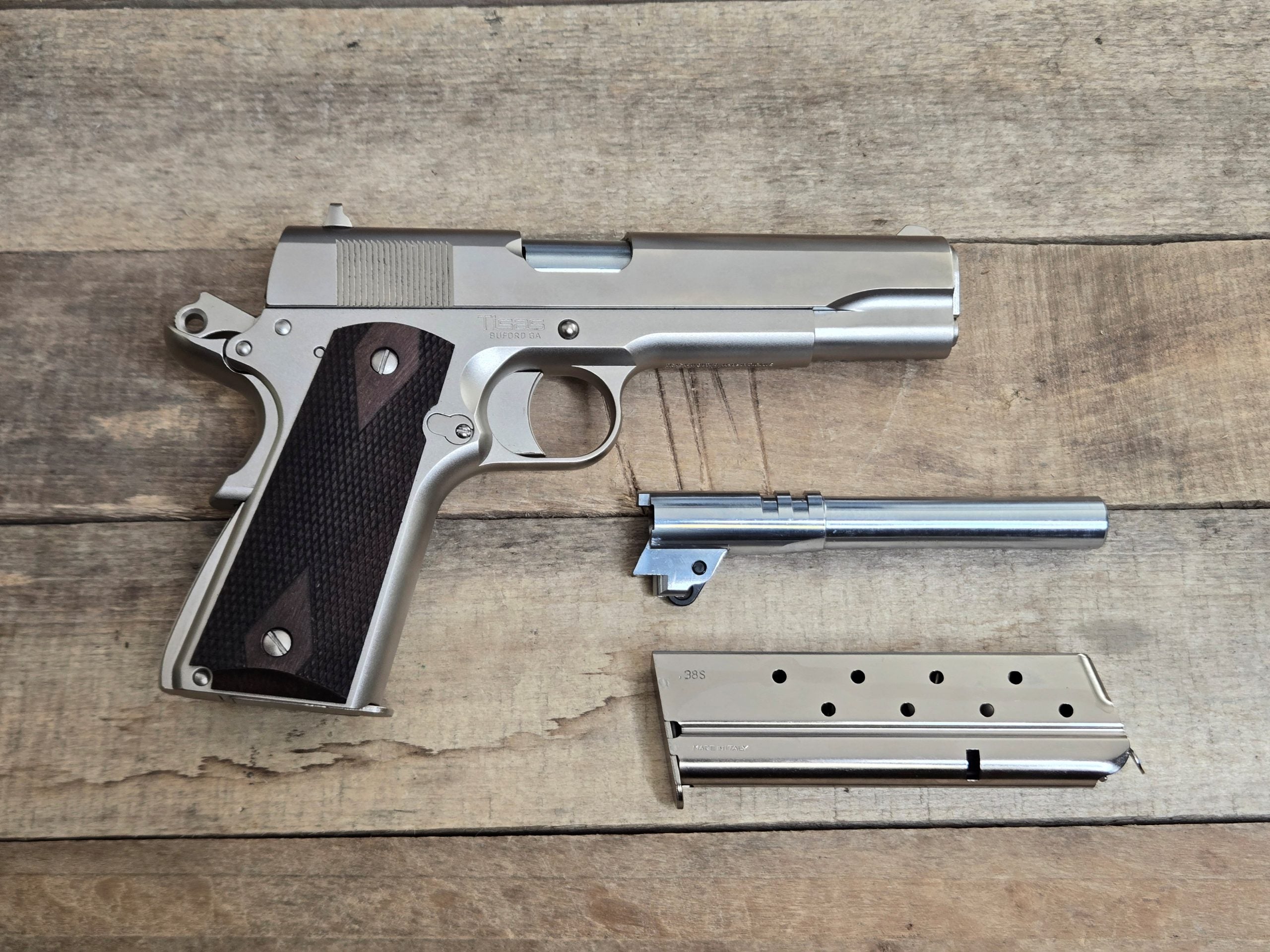
I have kicked around the idea of buying an inexpensive 1911 like a Rock Island or Tisas, mainly just to get familiar with the platform, and have another fun gun.
Buy the RIA Match Pro Ultra, Art…it has a better trigger, sights, and other features.
Go for the MAC MEUSOC OR THE JSOC… Even though they are Turkish🙃…They are really good guns and LOOK THE PART!… AND HAVE FRONT STRAP CHECKERING!.. ROCK ISLAND makes a decent but fugly gun.. Rock Island needs to go all out to make more attractive guns.. and a MEUSOC!..
Springfield needs to go back to the drawing board on one thing… PUT OCTO CHECKERING ON EVERY FRONT STRAP ON EVERY 1911..OR SUPPLY THEM WITH PACHMEYER WRAPAROUND GRIPS!.. I have the Marine Corps operator with the OCTO checkering on the front strap.. GREAT GUN INDEED!.. AND THEY DISCONTINUED IT!… WTH!!… MAKING A 1911 IN THIS DAY AND AGE WITHOUT FRONT STRAP CHECKERING SHOULD BE A CRIMINAL OFFENSE!..
I never understood why 45ACP is the butt of all the “old” jokes when the shooting world revolves around 9mm which is 3 years OLDER.
End user issues more than the round. Both can be made to work great for their areas of focus.
GT is a deployment dodging coward.
What’s wrong TTAG to chicken to leave my previous comment up?
Have an issue , need a tissue Miss?
It’s true, guy never deployed but acts all Tier-1.
I’d be embarrassed if I served as long as he did and didn’t do a combat deployment. It’s the ultimate test for all you flat range commandos.
I’ve never had problems with my Sig 1911’s stock springs and a silencer.
The thought that 1911s are the sports cars of the handgun world is odd. They will go thousands of rounds without cleaning, tolerate a wide range of ammo, sit for months without attention (just like striker fired polymer guns) and tolerate “limp wristing” so long as you depress the grip safety. Your dog can’t chew them up. The biggest hits are the weight when carrying them around, capacity, and that they weren’t milled for red dots for a long time.
And a mediocre stock trigger on a 1911 will still feel superior to even an aftermarket “performance” trigger on an Austrian potato gun.
You could pick up the new double stack Kimber for less.
Guessing Kimber had a rebound on quality control when they got the new board members?