
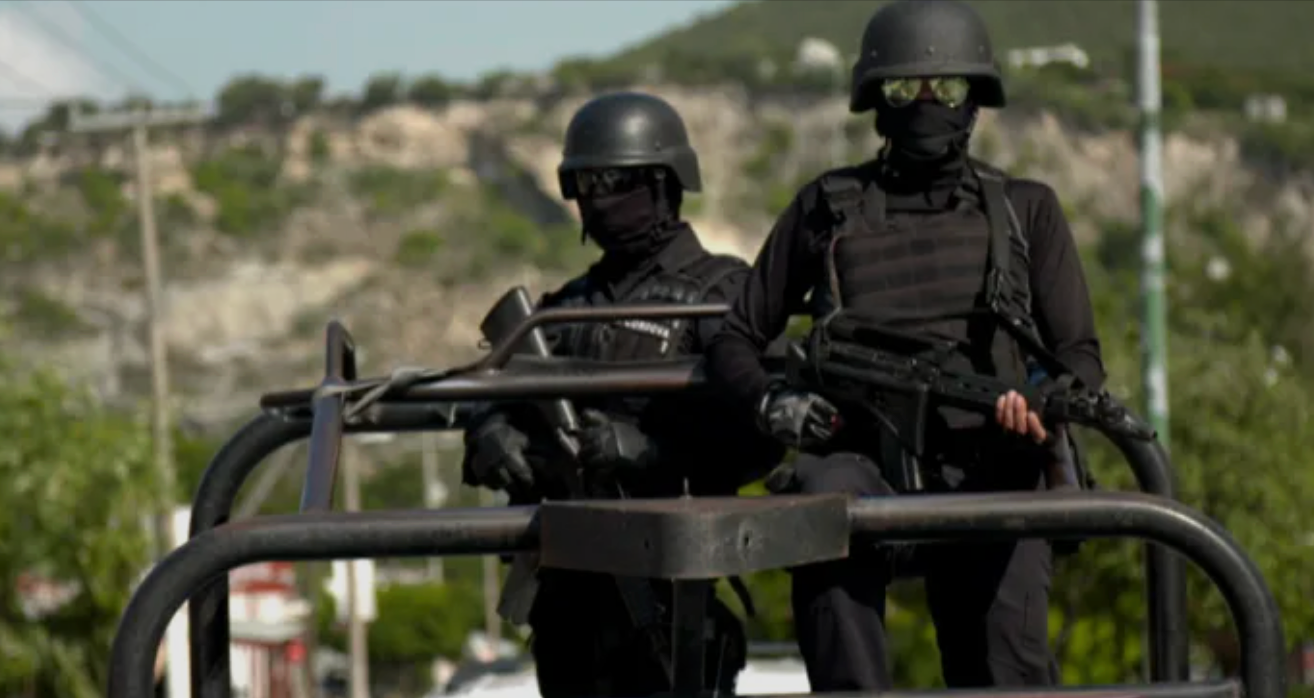
Federal prosecutors just charged a gun dealer with terrorism.
That’s never happened before—and it changes the stakes for the entire firearms industry.
An Arizona FFL is now facing material support charges…
What Allegedly Happened
According to the indictment, Laurence Gray — owner of Phoenix-area shop Grips by Larry — sold six firearms to an undercover ATF agent posing as a cartel gun runner. The buys went down across the spring of 2025. The agent reportedly paid $42,000 in cash for the first three guns: a semi-auto .50 BMG rifle and two belt-fed “squad” weapons (read: civilian-legal versions of the M249 SAW). Subsequent buys included another civilian-legal .50-cal.
The damning part of the complaint isn’t the guns themselves — none of those firearms is illegal to sell — it’s what was allegedly said during the transactions. The informant reportedly told store employees the guns would go “directly to Mexico.” On a later sale, an employee was reportedly told the buyer was working for the New Generation Jalisco Cartel (CJNG). According to prosecutors, the employee “stated he understood and continued with the sale.”
If those allegations are accurate, that’s not a gray-area sales practice. That’s a flagrant violation of federal law that any honest FFL would refuse on principle and survival instinct alone.
Gray has pleaded not guilty. Both the original 2025 trafficking-related indictment and the March 2026 superseding indictment that added the terrorism charges are still working their way through the courts. We don’t know what gets proven at trial, and assertions in a complaint are not evidence.
The Real Story: Trump’s FTO Designation Just Got Its First Test Case
The reason this case matters beyond one Phoenix shop is the legal vehicle being used. In February 2025, the Trump administration formally designated six Mexican drug cartels — including CJNG — as Foreign Terrorist Organizations. That designation was always going to have downstream consequences. This indictment is the first big one.
Once a group is designated an FTO, providing it with “material support” — money, weapons, services, anything — becomes a federal terrorism offense carrying penalties dramatically more severe than the underlying trafficking charges. We’re talking decades in federal prison versus what would historically have been a much lighter trafficking sentence (assuming the case got prosecuted at all, which most don’t).
A former DHS investigator who worked on Arizona gun trafficking cases told ICIJ this looks like a “test case” for a new federal strategy. That tracks. DOJ is clearly probing how far the FTO designation can stretch as a tool against the gun trafficking pipeline, and an Arizona shop where employees allegedly acknowledged the destination of the firearms is about as clean a fact pattern as prosecutors are going to get for a maiden voyage.
Our Thoughts
Knowingly selling firearms to people you’ve been told are sending them to a violent transnational cartel is indefensible. It’s a betrayal of every honest gun owner, every law-abiding FFL, and every responsible buyer who fills out a 4473 in good faith. If the allegations against Grips by Larry hold up at trial, the shop deserves whatever the jury hands down. Full stop.
That said, there are reasons for the broader gun-owning community to watch this case very carefully.
First, the federal government is not a credible narrator on Mexican cartel arms trafficking. The same federal apparatus now positioning itself as the principled prosecutor of cartel arms suppliers is the same apparatus that ran Operation Fast and Furious — the ATF program that walked roughly 2,000 firearms across the border into cartel hands, including weapons later used to murder Border Patrol Agent Brian Terry. No senior official ever did time for that. The U.S. government has also been the direct supplier of fully-automatic weapons to a Mexican military that loses a substantial percentage of its inventory to the very cartels it’s supposed to fight. The “U.S. gun shops are the problem” narrative has always been the convenient version of the story.
Second, the FTO hammer cuts in more than one direction. Watch how prosecutors decide what counts as “material support.” The Arizona case involves alleged direct, knowing sales to a buyer who self-identified as a cartel runner. That’s the easy version. But the same statute could theoretically be deployed against manufacturers, distributors, or dealers under far more attenuated theories of “knowing” — exactly the legal theory the Mexican government already tried to use against U.S. manufacturers before SCOTUS shut it down 9-0 under the PLCAA last summer. PLCAA blocks civil suits, not criminal prosecutions. If DOJ gets aggressive, the FTO designation could become the back door around the wall the Supreme Court just rebuilt.
Third, the press release math doesn’t add up. Mexican defense officials told reporters that 80 percent of the 23,000 firearms seized since late 2024 originated in the U.S. That number gets repeated constantly and almost never gets interrogated. It conveniently ignores that ATF only traces the guns Mexico submits for tracing — not all seized firearms — and the submitted batch is heavily weighted toward weapons the Mexican government already suspects are American. It also ignores Central American military stockpiles, Eastern European supply chains, and the well-documented “shrinkage” from Mexico’s own armed forces. There’s also the awkward detail that ICIJ itself reported in February: nearly half of seized .50-caliber ammunition came from a U.S. Army plant, not from Bob’s Gun Shop.
The Bottom Line
If Laurence Gray did what prosecutors say he did, the case against him is sound, and the gun community shouldn’t rush to defend him. Bad FFLs hurt good ones, and a guy who sells .50-cal rifles to someone openly bragging about cartel ties isn’t a martyr — he’s a liability the entire industry has to clean up after.
But the precedent being set here is bigger than one Phoenix shop. The FTO designation just became a live prosecutorial tool in the firearms space, and how DOJ chooses to use it — narrowly, against actual knowing accomplices, or broadly, against anyone whose products end up in cartel hands — will tell us a lot about whether this is law enforcement or politics in a law enforcement costume.





RE: “If Laurence Gray did what prosecutors say he did, the case against him is sound, and the gun community shouldn’t rush to defend him.”
Sounds like greed got the better of the store owner or a commission employee, etc. However certain blowbags who read only the headlines will trip over each other to bash Trump’s DOJ and defend the store. Fact is there are some stupid bad apples among the Gun commumity who will sell to anything with the money and it does not work that way. If there is a courtroom conviction rest assured Gun Contollers will use it for all its worth and most likely in one way or another the 2A will pay.
Time once again for some Sunday Morning Kris…
https://youtube.com/watch?v=gPGuUHNT7U4&si=HzS4T8eMZMxGqKsi
What kind of gun dealer would sale a gun to someone who said these are going to mezkin gangsters? ,,,, with witnesses even.
I’m calling Bullshit on this article.
I have to wonder if the guy was just really stupid and greedy, or if they threatened him. He might be able to argue that he was afraid that if he denied the sale, he could end up skinned alive or hanging from an overpass.
First paragraph of “Our Thoughts” where these people should be held accountable, but how come no one was held accountable when Department of Justice (DOJ) allowed and oversaw the “Fast and Furious” operation, which allowed over 2,000 firearms to be sold illegally no one under the adminastration was ever charged.