
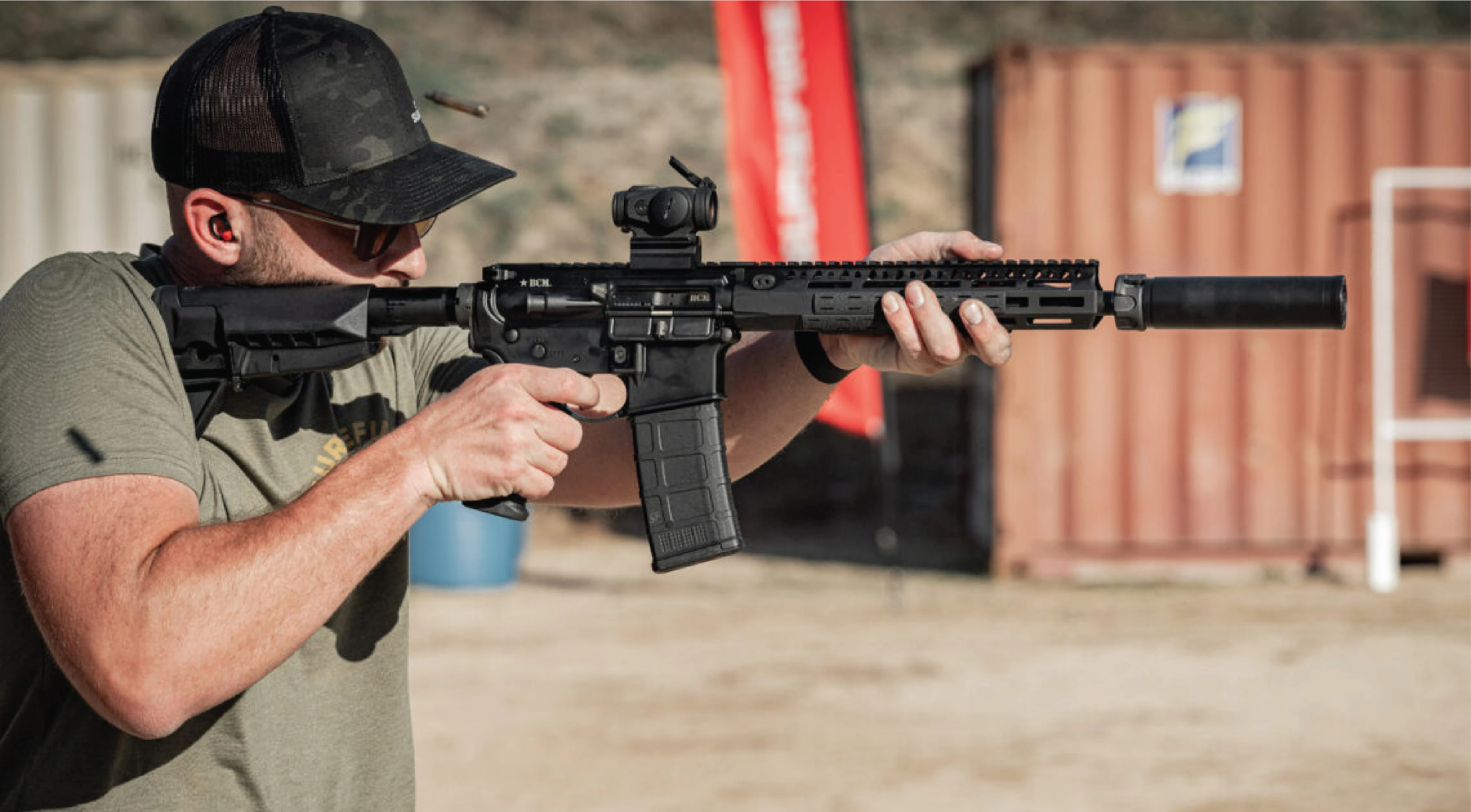
Imagine going to federal prison because your rifle barrel measures 15.9 inches instead of 16 inches. Sound absurd? Welcome to the world of short-barreled rifle (SBR) and short-barreled shotgun (SBS) regulations, where a fraction of an inch determines whether you’re a law-abiding citizen or a potential felon facing up to ten years in prison and a $250,000 fine.
The National Firearms Act of 1934 established these regulations, creating arbitrary barrel length restrictions that continue to baffle gun owners nearly a century later. A rifle must have a barrel length of at least 16 inches, and a shotgun must measure at least 18 inches. Fall short of these measurements, and your firearm becomes an NFA item requiring federal registration, a $200 tax stamp, months of waiting, and enough paperwork to wallpaper a small room.
The Historical Context Nobody Remembers
When Congress drafted the NFA in 1934, the country was reeling from Prohibition-era gangster violence. Lawmakers wanted to restrict concealable weapons that they believed criminals favored. The original bill actually targeted handguns as the primary threat. SBRs and SBSs were included to prevent people from circumventing a potential handgun ban by simply cutting down rifles and shotguns.
Here’s where it gets ridiculous: handguns were removed from the final legislation, but the restrictions on short-barreled rifles and shotguns remained. The entire premise for restricting SBRs and SBSs evaporated, yet we’re still living with regulations designed to plug a loophole for a ban that never happened. It’s like keeping a screen door on a submarine.
Are SBRs Legal? Yes, But With Absurd Complications
So are SBRs legal? Technically, yes. Short-barreled rifles are legal under federal law, but they’re classified as NFA items requiring registration with the ATF. You’ll need to submit ATF Form 4 (if purchasing from a dealer) or Form 1 (if building your own), pay the $200 tax stamp, wait anywhere from several weeks to months for approval, and maintain proper documentation of your NFA item.
The process isn’t just bureaucratic theater. It’s an expensive theater. Beyond the tax stamp, you’ll often pay inflated prices for SBR-classified firearms, plus potential legal fees if you use a gun trust. And if you want to cross state lines with your legally registered SBR? That requires additional ATF permission via Form 20. Forget to file it, and you’re committing a federal felony.
Meanwhile, AR-15 pistols with arm braces exist in a legal gray area that has flip-flopped based on ATF rulemaking whims. These firearms can have barrels under 16 inches and function nearly identically to SBRs, but they’re not classified as rifles because they lack a stock. The ATF’s recent attempts to reclassify braced pistols as SBRs only highlighted the arbitrary nature of these distinctions.
SBR vs Rifle: Why the Difference Matters (But Shouldn’t)
Let’s examine the practical differences between an SBR and a standard rifle. An SBR is more compact, slightly lighter, and easier to maneuver in confined spaces. A standard rifle offers marginally better velocity and accuracy at extended ranges due to the longer barrel. That’s it. That’s the difference.
Both fire the same ammunition at lethal velocities. Both are equally capable in the hands of a criminal. Both require the same level of responsibility from the owner. The only meaningful distinction is that one requires a year’s worth of paperwork and federal registration, while the other can be purchased after a standard background check.
The ballistic performance difference is negligible for most practical purposes. A 14.5-inch barrel versus a 16-inch barrel in 5.56 NATO loses perhaps 50-100 feet per second in muzzle velocity. This matters to competitive long-range shooters and military snipers. It doesn’t matter to someone defending their home or a criminal intent on violence.

The Shotgun Side of Stupidity
Short-barreled shotguns face even more absurd restrictions. An 18.1-inch barrel is perfectly legal. An 18-inch barrel requires federal registration. A 17.9-inch barrel makes you a felon. We’re literally talking about measurements smaller than the width of a nickel determining legality.
The original justification claimed that sawed-off shotguns were gangster weapons of choice. Historical evidence doesn’t support this narrative. Thompson submachine guns, handguns, and standard shotguns were far more common in criminal activity. But the mythology of the sawed-off shotgun persisted, cementing regulations based more on Hollywood than reality.
Modern defensive shotguns with 14-inch barrels offer superior maneuverability for home defense. They’re easier to store, lighter to carry, and more effective in confined spaces. But accessing these advantages requires navigating the same Byzantine NFA process as SBRs, complete with tax stamps, waiting periods, and the perpetual risk of accidental non-compliance.
The ATF’s Enforcement Nightmare
Even the ATF struggles to enforce these regulations consistently. Measuring barrel length seems straightforward until you realize it’s measured from the closed bolt face to the end of the barrel, but before any permanently attached muzzle device, unless it’s pinned and welded. Overall length measurements include any folding or collapsible stock in the extended position.
Confused yet? So are many gun owners who’ve accidentally created NFA items without realizing it. Installing a shorter barrel on your AR-15 before removing the stock makes it an SBR, even if only for the thirty seconds it takes to install a pistol brace. Constructive possession laws mean simply having the parts to build an NFA item can be illegal, even if you haven’t assembled them.
The regulations create a minefield of technical violations where well-meaning gun owners can become felons through ignorance or innocent mistakes. This serves no public safety purpose. It simply criminalizes arbitrary configurations while doing nothing to prevent actual violence.
The Path Forward: Legalize SBRs and SBSs
The case for repealing SBR and SBS restrictions is straightforward. These regulations don’t enhance public safety, create massive compliance burdens, waste ATF resources on paperwork instead of preventing crime, and criminalize arbitrary mechanical configurations with no bearing on a firearm’s lethality.
Several bills have been introduced in Congress to remove SBRs and SBSs from NFA regulation, including the Home Defense and Competitive Shooting Act. The Silencer Shop Foundation’s fight to dismantle the NFA is about aligning law with reality, because suppressors and SBRs are no longer niche items; they’re mainstream gear. Visit The Silencer Shop Foundation to get involved, donate, and help push this fight over the finish line.
Silencer Shop on TTAG:



Don’t forget that if your AR lower was transfered as a rifle it can’t have a barrel shorter than 16″ unless you register it as an SBR. And that’s regardless of using a brace or a stock. Once a rifle, always a rifle. A pistol lower can be either or and back again if I understand it correctly. It’s all lunacy to put more years on your charge of whatever they dream up so you’ll take the plea deal. Like lying that you were going 20 over when you really were only going 10 mph over.
The law is ludicrous besides being unconstitutional.
Use receivers stamped multi caliber. At least you can switch calibers without breaking some insane nitpicking law.
Nothing but insanity can ever come from Gun Control an agenda History Confirms is the best pal Racism, Slavery and Genocide ever had. Its diabolical History proves it is never going to bake a cake for those exercising a Constitutional Right.
https://youtube.com/watch?v=WlItbl9SOAg&si=EoVT4yd61lT9t3q5
I personally see no advantages of a short barreled rifle. Killing snakes with an SBS is easy and fun.
Remembering a flock of blackbirds that were flying over my place years ago. I cut loose with an sbs and #8 shot. Nothing happened, I’m like what the fuck? Then it started raining birds. I was amazed to find many different species of black birds in that flock. I had assumed they would have been a single species.
And yeah I tried fried blackbird that night, its nothing to sing about believe me.
Maybe I should have made a pie?
Did you remove the feathers, beaks, feet, and guts from those blackbirds? If not, I think I know why you didn’t sing. To the contrary, you probably howled at the moon all night instead.
We osprey usually are content to fish. It’s because the feathers taste so bad, actually.
I am Osprey, of course…not Robin from Tennessee. (hint, hint, Scott Witner)
“I personally see no advantages of a short barreled rifle.”
The opposite.
SBRs are objectively advantageous for maneuvering in tight places, singlehanding, and retention – some or all of which will be relevant in nearly 100% of DGUs.
16″+ barreled rifles are objectively advantageous for 300+yd shots – which are relevant to 0% of legally defensible DGUs.
Also, about half the country (where far more than half the deer and hunters live) is terrain amenable to SBR range.
Pistols are sbr’s without a stock. Even better for tight spaces.
A rifle is a rifle until its barrel is 16inches then it’s a Carbine anything less is just an oversized clumsy pistol.
Whether or not history supports or diminishes the popularity or use of short barrelled rifles or shotguns during the Prohibition Era, history supports the proposition that the Federal Government at the time believed that it did, and that such firearms were concealable. Given an intent to ban concealed firearms (which with handguns was accomplished separately) there is meaningful distinction between short barreled long guns and full size firearms, a distinction that will always come down, at some point to minuscule measurements. That this is still true is reflected in the on-going battle over the classification of firearms as pistols or long arms resulting from the simple expedient of removing the stock.
26inches overall length.
The surge in popularity of AR pistols dispels any claim that SBRs are especially dangerous. How many millions have been sold without issue?
Probably getting close to how many gun owners in NY and certainly past unrestricted pistol permits.
The US Constitution is not, and may never be used as, a limit upon the People. All too oft people regard the introductory statement of the 2nd Amendment, “A well-regulated militia, being necessary to the security of a free state” as a clause upon which the right of the People depends. Nothing could be further from the truth. As opined in US v. Miller (1939) SCOTUS unanimously (8-0, 1 abstention) agreed that the introductory statement of the 2nd Amendment specifically protects arms of efficacy to the military for the militia which is comprised of the People. Since Miller was not represented in the arguments, and as such, no evidence that a short barreled shotgun was of efficacy to the military was presented, they upheld the conviction of Miller and the NFA restriction. I’m sure that our special forces would have a different opinion on the efficacy of such a weapon today. Regardless, in Miller, SCOTUS correctly cited the introductory statement in support of the true meaning of the 2nd Amendment; for the People to retain their natural right to fight all enemies, foreign and domestic.
In the absence of any evidence tending to show that possession or use of a “shotgun having a barrel of less than eighteen inches in length” at this time has some reasonable relationship to the preservation or efficiency of a well regulated militia, we cannot say that the Second Amendment guarantees the right to keep and bear such an instrument. Certainly it is not within judicial notice that this weapon is any part of the ordinary military equipment, or that its use could contribute to the common defense. Aymette v. State, 2 Humphreys (Tenn.) 154, 158.
United States v. Miller, 307 U.S. 174 (1939)
This is the proverbial writing on the wall for the entire NFA et. Seq. in a post NYSPRA v. Bruen world. It is quite surprising that this logical challenge to the NFA, based upon this ruling, has never been brought forth by some young industrious barrister. Enter the post Bruen era, likely to put an end to ridiculous laws restricting weapon types and magazine sizes, and the common-sense overarching challenge to the NFA seems inevitable. A win against the NFA restrictions of machine guns, short barrel rifles, and suppressors would usurp and pre-emptively overrule these individual states’ unconstitutional laws clearly flying the finger at SCOTUS.
Gman,
I have wondered the exact same thing myself–that someone should be able to successfully challenge the National Firearms Act of 1934 based on the 1939 Miller decision.
Outside of that, couldn’t someone also successfully challenge the National Firearms Act of 1934 (at least the “short barreled” stuff) for being “arbitrary and capricious”? As this article aptly points out, there is no difference in lethality nor concealability between a 15.98 inch barrel and 16.02 inch rifle barrel.
Personally I am hoping to see a revival of letters of marque for priveteering interdictions of cartel boats