

| Image | Product | Price |
|---|---|---|
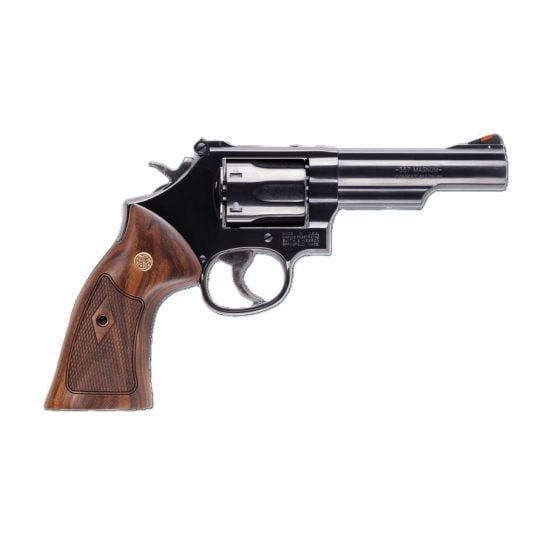 | Check Price |
1935 was a banner year for revolver lovers. That was when the .357 Magnum cartridge made its appearance. It was chambered in a revolver that was based on the old S&W .38/44. This later became the Model 27, and it remains (and was, as you can buy a new one for $ 1,209) one of the top examples of S&W’s craftsmanship. Featuring the large “N” frame, adjustable sights, an etched top strap, a high-polish job, nice wooden grips, recessed cylinders, and a presentation case, the gun was known as the “Registered Magnum” upon its 1935 introduction. It sold for $60, or $39 if you were a LEO or NRA, or other such member. Sixty dollars in 1935 would be $ 1,409 today, which makes the current one at $ 1,209 seem reasonable.
Gunwriter Philip Sharpe was instrumental, along with Elmer Keith, in developing the .357 Magnum cartridge, which was matched to this gun on its introduction in 1935. Sharpe used the gun and cartridge to take a wide range of big game, all over the globe. Even considering the guns’ price tag during the Great Depression, S&W almost couldn’t keep up with orders for them. Police departments issued it… It was, at the time, the only revolver cartridge capable of punching through gangsters’ car doors. (Semi-auto fans out there would be happy to know that there was a round that 1911s could fire that would all but do the same, the .38 Super, but at that time, most police agencies issued revolvers.) The .357 was a sure bet in those days, punching through thin metal car doors or glass.
I have never owned a 27, but I did own a 4-inch “Highway Patrolman” Model 28. That was the plain-Jane version of the 27, minus the polish job and some other goodies. I wish I had it back.
The Model 19 Story
In 1955, a retired Chief Patrol Inspector of the U.S. Border Patrol, Bill Jordan, collaborated with S&W to discuss creating a K-frame version of the .357 Magnum. He envisioned a gun, a “peace officer’s dream”, that agents or police could carry that wasn’t as bulky and heavy as the N-frame .357s made to that point. It was to have a square butt with hand-filling grips, a heavy barrel, and adjustable sights. On November 15th of that year, the four-screw Model 19 was born, although that model number was not attached to the gun until a couple of years later. That was 1957, when it sold for all of $95 ($ 1,087 today, which is right in line with its current $ 1,089 MSRP). However, when it was initially introduced, it was called the Combat Magnum.
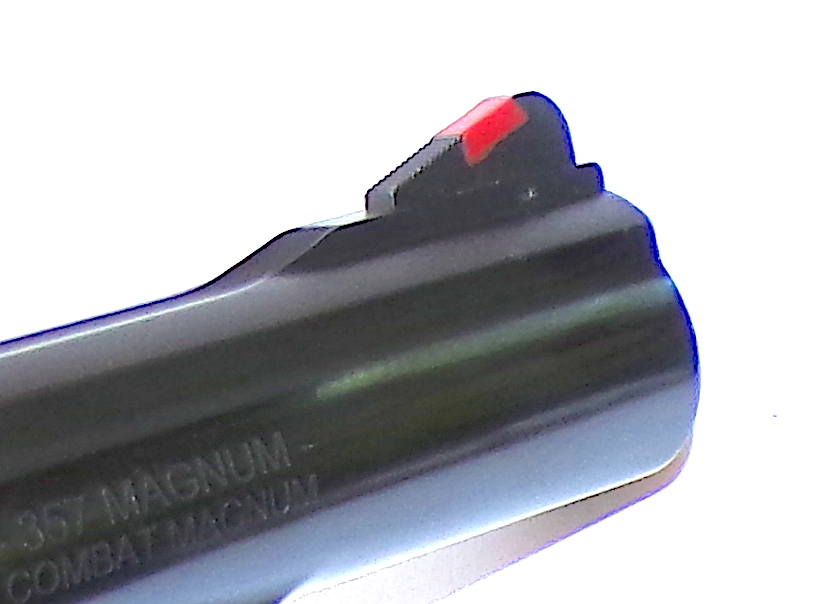
The original was made with a 4” barrel and issued to INS and Border Patrol agents. It was later available with 2.5” and 6” barrels. The gun was made (as the Model 19 after 1957) until November 1999, although its stainless counterpart, the Model 66, was made from 1970 to 2005. Now, via the Classic Series, we have the great 19 back, and it’s a doozy. It’s even got “Combat Magnum” engraved on the barrel.
All wasn’t peaches and cream, however. There were instances of frames and barrels cracking when guns were fed a steady diet of hot magnum loads. The K frame was identified as the cause, which led S&W to introduce the L frame in 1980 with the 586 (blued) and 686 (stainless) series. They were engraved “Distinguished Combat Magnum.” The slightly beefier frame and larger cylinder not only strengthened the gun but also allowed a 7th chamber to be cut in some versions.
But… If you shoot mostly .38s for practice with some .357s thrown in, your 19 will likely outlast you without needing a factory visit.
Features & Specs
The Combat Magnum is special. I have owned S&W revolvers for close to half a century and have been impressed more often than not. As stated, I wish I had that Model 28 back, along with a Model 17 .22 LR that I once owned. These are the tip of the iceberg. It seems I always sell or trade the wrong guns, for which I kick myself. You’d think I’d learn.
At any rate, let’s look at the Combat Magnum.
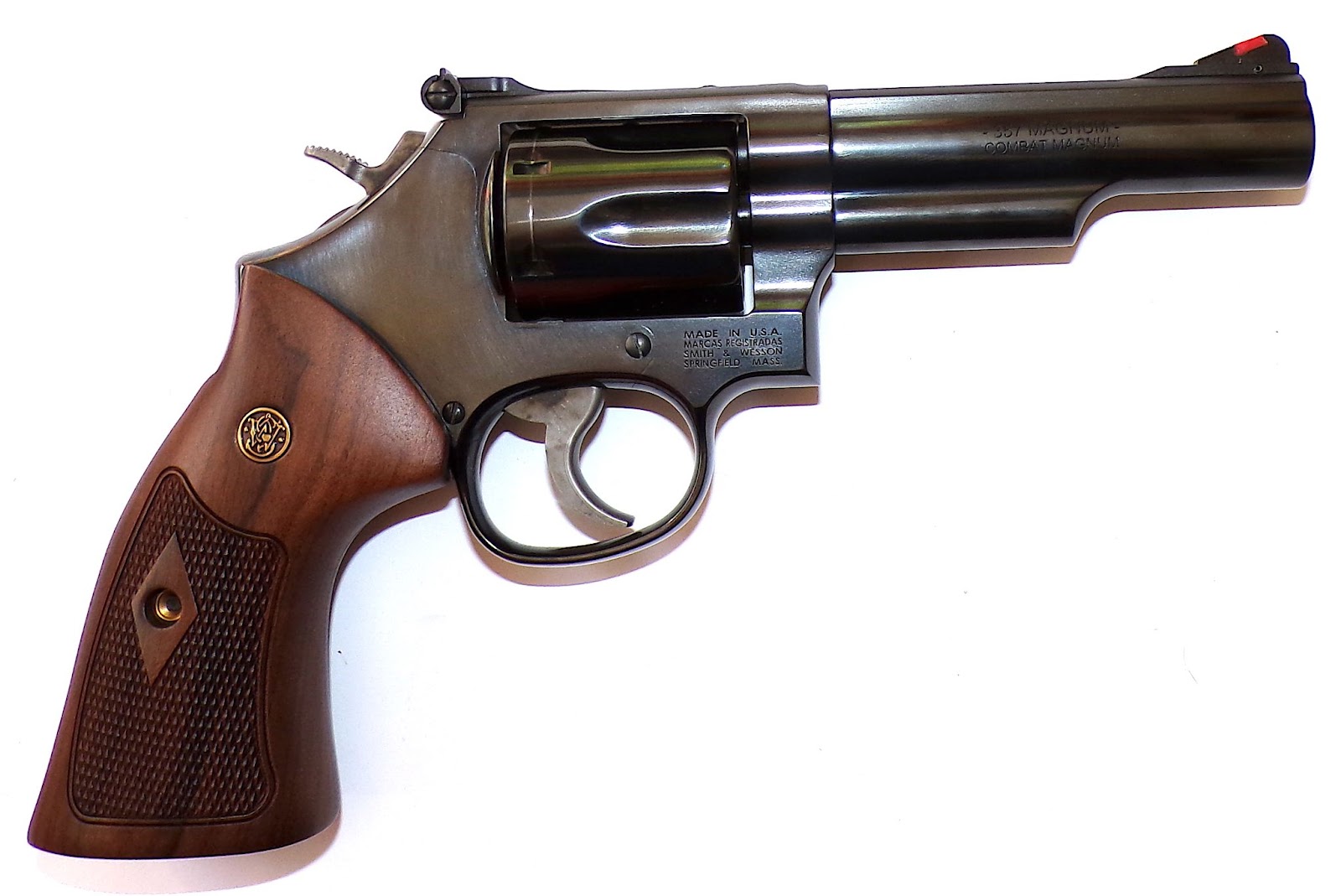
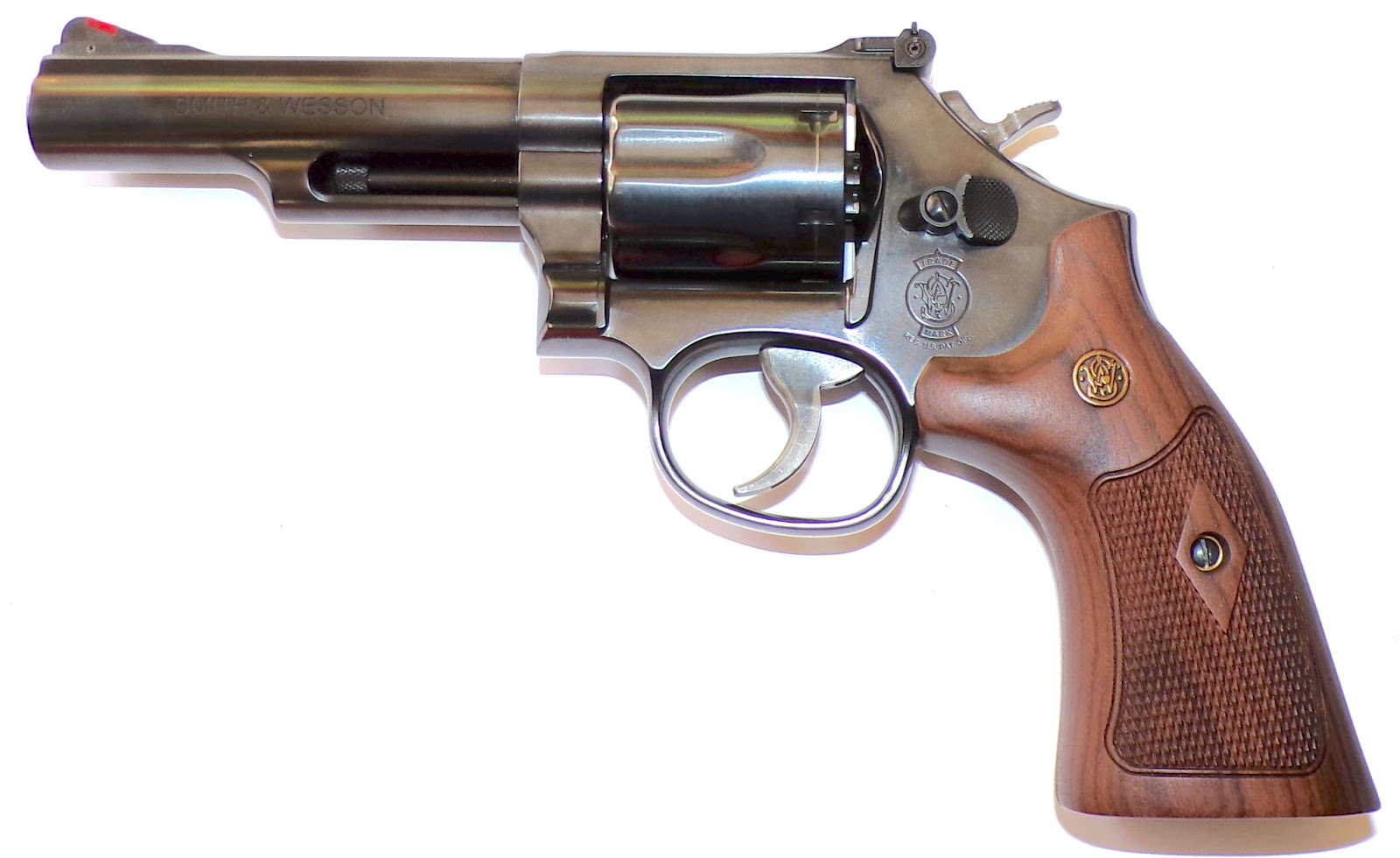
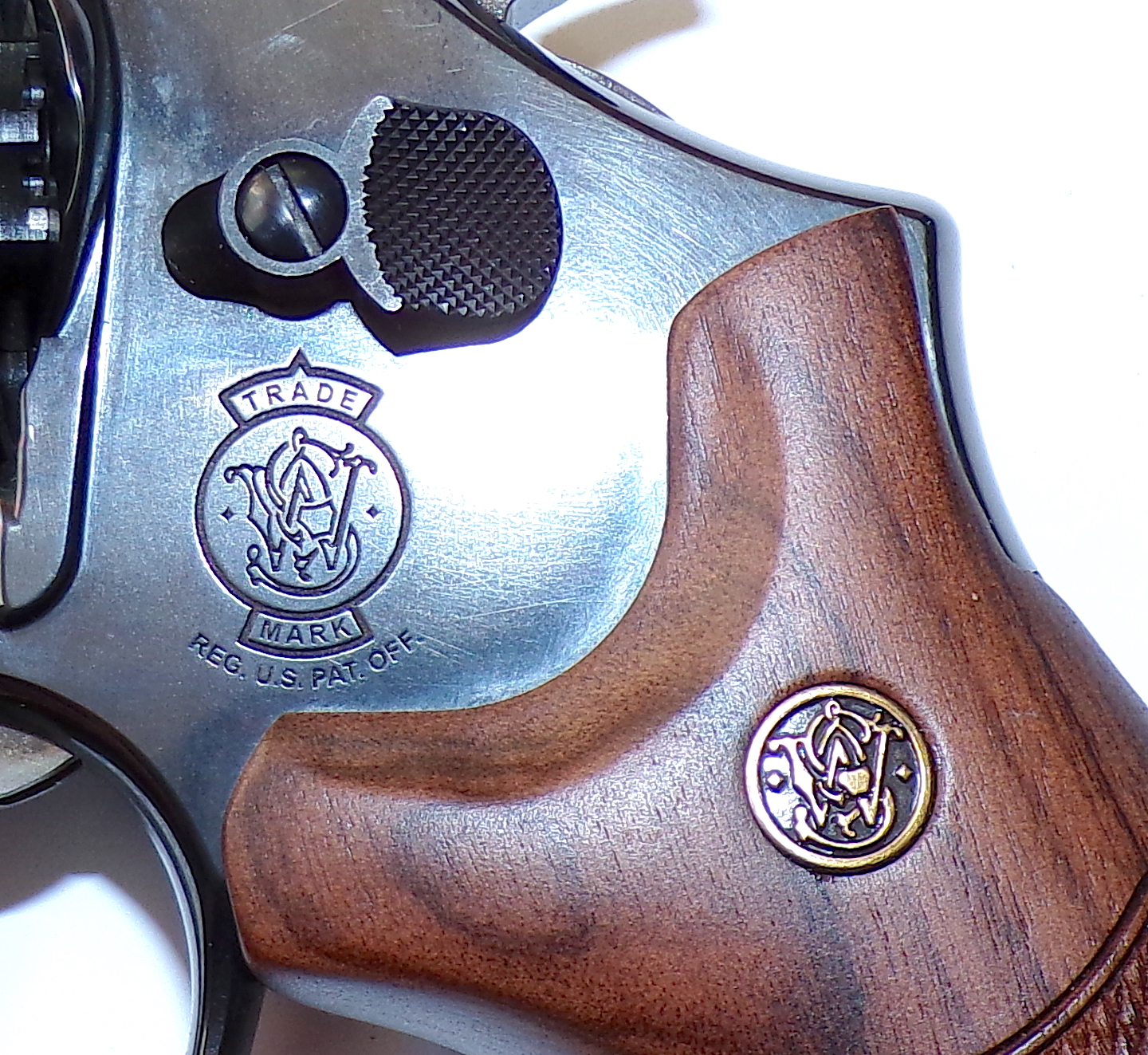
Notice anything in the photo above? Look above the cylinder release… no lock! Yay! Finally! Hopefully, that idiotic “Hillary Hole” is on its way out across the board. Also, notice the excellent, polished finish and the wonderfully sculpted grips.
Specifications and Then Some
- Width: 1.45 In
- Length: 9.87 In
- Height: 5.85 In
- Weight: 37.4 oz
- Caliber: .357 Magnum
- Size: Medium1
- Capacity: 6
- Action: Single/double action2
- Barrel Length: 4.25”
- Grip: Wood
- Sights: Red ramp front, adjustable rear
- Optic Ready: No
- Safety: None3
- Color/Finish: Blued4
- State Compliance: Co, Ct, De, Hi, Il, Md, Nj, Ny, Ri, Vt, Wa
- Threaded Barrel: No
- Barrel Material: Carbon Steel
- Frame: Carbon Steel
- 1 K frame
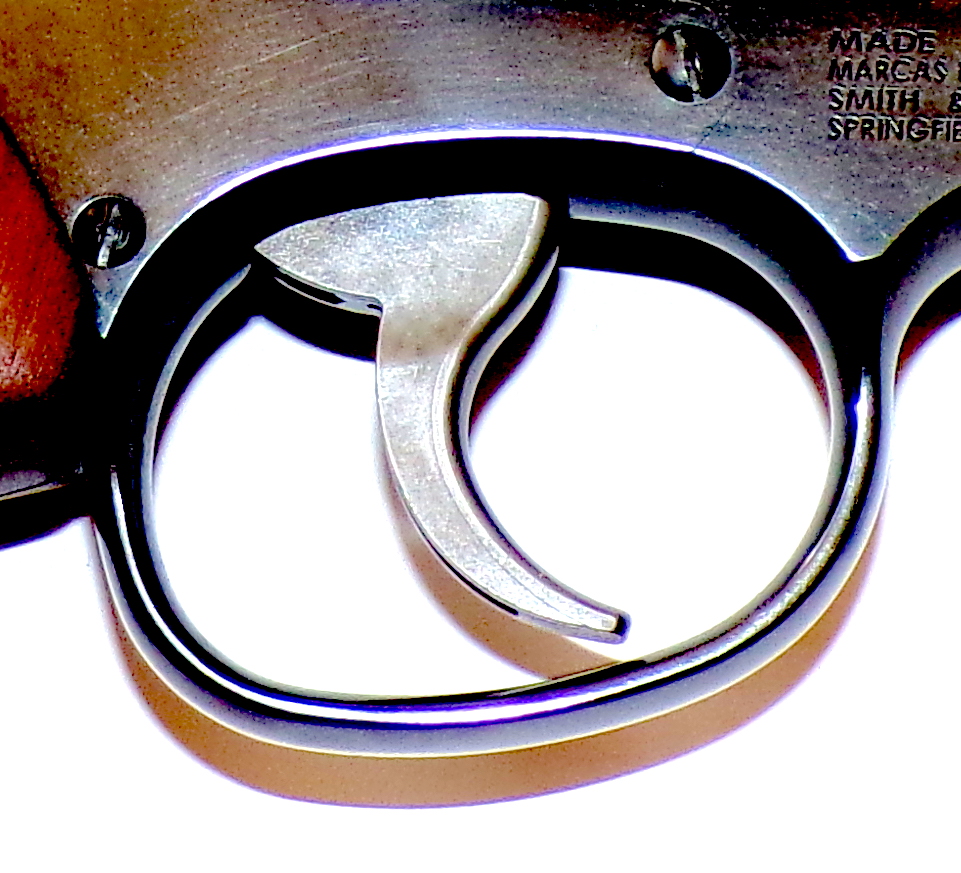
- 2 Trigger is smooth and .38” wide; pull weight averaged 10.3 lbs., DA, and 3.7 lbs., SA
- 3 The firing pin is frame-mounted, so it’s safe to carry with all six cylinders loaded
- 4 Highly polished blue
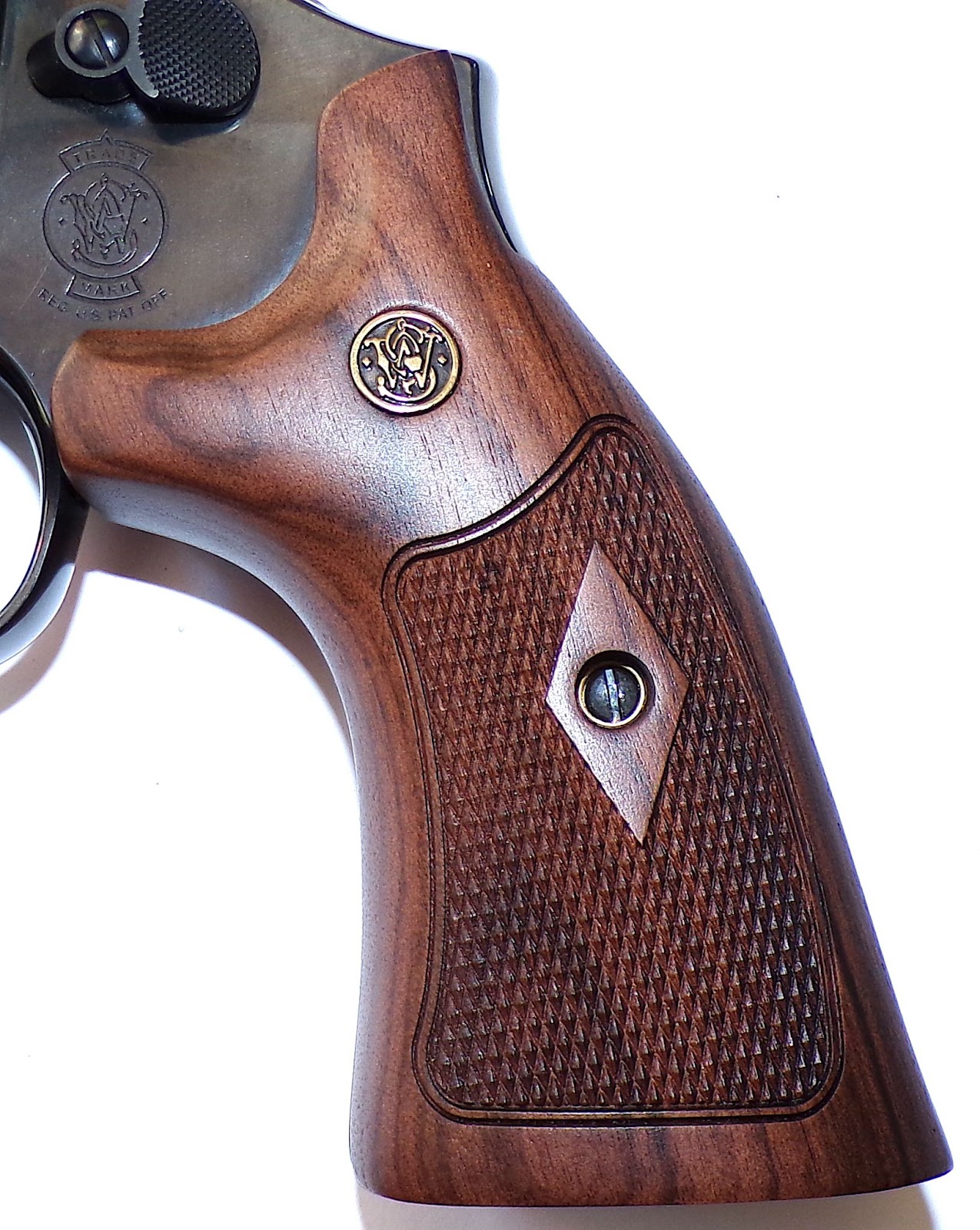
The wood grips are gorgeous
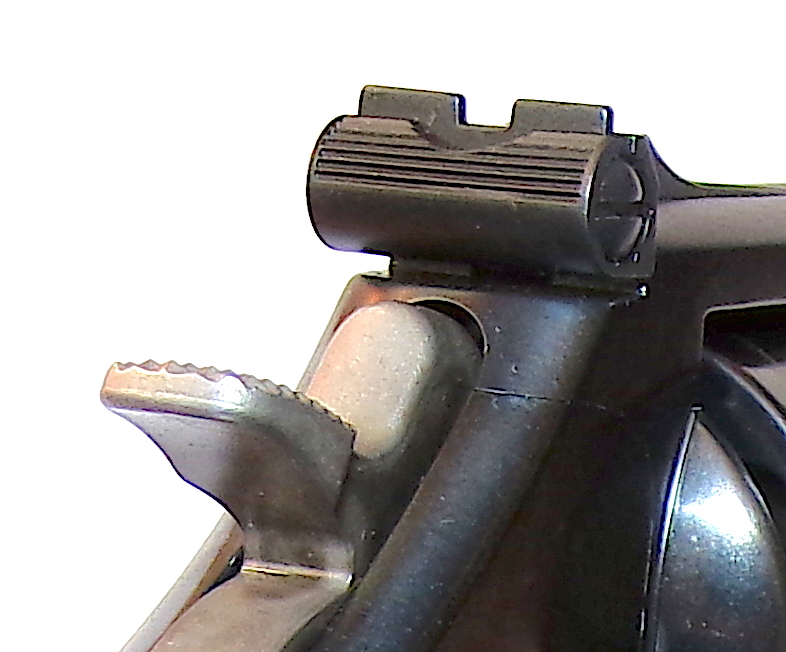
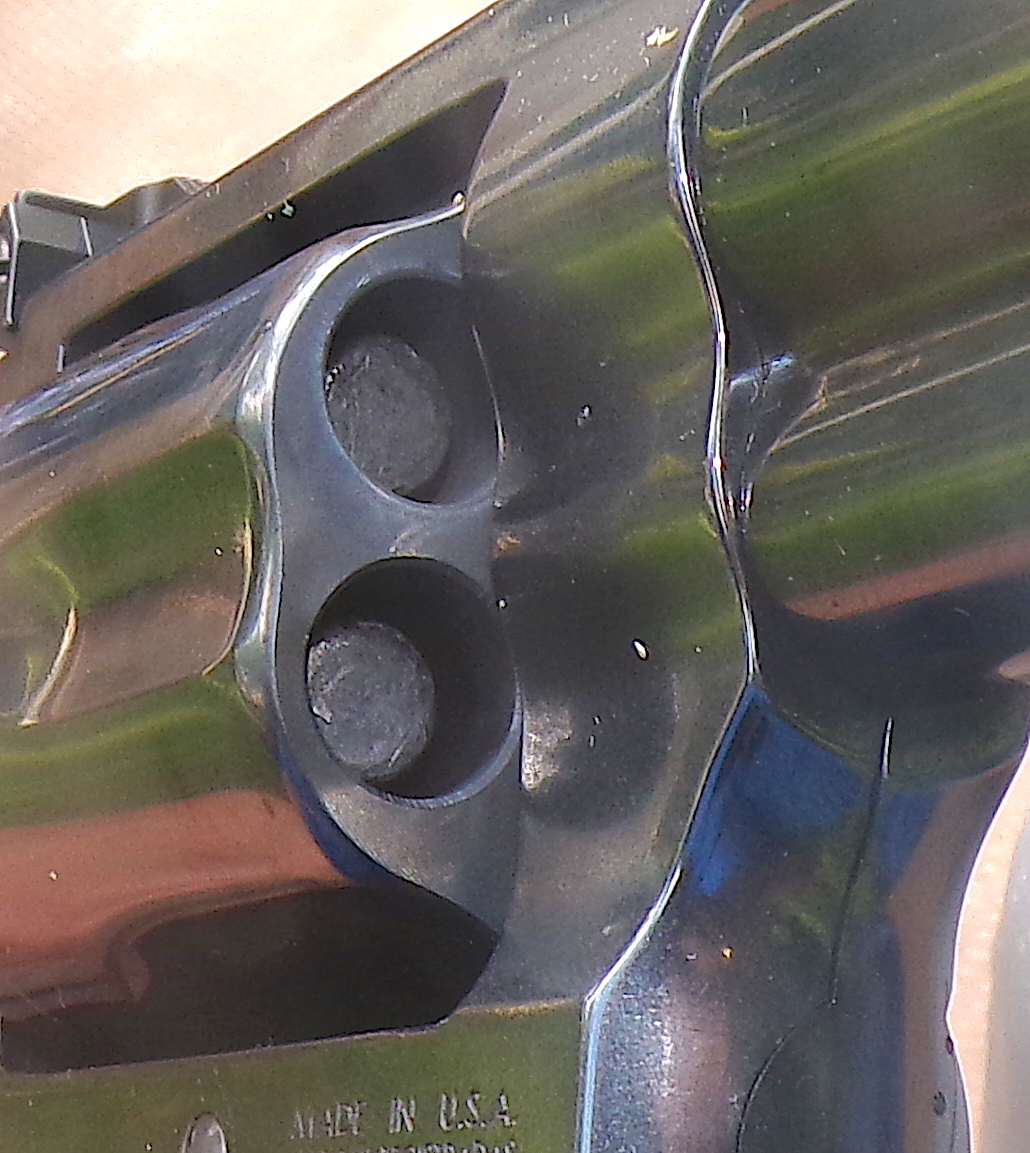
The cylinder is stuffed full with .357 goodness. Note the extra cylinder length… You could use longer bullets if desired for hunting.
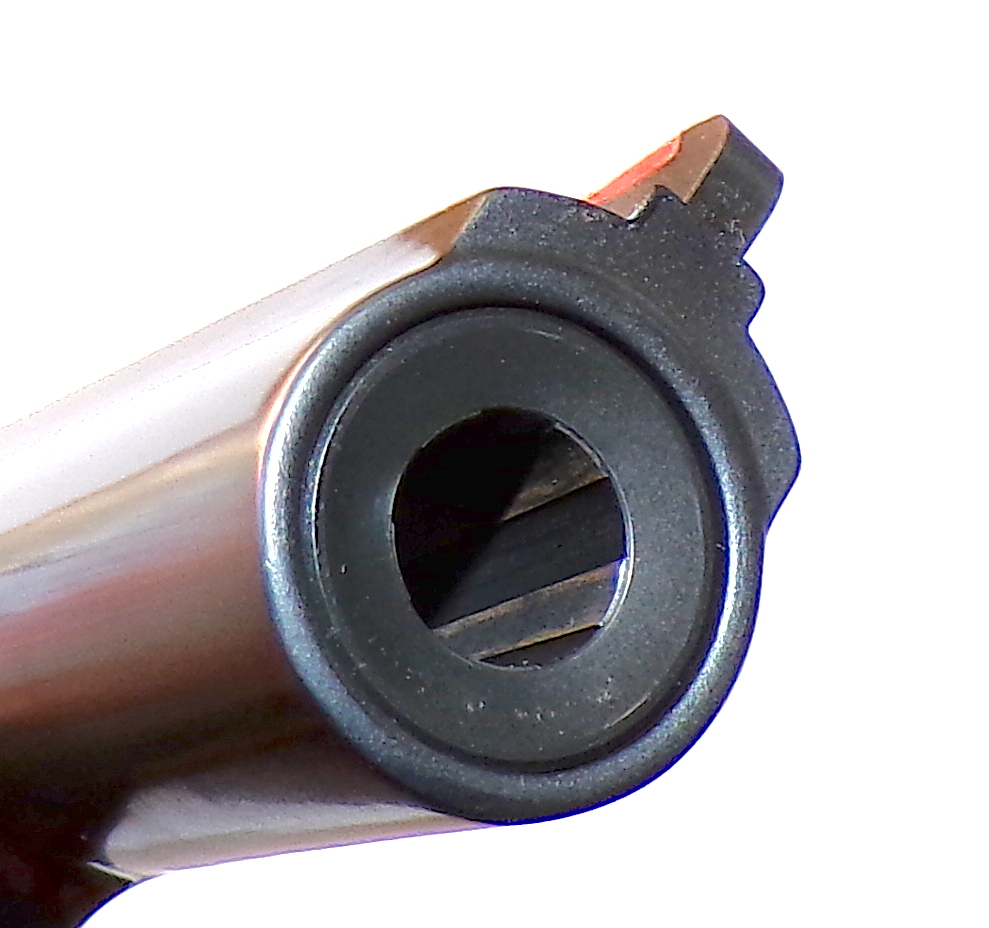
One of the few differences between the S&Ws of my younger days and today’s is the two-piece barrel. Some say that it helps prevent barrel cracking, as mentioned above.
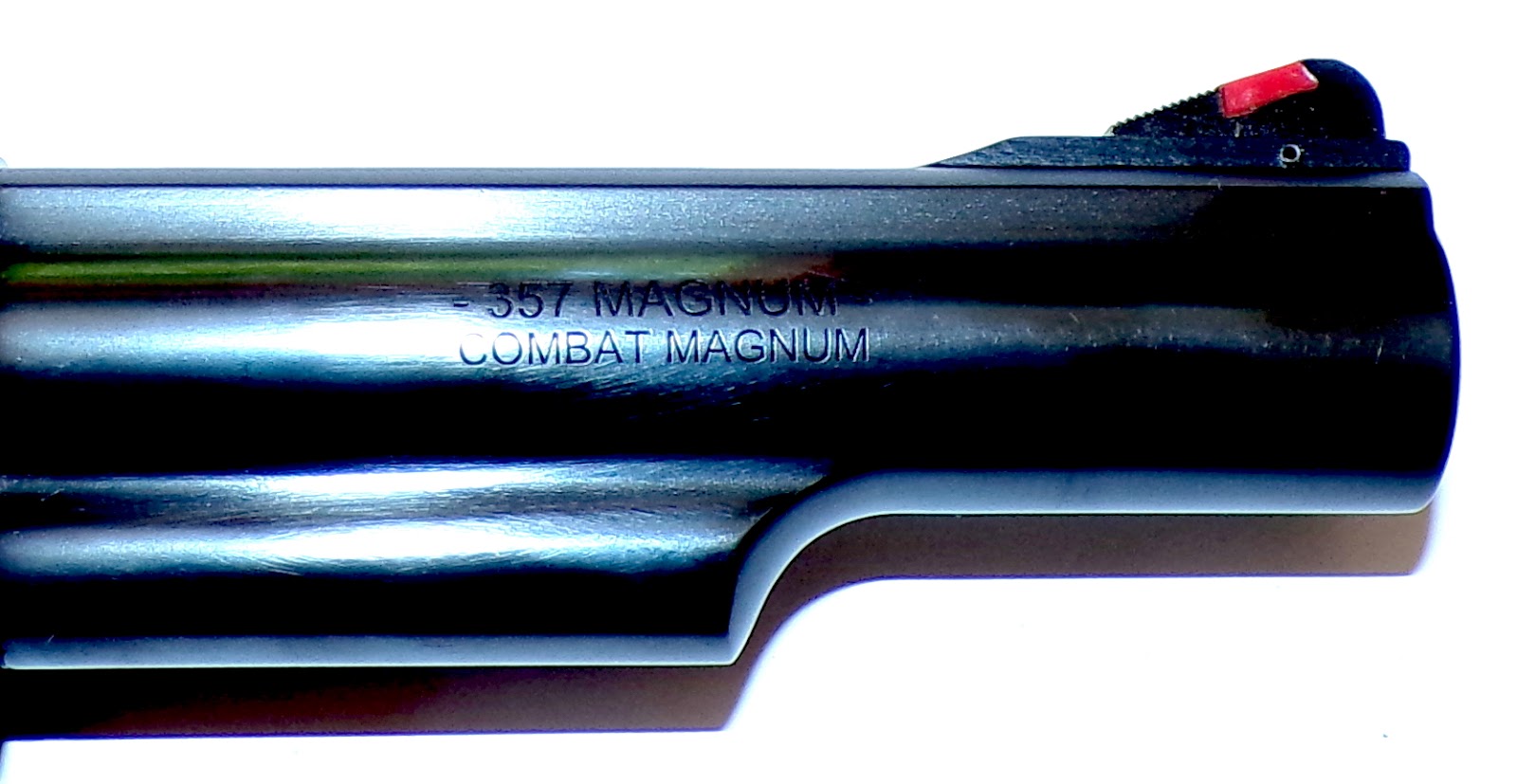
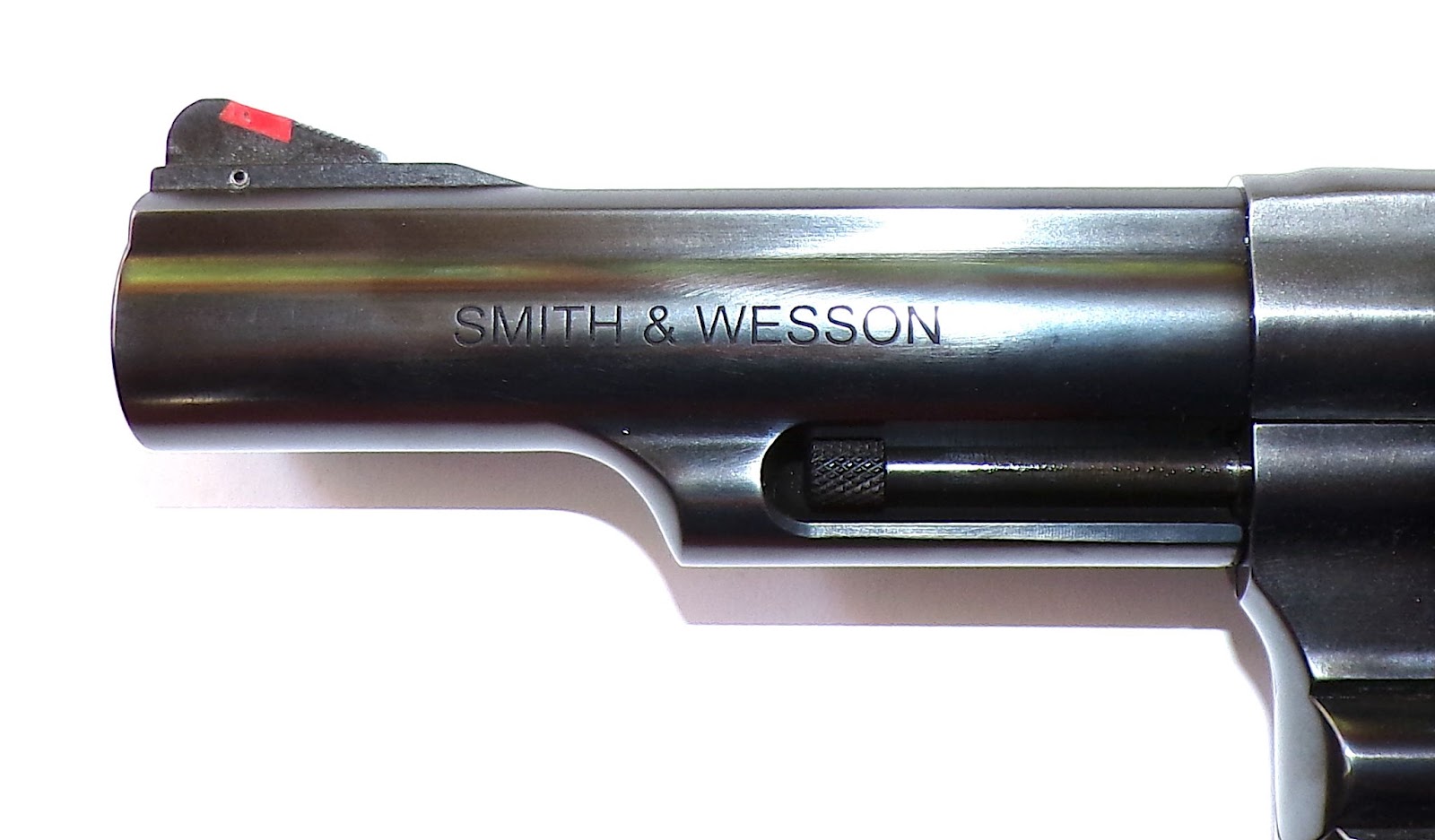
The Model 19 And I
A bit more of my story might be appropriate here. I remember, as a young, newly-minted band director in a tiny south-central Indiana town around 1975, seeing a pristine Model 19 in a gun case at a local gun shop. The price was $150. However, on my meager salary, it might as well have been $5,000. There was no way I could get that revolver, but notice how the memory has stuck with me for almost half a century…I can still see it in that gun case. It really made an impression on me. I’m not sure if it was the polished finish, or the Goncalo Alves (at that time) grips, or what… I just know I would love to have owned it. That did not happen.
So, fast forward to today, and consider the Classic 19 we have before us. With the exception of the two-piece barrel and slightly fancier wood grips, it looks pretty much like the old 19. This is old-school revolver construction at its best, in terms of fit and finish. The bluing is deep and shiny, and the grips are beautiful. The side plate fits tightly with no seam, and the hardy rear sight is click-adjustable, just like the older one. That bright red insert is installed in the front sight, just like before. The case-hardened trigger and hammer stand out nicely against the dark blue elsewhere. This represents a fitting homage to a classic wheelgun from an era long gone.
Uses For The Model 19
Why would you buy one of these? I’ve known of folks carrying them like it was 1979, but that would be a stretch, for me at least. What else could you do with one?
A couple of uses come to mind. First, there’s always the need for home or property defense. A 1200-foot-per-second 125-grain JHP out of a 4-inch barrel has been known to discourage wrongdoers, either two- or four-legged. Additionally, as mentioned earlier, the .357 is commonly referred to as a car door or window penetrator. If you need to stop a car (or rogue pterodactyl), this should work.
Another use I see (for around here, at least) is as a backup to your deer hunting main armament. The .357, out of at least a 4-inch barrel, is deer-legal here in the Hoosier state and would make a great tag-along on your next hunt. Stoked with .38s, it becomes a small-game-getter… been there, done that.
How about as a trainer gun of sorts? Load it with .38 target wadcutters, and you have a great step-up gun from the .22 pistol or revolver Junior has just graduated from.
These are just a few ideas… I’m sure you could think of others.
How’d It Shoot?
My last visit to my backyard bench with a .357 in my hand was for a review I conducted last week of the 21-ounce Charter Arms Mag Pug. Talk about painful… it physically hurt to shoot it more than a few times with magnums. So, I was looking forward to putting lead downrange with a heavier, more purpose-built revolver.
I took a selection of both .38 and .357 loads with me to my 25-yard backstop, and here are some of the better, typical results.
This MagTech .38 Special practice load shot decently, if a bit low/left.
S

A PMC 158-grain JSP load centered well… no sight adjustment needed.
These were, as I said, typical results for this 19. It tended to be more accurate than I was!
Summary
A four-inch .357 is one of the handiest firearms you can own. From camping to targeting to hunting to personal protection, you can’t go wrong. It is very versatile, since it will shoot both mild .38s with not much more recoil than a .22 LR, up through game-stomping .357s. The 19 is simplicity itself… once the cylinder is loaded, all it takes is a trigger pull to fire it.
Need a quick bullseye gun? Load .38 wadcutters. How about a deer-getter? Heavy .357 JHPs or SWCs are a solution for that. Training against flinch? Have someone load it randomly with both milksop 38s and fire-breathing magnums. That’ll cure you.
And, if you are in the market for an even more upscale Model 19, there’s always the Performance Center Carry Comp. This is a gussied-up 19 with a barrel port in front of the front sight. The grip features a round butt, and it also comes in a 2.5” version. It features a tritium night sight and a tuned action. Expect to pay close to its $ 1,299 MSRP; it is in high demand. I reviewed one once, and it is certainly a contender to be an all-around .357 for carry or other purposes.
There are many reasons to own a four-inch .357, and the 19 is one of the best of the breed. Wheelguns are making a comeback, so you may want to take a look… The classic 19 is back!
Where To Buy



I collect 19s. Have all 3 barrels lengths. In blue and nickel. I occasionally do carry them. Still my best shooting revolver I own. I recommend one to anyone
My first handgun was a S&W model 19. Four inch, blue. I was 18. I still have a 19. Six inch, blue, pinned barrel, countersunk chambers. Other K frames also. A 65, a 6″ 17, etc. I like them. That said, this one doesn’t do anything for me. The two piece barrel really kills it for me. Pass.
Shrouded barrel is a no buy for me. Pinned and recessed is only Smiths I’ll ever buy. Built by craftsman not assembled by unskilled labor.
While I would potentially buy a new Smith given a choice I would rather have an old one too.
A couple weeks ago I lucked out and picked up a model 28 6” made in 1979. It’s great aside from the kind of tacky hogue grip a previous owner stuck on it and the rear sight assembly doesn’t want to adjust too well anymore but it’s more or less where it needs to be so that’s not such a big deal. As far as the action it functions great and is more smooth and crisp than a lot of guns I’ve handled and the lockup seems as good as my newer Smiths. Plus it may sound crazy but I think even the sounds the action makes is more satisfying to hear than a more recent example, probably something to do with old machines steel parts vs. modern MIM if I had to guess.
Bigfoot of Borg,
Nice find on your newly acquired Model 28.
I suspect that the older versions do sound different–and probably more pleasant as well. (They may sound more “solid” and less “tinny” like many car doors–depending on manufacturer/model–can sound more “solid” and less “tinny” when you close them.)
I used to live Smith & Wesson firearms..I had a good friend named KEN that bought one of their new 40 Cal folding carbines… after about 40 rounds of magtech 40cal fmj.. the whole gun exploded in his hands!!.. he sent it to Smith & Wesson customer service… the customer service kept it for over three months… They sent it back to the wrong address and would not correct it after multiple phone calls… so when he finally got it, he opened it.. the destroyed gun was in the box… they said he was shooting over pressurized ammo and caused the gun to blow up.. flat out lies to avoid fixing the gun.. no more Smith & Wesson products for me again… as for you, buyer beware!!
It looks pretty, but my old Stainless Steel Ruger Security Six meets my .357 needs.
Shrouded in Mystery
I knew a guy named Theobald.
He had a .38spl Police Positive. He lived in a bus.
I was going to steal it but he was a big biker type guy with friends and they’d already beat me up once for saying that they couldn’t beat me up so I let him keep it.
Smith and Wesson sure know how to make a beautiful revolver. Their model 19 is one of the most (if not the most) aesthetically pleasing revolvers in existence.
Having said that, I am with the others on this forum who will pass on a two-piece barrel.
What I would absolutely LOVE to acquire is a Ruger GP100 with a 5-inch barrel. Ruger normally makes them with 4-inch or 6-inch barrels. However, they have made a few limited production runs with 5-inch barrels. When it comes to revolvers, in my opinion the “perfect” barrel lengths are 3-inches (for everyday carry) and 5-inches (for home and woods defense).
I like 3-inch barrels for everyday carry because they are still compact and yet you get a little extra barrel length for a modest speed boost and increased accuracy at distance. (Plus, revolvers with 3-inch barrels just look more proportional/balanced whereas snubbies look kind of dumb for lack of a better word.) I like 5-inch barrels for home and woods defense because you get another speed and accuracy boost without getting too “front” heavy. (And for woods defense you can still carry a revolver with a 5-inch barrel in a hip-holster with relative ease to draw in a hurry–whereas a chest holster starts to make more sense with 6-inch and longer barrels.)
Anyone have a Ruger GP100 (chambered in .357 Magnum) with a 5-inch barrel in excellent/mint condition for sale (preferably in stainless steel)?
Snubbies are for pocket carry. I love my S&W 642 for that use. The 3″ looks far better, and performs better, but won’t fit in the pocket.
In half of my outfits it has never been a problem for the rest a 365 or 2 in snubbie
Not to offend anyone on here (unless S&W is on). As I was looking at the first pics all I could think of was a well put together RRA? Or maybe one of those used CZ revolvers for sale on some sites. It just don’t look quire right.
Yes I have owned and still do several S&W revolvers but wow what we have come to accept as (the pinnacle?) top quality guns has dropped significantly.
Once again, not to offend but to express my disappointment in this product.
John W.,
I take no offense at your comments. While this particular S&W revolver is very good looking (especially in terms of overall styling), it definitely does not rise to the level of masterpiece. I have seen phenomenal deep bluing on other handguns (I don’t recall which manufacturer) that was basically opalescent and drop-dead gorgeous. And I have seen wood grips with exceptional wood grain that were absolutely beautiful. The revolver pictured in this article, while VERY good looking, does not rise to that level. It would appear as well that the price of this revolver reflects the fact that it is a solid beauty and definitely NOT a masterpiece.
*QUITE
“safe to carry six” has nothing to do with frame-mounted firing pins, and everything to do with the bump on the rebound slide that prevents the hammer from going all the way forward unless the trigger is fully to the rear. That little blocking tab thing is redundant, and pointless. Not sure what lawyer demanded that, but it’s one more thing to break or jam up with crud.
With an empty revolver (of course), pull the trigger and hold it back. Now ease it forward. You’ll see the rebound slide pull the hammer away from the frame. Like they have for (over?) a century.
Carrying six in any recent vintage S&W revolver is perfectly safe. Just like it was for your grandfather.
Of course I mean Double Action revolvers, not single-action. And that redundant tab could help if you dropped the gun from some unlikely height, but the hammer will have to break for it to come into play as a safety.
In any case, S&W double-action revolvers have been safe to carry fully-loaded for well over a century. Frame mounted or hammer-mounted firing pins do not matter.
Oh my, Duly Elected politician is delirious again, off his meds and showing his true side…stealing guns? Well now that just goes along with lying and cheating, doesn’t it?
He’s trying to be Possum. There was only one Possum…
No thanx.
That “hand-filling” grip might be an actual thing on the “new” model 19, but I first qualified with a “Combat Masterpiece”, using .38spl ammo. At every shot, the gun shifted left or right in my hand; grip too small (am 5’6″, 150lbs). Never liked that gun, even though it was the issued service piece.
I have an older Model 19, beautifully blued, and it’s just wonderful all around.
With that said, I would also recommend this new Model 19, as metallurgy has gotten even better since the 1970’s…now that the stupid “Hillary Hole” pseudo-safety is gone. This is how a modern Model 19 should be. Your “safety” is your brain; just remember and practice the Four Rules of Firearms Safety. This new M19 is quite a good looking piece, classic in its lines. Personally, I think all of them should come with the “Coke-bottle” old-style wooden grips, but that’s just a personal preference since I have bigger hands. The ones on this gun do look good.
As for the 2-piece barrel, I’m all for anything than enhances actual firearms safety, such as modern metallurgical engineering. So, I don’t mind the 2-piece barrel one bit, not if it helps the gun’s longevity, especially with full-house .357 Magnum loads. And for those who say, “only pinned and recessed for me, thanks”, well, you have the right to that view. I simply don’t share it. Yes, my .357 Magnum wheelgun is pinned and recessed. I also have fired the non-pinned-and-recessed models, starting from the 1980’s, and they also are excellent.
I’m just glad that S&W is now remembering what a revolver should be. This new iteration of the Model 19 is a revolver that I actually would buy if I didn’t already have a Model 19.