
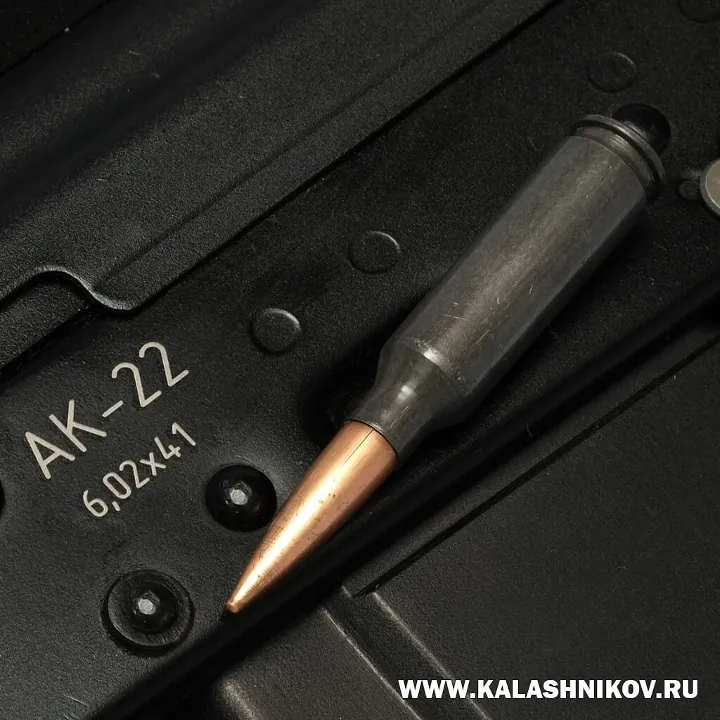
Russia just threw down the gauntlet. Their new 6.02×41mm prototype isn’t just another intermediate cartridge; it’s Moscow’s not-so-subtle way of telling NATO, “Your body armor won’t save you.”
From the “Poison Bullet” to Today
In the 1980s, the Soviet Union adopted the 5.45×39mm round for its AK-74 rifles. It earned the infamous nickname “poison bullet” thanks to its tumbling projectile that carved out horrific wound channels. Mujahideen fighters hit by the round often had to endure days without treatment, leading to infection, gangrene, and a reputation for grotesque battlefield injuries.
Soldier of Fortune’s own Galen Geer even smuggled 5.45 ammo out of Afghanistan to show the world what the Soviets were using. At 2,950 fps with a 52-grain bullet, the 5.45×39 gave Soviet troops a lighter, flatter-shooting round than 7.62×39, allowing them to carry more ammo and hit effectively out to 500 meters.
Body Armor Changed the Game
Fast-forward to 2023, and NATO’s improved body armor has made older intermediate calibers far less effective. That’s where the 6.02×41mm comes in. Filed under Russian patent RU 2809501 C1 by Tula Cartridge Works with input from Kalashnikov Concern, this new round is designed with one goal: defeat Level IV body armor.
Specs That Mean Business
- Projectile: 7.5-gram (≈116-grain) tungsten-carbide core
- Muzzle Velocity: 800 m/s (≈2,625 fps)
- Muzzle Energy: ≈2,000 joules (≈1,475 ft-lbs)
- Effective Range: 800 meters against armored targets
For comparison, that’s significantly more energy than 5.45×39 (≈1,300 J) and even more than 5.56 NATO (≈1,700 J). The 6.02 is designed to remain supersonic and hard-hitting well beyond 500 meters, effectively doubling the range of legacy 5.45 rounds.
Unlike the tumbling 5.45 or the velocity-dependent fragmentation of 5.56, this cartridge is all about deep, straight-line penetration and hydrostatic shock, making it a nightmare for surgeons and anyone hiding behind armor.
The East–West Arms Race Heats Up
The U.S. military’s Next Generation Squad Weapon (NGSW) program is taking a similar approach with the 6.8×51mm SIG Fury, now chambered in the XM5 rifle and XM250 LMG. That round pushes 135- to 140-grain bullets at nearly 3,000 fps, delivering 2,700 ft-lbs of energy, but at the cost of heavier ammo and more recoil.

The Russian 6.02×41mm, by contrast, strikes a middle ground: it’s lighter, easier to control in full-auto, and keeps AK-platform rifles relevant on a modern battlefield where plates are the norm.
Why It Matters
Whether or not the 6.02×41 ever goes into mass production, its very existence signals where the global small-arms race is headed: more energy, more penetration, and a focus on defeating armor at distance.
The days of 5.45 and 5.56 ruling the battlefield uncontested are numbered. The future of infantry combat may very well be chambered in 6mm.
Our Take
If you’re looking for proof that the near-peer fight is driving small arms development, this is it. Russia is clearly acknowledging that NATO’s proliferation of Level IV plates and hard armor inserts has fundamentally changed the game.
The 6.02×41mm isn’t just about better terminal ballistics; it’s about regaining overmatch. This round enables Russian infantry to engage targets at ranges of 700–800 meters and still penetrate the armor most Western soldiers wear. That has major implications for U.S. and allied troops if a future conflict breaks out in Europe or Asia.
In many ways, this mirrors America’s move to the 6.8×51mm SIG Fury under NGSW. Both sides are seeking a solution to the same problem: how to keep the rifleman relevant in an era where body armor can withstand 5.56 or 5.45mm rounds at a distance.
The message here is clear: the next big war won’t be fought with legacy 5.56 rifles. It’s going to be fought with hotter, harder-hitting cartridges, and the side that fields them first, at scale, will have a serious advantage.









Nothing new here. Improvements in munitions have taken place since the stone and spear and knights use of armor. He who lags behind ones enemy faces the perils of his enemy.
As usual, the Russian answer to the question is much cheaper and more practical than the American one.
That American”Fury” round seems expensive and impractical.
Also, this round may be effective out to 800 or even 1000 yards, but there isn’t any chance it would penetrate level 4 armor out past a couple hundred yards. The energy isn’t there.
Art out West,
Bullets rely on velocity to penetrate body armor, not energy. For example a very large and very heavy bullet could be slow and still have significant energy due to its massive weight–and yet it will not penetrate body armor.
My rough understanding is that a bullet needs to have a retained velocity (at range and on target) of at least 2,000 feet-per-second typically to penetrate body armor. The most practical overall way to make that happen is to use bullets with very high ballistic coefficients (which retain velocity much better down range). Based on the pictures included with this article, the bullet looks to be very long and would thus have a high ballistic coefficient. Hence its alleged ability to penetrate body armor at longer ranges, in spite of its modest muzzle velocity of less than 2,700 feet-per-second.
Depending on the armor type, velocity, mass, hardness, shape, and diameter all have interactions in overlapping areas. For ceramics all of them matter and velocity isn’t the most critical factor (see m993 doing better than m995 and both being outperformed by 8mm Mauser ap surplus ammo)
Uncommon -Sense,
Remember that we are talking about level 4 plates, not kevlar. Level 4 plates are supposed to stop armor piercing 30-06 at near point blank range.
With this long skinny projectile, and proper hardened material construction, this ammo should penetrate level 4 at it’s initial stated velocity of 2700 fps. At 300 yards, it has probably dropped to around 2000 fps, and probably wouldn’t penetrate level 4 plates. At 800 yards, this projectile has probably dropped down to 1200 or so fps and certainly won’t penetrate level 4.
Then again, most combat is said to occur at less than 200 yards, and at that range, this inexpensive and practical rifle round probably makes our armor obsolete.
Uncommon, have designed rifle and pistol AP. Best course is to emulate cannon rod penetrator rounds which leave at a mile/second and carry mega-joules…but they are not just fast, they’re also heavy, sturdily constructed and sharp. The next generation will incorporate shear band self sharpening…
To do better, bullet construction is critical so we follow the long rod penetrator theory because spitzer shaped penetrators have high sidewall friction. Exposed tips like the A1 are also easily destroyed by harder ceramics.
In fact, the best Level IV demonstrated had a frangible bullet that cratered the Boron Carbide and then released the penetrator core. This was at 2,450fps simulating a short barrel 7.62mm. If you want penetration at longer ranges, the bullet needs to work at low velocities. Current design is a hardened Steel or Tungsten alloy sharpened rod, in a machined Copper projo with a pointed Aluminum tip. You have probably seen how well they work already on TV.
There is a lot of information on AP at the Defense Technical Information Center.
That’s right, even though the Russians have all the Tungsten they want, you have to make it through ceramic and then Kevlar after your core is blunted. And please stop showing that old “6.8 SiG Case Drawing”, the “improved model” is much worse now; Brass simply swaged over the Steel committing the two cardinal sins of Brass making which are thinning and work hardening the Brass. No lock ring or Brass inside the Steel…
Look up the photo by “We Are The Mighty” of a really nice 6.8 SiG case head separation. A ripped 6.8x51mm cartridge base (left) and a mangled case neck
(reddit.com/u/vindictivevader)
Assuming it is actually made I any number above typically Russian vaporware the diameter and likely impact velocity “shoud” have little problem penetrating SAPI plates and most level 3/ RF1 and RF2. With it being a marginal step up from m995 it would likely struggle with ESAPI plates made after 2014 and most medium quality lv4/rf3 plates. XSAPI and higher end lv 4 LOL no. With that said it does potentially increase the cost for effective armor for forces that use it and give some anti vehicle capacity for users
Well, I hope none of us have to test it. Although I do have a case of that Mouzer food you mentioned, should someone decide to test that “behind every blade of grass” theory.
“…diameter and likely impact velocity…”
May be something to this. I spent one summer break from college playing around experimenting with some hot loads for the Contender in 223 and the 700 in 22-250. I had my target set at 25 yards out from the picnic table in the back yard, and behind it was a bullet deflector that I built. You’d be surprised what a farm boy with some scrap metal, a Lincoln welder, and some time, can come up with. Dad didn’t like the holes in the turf that bullet deflector made as the bullets were ricocheted down. The yard was pretty rough, so I don’t think he really felt those holes while sitting on the tractor, but he said he did. So I grabbed a slab of 1” thick mild steel that we used to protect the bench whenever we were whanging away at something. It had a slot torched through one end to make for a grab handle. I suspended it between the target frame and the deflector on two pieces of scrap rebar, and figured it would make those varmint bullets splat harmlessly, and went back to my shooting. 50 grain TNT bullets for the 223 and 55 grain PSP for the rifle. Being that close, the bullets mostly stacked through one hole in the paper for each group as. I saw a curl of smoke come up off the target after a couple groups, and found those bullets hitting that plate had generated enough heat to catch some shreds of paper hanging there. Now that was pretty cool. Like I said, those were some hot loads, pun maybe intended. Put out the fire, made a few more aiming dots on the target, and then noticed that those bullets were drilling into that steel, not just splatting. Well of course I had to experiment. I found that 5 shots from the 223 stacked in the same hole would drill all the way through that plate. The rifle needed only 3 shots.
I showed Dad, and he wasn’t impressed. He grunted, and then asked if the boat was ready for walleye fishing. Priorities. Yep, and off we went up to the boat ramp in Vermilion. Later while we were cleaning fish, he admitted that it really was pretty cool, but only if I welded those holes shut and ground it smooth on both sides when I was done.
That was a good summer.
Steel (especially mild steel) is more effected by velocity bullet shape and hardness/density of bullet/core/tip. M193 (and the bullet involved in larger cases) tends to do great above 3150fps for about anything light enough to wear especially when actual armor plates that readily handle m193 start around 12 pounds per plate while lv4 ceramic of the same size tends towards 7-8 at the heavier end. 855 green tip does have trouble with steel as the steel tip tends to compress into the lead core and increase the effective surface area of impact while the 855a1 I have yet to see relevant steel body armor that can stop it. Ceramics have a lot more factors but generally assuming same bullet materials and construction need to be thicker to handle larger caliber rounds and generally get designed around 30 cal so the larger ap rounds can often penetrate most lv4 even when they easily stop 338 lapua ball rounds. Longer penetrator cores could also help but thus far haven’t shown as much of an increase in effectiveness. With that said Ukraine and many likely lower intensity wars where older surplus and low to medium end plates may show up are likely to have issues with this article’s design.
We’re talking about a country that can barely produce new hulls for its armor fleet, there’s word that their machine tooling for AK’s is almost completely worn out and theyre using hose clamps on their drones. So that begs the question, will we actually see this round in the field or is this just wunderwaffe for Putin?
Well Russia is still dangerous with how many nukes? I thought Ukraine would crumble after a decline of American aid but here we are in 2025. I still have some Tula 223🙄
That description would have been accurate a decade ago but will be interesting to see if China takes the idea.
US Federal Debt = $160,000 per Citizen
Russian Federal Debt = $2,500 per Citizen
The US is insolvent & headed for Chapter 13 Liquidation Bankruptcy…….. Sorry
US gdp per capita 85,809.90
Russian gdp per capita 14,889.02
Spasbo
Using the supplied user name and email address (thanx ttag)
Xdduly Elected Official post:
🔥🌎🔥
Pray for PEACE
Sites autopopulating random name/email from the backend again, FYI.
That description would have been accurate a decade ago but will be interesting to see if China takes the idea.
6arc with shoulder UNackleyimproved
But feeds like a champ.
Well if the Ukrainians, Bomb Tula, They would have lost a ammo plant.
Norinco the China brand Tula and ain’t nobody going to bomb China’s anything no matter how much ordnance they supply to Russia.
No, Governor Waltz, Tula is an arsenal in Russia…and Norinco is a conglomerate of defense companies in China. You could have looked that up before driveling, but the Alzheimers unit probably limits your use.
And we are defeating China without bombing by onshoring or relocating manufacturing and raw material production. Not to mention their inexperienced, distant second place military. If they take the Harbor Freight Navy across the Taiwan Straight, then we will missile and torpedo them. We also have a new bomb for B2 and B21 that snaps ships in half with just one…now we are making them for our over 1,000 F-35s.
Never going to happen, just a bunch of tin chest generals rattling their sabers, unless fools like you disarm us.
Interesting that an article in Soldier of Fortune published two days before this one shared the same information. Quite the coincidence.
Mikial, Is Soldier of Fortune still published? We used to pass it around the barracks back in the day. Most of the articles came out of South Africa and Rhodesia. Peter Kokalas wrote the Full Auto column and Bill Bagwell wrote Bagwell On Blades. Then the magazine turned to shit so I stopped reading it.
GF, its online but lacks the fun of an actual magazine.
I’m impressed. Russia has developed a shortened .243 Winchester.
That’s fair, we “invented” the 6PPC by stuffing a 243 into a 220 Russian case – itself a necked down 7.62×39… now they just stole it back.
So… Soviet (sorry “Russian”) version of 6mm ARC with a tungsten penetrator.
Honestly what we should be doing (6mm ARC) instead of the Fury round.
6mm ARC or 6mm Max. The ARC has slightly better performance, but it requires a whole new rifle to exploit its full potential. The Max only needs new barrels and magazines. You get 99% of the performance at a much lower cost.
Add to that the case technology from Shell Shock Technologies, and you get even higher performance without jeopardizing safety and reliability with excessive chamber pressure.
Came here to say the same thing. 6mm is about perfect for the medium cartridge carbine game. Its light to carry still, fast enough to be flat, heavy enough to penetrate. 100% what the us should be looking to use right now.
What am I missing? Did’n’t we field a rifle during WWII, that was semi-automatic, and fired a round 1000 yards with a tungsten-carbide core, that would do the same damn thing?
I have been saying for several decades the US needs a better ammunition for it’s troops. I have sent suggestions to ammo manufacturers and it all falls on deaf ears… Now with the invention of the Hybrid case or the “Shell-Shock Case” from Badlands Ammo Co. the ability to drive projectiles at or above 3000 feet per second is easily in reach. My suggestion is a case similar to the current 5.56x45mm, with a slightly larger diameter from .378 up to .400, with a length of 42mm, and bring the projectile diameter up to either 6mm (.243) or 6.35mm (.250) and run a bullet weight around 100 to 110 grains at 3000 feet per second out of a 14.5 inch barrel.
This would perform close to, if not better than, the 6.8x51mm (277 Fury aka 308 stupid) and still be able to run in AR-15/M-16 size firearms with a 2.260 Case Max OAL. The changes would be minimal, requiring a new barrel, a new bolt, and a revamped gas system to ensure proper function. As for ammunition amount, you would lose only two rounds in the current-sized 30-round standard magazine, 28 instead of 30.
But what do I know, I’ve only been in the gun field for over 45 years…